Big G Mystery Deepens After 10-Year Gravity Study
Gravity is one of the most familiar forces in the universe. It keeps planets in orbit, anchors humans to Earth, and shapes galaxies across the cosmos. Yet despite centuries of scientific progress, researchers still cannot precisely measure one of gravity’s most important numbers — the universal gravitational constant, commonly known as “Big G.”
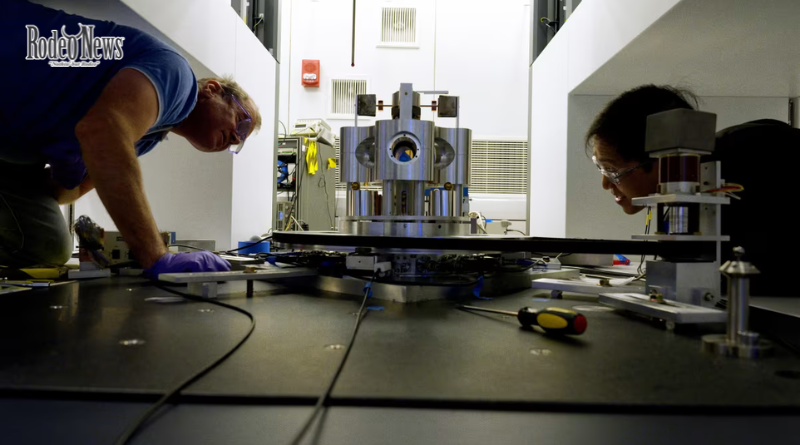
A decade-long Big G gravity study conducted by scientists at the National Institute of Standards and Technology (NIST) was expected to bring physicists closer to finally solving the puzzle. Instead, the experiment produced yet another conflicting result, deepening one of physics’ longest-running mysteries.
What Is Big G?
The gravitational constant, represented by the letter G, determines the strength of attraction between two masses. It is a central part of Isaac Newton’s law of universal gravitation.
F=Gr2m1m2
In this equation:
- F represents gravitational force
- m₁ and m₂ represent two objects’ masses
- r is the distance between them
- G is the universal gravitational constant
Scientists know the approximate value of G, but unlike other fundamental constants in physics, its precise measurement remains surprisingly elusive.
According to experts, gravity is far weaker than the other fundamental forces in nature, including electromagnetism and nuclear forces. Even tiny environmental disturbances can disrupt experiments attempting to measure G accurately.
The 10-Year Big G Gravity Study
The latest Big G gravity study began in 2016 under the leadership of physicist Stephan Schlamminger at NIST in Maryland.
The project aimed to replicate a previous experiment originally conducted by researchers at the International Bureau of Weights and Measures (BIPM) in France. That earlier experiment had already produced a value for G that differed from other measurements worldwide.
Rather than building an entirely new system, the NIST team used the same torsion balance apparatus designed decades earlier. The experiment relied on carefully arranged metal cylinders whose tiny gravitational attraction could twist a suspended wire. By measuring this twisting force with extreme precision, researchers hoped to calculate Big G more accurately.
The researchers also introduced additional safeguards and modifications during the process. They performed measurements using both copper and sapphire masses to determine whether material composition affected the outcome. Surprisingly, both materials produced nearly identical results.
However, the final number still failed to match previous measurements.
Why Scientists Are Frustrated
The new Big G gravity study produced a value approximately 0.0235% lower than the original BIPM result. While that difference may sound tiny, it is enormous in precision physics.
For comparison, many other fundamental constants are known to extraordinary precision, sometimes accurate to more than a dozen decimal places. Big G remains the least precisely known of the major physical constants.
Physicists say this inconsistency creates a major scientific headache because every new experiment seems to produce a slightly different value.
G≈6.674×10⁻¹¹ m3 kg−1 s−2
The new measurement reported:
G=(6.67387±0.00038)×10−11 m3 kg−1 s−2
Although the discrepancy appears microscopic, it is large enough to raise concerns that unknown experimental factors may still be influencing the measurements.
Why Measuring Gravity Is So Difficult
Unlike electromagnetism, gravity is incredibly weak at laboratory scales. Even tiny vibrations from nearby traffic, temperature changes, static electricity, or microscopic shifts in equipment can interfere with experiments.
Scientists attempting to measure Big G must isolate their apparatus from almost every environmental influence imaginable.
The challenge becomes even greater because gravitational attraction between small laboratory objects is extraordinarily faint. Researchers are essentially trying to detect minuscule forces while eliminating every possible source of error.
That difficulty explains why scientists have struggled with the problem for more than 225 years, dating back to Henry Cavendish’s famous 18th-century experiments.
Could New Physics Be Hiding Behind the Mystery?
Some physicists believe the repeated disagreement between experiments may simply reflect technical limitations. Others wonder whether something deeper could be happening.
Gravity remains the least understood of nature’s four fundamental forces. Unlike electromagnetism and nuclear forces, gravity still lacks a complete quantum explanation within the Standard Model of physics.
If future experiments continue producing inconsistent results, researchers may eventually need to consider entirely new theories or hidden physical effects.
However, most scientists remain cautious about making such claims. For now, the leading explanation is still experimental uncertainty rather than revolutionary new physics.
Scientists React to the Results
The demanding nature of the project took a personal toll on the research team.
According to CNN’s report, Schlamminger described the experience as “life-sucking” and compared the process to “walking through a dark valley.”
Still, the physicist later reflected more positively on the effort, saying that every measurement helps scientists learn more about the universe.
Online science communities also reacted strongly to the findings. Many Reddit users expressed surprise that such a fundamental number remains so difficult to determine.
•
r/science
›
the difficulty of measuring G is really underappreciated. even after centuries of refinement the uncertainty is still orders of magnitude worse than other fundamental constants.
•
r/ScienceUncensored
›
Despite centuries of effort, measurements of gravitational constant still vary by about one part in 10,000.
•
r/technology
›
Nice article about one of the most famous fundamental constants, the gravitational constant ‘big G’. And the one that is hardest to measure precisely.
Give feedback
Why the Big G Gravity Study Still Matters
Even though the experiment failed to settle the debate, scientists say the work remains valuable.
Each new measurement helps researchers identify potential weaknesses in current methods. The latest findings may also guide future experiments designed with even more advanced technology.
The study also highlights an important reality about science: not every experiment produces definitive answers. Sometimes research reveals how much remains unknown.
For many physicists, the mystery surrounding Big G is both frustrating and exciting. It represents one of the few remaining areas in modern physics where uncertainty still exists at a fundamental level.
The Search for Gravity’s True Value Continues
The Big G gravity study may not have solved the mystery of the gravitational constant, but it has reignited global interest in one of science’s oldest unanswered questions.
Future researchers will likely continue refining torsion balance experiments while exploring entirely new methods for measuring gravity with greater precision. Advances in quantum sensors, atomic interferometry, and space-based measurements could eventually help scientists overcome the limitations that have plagued gravity experiments for centuries.
Until then, Big G remains one of the universe’s most stubborn secrets — a reminder that even in an age of advanced technology and space exploration, nature still holds mysteries scientists cannot fully explain.