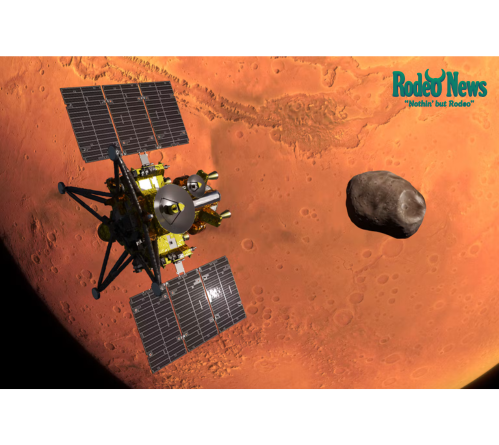
Japan’s Phobos Mission Targets a Historic Mars Discovery
Previous missions have returned material from asteroids and Earth’s Moon, allowing scientists to examine extraterrestrial rocks using sophisticated laboratories on Earth. However, bringing material back from the Martian system presents substantially different engineering challenges.
Each stage requires precise coordination between spacecraft systems and mission control teams.
According to JAXA’s mission plan, the spacecraft will use two sampling methods to obtain material from Phobos. One technique will gather surface particles, while another will collect material from below the surface.
The agency aims to retrieve at least 10 grams of material. Although that amount may appear small, it could provide scientists with enough material for multiple investigations, depending on the samples’ composition and the analytical techniques employed.
Researchers will examine the returned material for information about its minerals, chemical composition and possible relationship to Mars.
The findings could help scientists determine whether Phobos formed from material originating on Mars or developed from an entirely different source.
The mission is also designed to demonstrate technologies needed for future robotic and potentially human exploration of the Martian region.
Why Scientists Want to Explore Phobos
Phobos is the larger of Mars’ two natural satellites, with a maximum diameter of approximately 27 kilometers. Despite its relatively small size, the moon could provide important clues about the history of Mars and the early solar system.
Phobos follows an unusually close orbit around Mars, traveling approximately 6,000 kilometers above the planet’s surface. It completes an orbit in roughly 7 hours and 39 minutes, circling Mars several times during a single Earth day.
Its proximity to Mars makes it particularly interesting to planetary scientists.
Material thrown into space by ancient impacts on Mars could have reached Phobos and become incorporated into its surface. If that material remains preserved, samples could provide indirect evidence of the planet’s geological history.
However, scientists must distinguish possible Martian material from the moon’s own composition and any other material that accumulated over time.
Phobos also presents an opportunity to investigate the broader environment around Mars.
Its composition, internal structure and geological features may preserve evidence from the early stages of the planet’s development.
Because Phobos and Deimos may share a common origin, understanding one moon could also help researchers explain the other.
The MMX spacecraft will therefore study both satellites, although Phobos remains the primary target for sample collection.
The Mystery Behind the Origins of Mars’ Moons
One of the central scientific questions driving Japan’s Phobos mission concerns how the two moons formed.
Scientists generally consider two major explanations.
Theory One: A Giant Impact Created the Moons
Under the giant-impact hypothesis, a large object struck ancient Mars, ejecting substantial quantities of material into orbit around the planet.
Some of the debris may subsequently have gathered together through gravitational interactions, eventually forming Phobos and Deimos.
An impact of this scale could have released a mixture of Martian rock and material from the object that struck the planet.
If Phobos formed through this process, its samples might contain minerals or chemical signatures consistent with Mars and the ancient impact.
Such findings would help researchers reconstruct the conditions that existed during an important period in the planet’s early history.
However, scientists need direct evidence to determine whether this explanation accurately describes the moons’ formation.
Theory Two: Mars Captured Ancient Asteroids
Another possibility is that Phobos and Deimos began as asteroids traveling through the solar system before becoming trapped by Mars’ gravity.
Asteroids preserve information about the materials available during the formation of the solar system.
Some contain water-bearing minerals and organic compounds, making them scientifically valuable for understanding how the ingredients associated with planetary habitability were distributed.
If Phobos originated as a captured asteroid, its composition could reveal similarities to particular asteroid populations.
Scientists would need to examine its mineralogy, chemistry and other characteristics to assess this possibility.
How Samples Could Resolve the Debate
Observations made by orbiting spacecraft provide valuable information, but remote measurements cannot always distinguish between competing explanations.
Laboratory analysis of returned material offers a more detailed approach.
Scientists can measure isotopic ratios, identify minerals and examine microscopic structures with instruments that are difficult or impossible to operate aboard a spacecraft.
These measurements could help researchers establish whether Phobos is more consistent with an impact-generated moon or a captured asteroid.
The answer may also reveal how material moved through the early solar system and how Mars evolved.
However, the scientific outcome remains uncertain until the spacecraft successfully returns its samples and researchers complete their analyses.
Japan’s MMX Spacecraft and the H3 Rocket
The Martian Moons eXploration mission combines Japanese engineering with scientific contributions from international partners.
JAXA leads the project, while NASA, the European Space Agency and European national agencies contribute instruments, expertise and technical support.
The spacecraft consists of three principal modules designed to support propulsion, exploration and the return of samples.
Its overall architecture reflects the complexity of a mission that must operate far from Earth and ultimately deliver extraterrestrial material to a recovery team.
The H3 rocket will carry the spacecraft from Japan’s Tanegashima Space Center.
Japan developed the H3 as a new generation of launch vehicle intended to support a range of national and commercial space missions.
For the MMX project, the launch marks the beginning of a multiyear journey involving navigation, scientific observations, surface operations and a return to Earth.
Following launch, the spacecraft is expected to reach the vicinity of Mars in August 2027.
It will then conduct observations of the Martian moons and prepare for its sampling operations.
The mission schedule includes an extended period around Phobos, allowing the spacecraft to study its surface and identify suitable locations for collecting material.
The spacecraft’s return module will eventually separate from the other components and carry the samples back toward Earth.
JAXA currently targets 2031 for the sample capsule’s return.
The French-German Rover Will Explore Phobos First
Before the principal sampling operations, a small rover developed through French-German cooperation is expected to investigate Phobos’ surface.
The rover, named Idefix, is designed to examine the moon’s terrain and collect information that will support the larger spacecraft’s operations.
Its work will be particularly important because Phobos has extremely weak gravity and an irregular, cratered surface.
On Earth, a vehicle’s weight and the friction between its wheels and the ground help it maintain traction. On Phobos, those forces operate under very different conditions.
A small movement or contact with the surface can produce an unexpected response, making ordinary driving and landing techniques unsuitable.
Idefix is designed with specialized wheels and mobility systems to help it move across the moon’s terrain.
The rover will also provide information about surface conditions and local topography.
Scientists can use these observations to evaluate potential sampling locations and reduce the risk of the main spacecraft landing in a hazardous area.
The rover’s planned mission is expected to last approximately 100 days, with surface operations anticipated around 2029 under the current mission plan.
Its findings will help engineers and scientists prepare for subsequent sampling attempts.
The partnership also illustrates how international cooperation can contribute to ambitious exploration projects that would be difficult for a single country to undertake independently.
How Japan Plans to Collect Samples From Phobos
Collecting samples from Phobos will require a carefully coordinated series of operations.
JAXA plans to use two complementary techniques to obtain surface and subsurface material.
NASA has contributed a pneumatic sampling system that uses pressurized gas to lift loose particles from the moon’s surface into a collection container.
The technique is intended to gather surface material without requiring a conventional drilling operation.
JAXA’s own sampling system will collect material from below the surface using a coring method.
This approach is designed to obtain a sample from a depth of approximately 2 centimeters, allowing researchers to compare shallow subsurface material with surface particles.
The spacecraft is expected to conduct two sampling attempts.
During the first operation, it will collect surface and subsurface material using the planned sampling systems. A second landing will provide another opportunity to obtain additional subsurface material.
Collecting samples through multiple operations could improve the scientific value of the mission by increasing the range of material available for examination.
It could also provide some protection against the possibility that a particular sampling site contains material that is less useful than expected.
Nevertheless, landing and sampling on Phobos will remain technically challenging.
The spacecraft must approach a suitable area, maintain control near the surface and complete its collection activities before departing.
Once the samples are secured, they will be stored inside a protective return capsule designed to withstand the journey through space and the intense heating associated with atmospheric reentry.
The capsule is expected to land in Australia in 2031 before the recovered material is transported to Japan for scientific analysis.
Could Phobos Samples Reveal Clues About Life?
The MMX mission is primarily intended to investigate the origins of Mars’ moons and the evolution of the Martian system.
However, the material could also provide indirect insights into conditions associated with the development of life.
Mars is a major target in the search for evidence of ancient habitability because geological observations suggest that liquid water existed on its surface billions of years ago.
If impacts ejected Martian material into space, some of that material may have traveled to Phobos.
Scientists expect that material originating from Mars could account for approximately 0.1% of the material collected from Phobos, although the actual composition of the returned samples will determine what researchers can investigate.
If Martian material is present, researchers could examine it for chemical and mineralogical evidence of the planet’s past environment.
The material might help scientists understand how water-related processes affected ancient Martian rocks and how organic compounds were distributed across the early solar system.
However, the discovery of organic compounds would not automatically demonstrate the existence of life. Many organic molecules can form through nonbiological processes.
Similarly, the presence of potentially habitable conditions does not establish that organisms actually existed.
Any claims about past microbial life would require careful laboratory analysis, independent verification and consideration of possible contamination.
The mission’s value lies in obtaining material that could help scientists investigate these questions more precisely.
NASA and European Partners Strengthen the Mission
International cooperation is an essential part of the MMX project.
NASA has contributed scientific instruments and sampling technology, while European partners have developed equipment and expertise to support surface exploration and communications.
One important instrument is MEGANE, a spectrometer developed with the involvement of the Johns Hopkins Applied Physics Laboratory.
It will measure neutrons and gamma rays associated with Phobos’ surface, allowing scientists to investigate its elemental composition.
These measurements can help researchers determine what the moon contains and compare its characteristics with different proposed origins.
NASA is also contributing to the mission’s scientific analysis and expects to receive a portion of the returned samples for study.
The European Space Agency is contributing deep-space communications technology, while France and Germany are cooperating on the Idefix rover.
These contributions demonstrate how international partnerships can combine scientific knowledge, specialized equipment and engineering expertise.
The results could benefit researchers well beyond the countries directly involved in building the spacecraft.
Once samples become available, scientists will be able to compare findings across laboratories and use multiple analytical approaches to test their conclusions.
Such cooperation will be particularly important if the samples reveal unexpected chemical signatures or evidence that challenges existing theories about the Martian moons.
What the Mission Could Mean for Future Human Exploration of Mars
Japan’s Phobos mission could also contribute to preparations for future human exploration of Mars.
Sending astronauts to the Red Planet will require solutions to numerous technical and operational challenges, including radiation exposure, communications delays, transportation and long-duration life support.
Exploring Phobos may provide an opportunity to develop technologies for operating around small planetary bodies.
The mission will test navigation, landing, sample collection and return systems in an environment far more distant and difficult to reach than the Moon.
Its observations of radiation and the Martian environment could also provide information relevant to the design of future exploration systems.
Phobos has attracted interest as a possible location for future missions because it orbits close to Mars and could offer a useful vantage point for studying the planet.
However, using it as a base would require extensive additional research, engineering development and assessment of the risks faced by astronauts.
The MMX mission is not designed to establish a human settlement or demonstrate that Phobos is ready to support astronauts.
Instead, it will provide scientific information and technical experience that may inform future decisions.
The spacecraft’s findings could help agencies better understand the environment around Mars and assess the challenges associated with sustained operations in the region.
Conclusion: Japan’s Phobos Mission Could Transform Mars Research
Japan’s Phobos mission represents an ambitious attempt to answer some of the most persistent questions about the origins of Mars’ moons.
By sending a spacecraft to Phobos, deploying a rover and returning samples to Earth, JAXA aims to obtain evidence that cannot be gathered through remote observations alone.
The mission will investigate whether Phobos formed from debris created by an ancient collision or originated as an asteroid captured by Mars’ gravity. Its observations of Deimos could also provide new clues about the evolution of the Martian system.
The project will face significant technical challenges, including navigating around Mars, landing on a low-gravity moon and safely returning extraterrestrial material to Earth.
Nevertheless, its potential scientific benefits are substantial.
Samples collected by the spacecraft could improve understanding of planetary formation, the distribution of water-bearing materials and the geological history of Mars.
The mission may also help researchers assess technologies needed for future robotic and human exploration beyond Earth.
With launch scheduled for October 20, 2026, and sample return targeted for 2031, the project is entering a crucial stage.
Its ultimate significance will depend on the material successfully collected and the discoveries scientists make after it reaches Earth.
If the mission succeeds, Phobos could provide a new window into the history of Mars and the processes that helped shape the solar system.