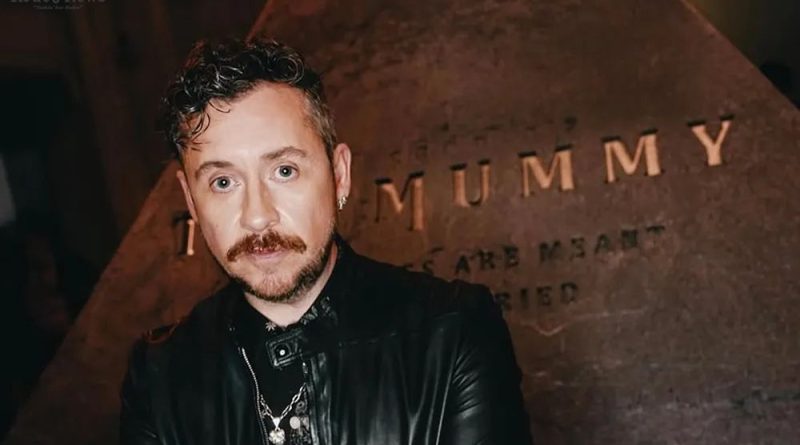
One of the most striking aspects of The Mummy Lee Cronin is its title. Instead of simply calling it The Mummy, the filmmakers chose to brand it as Lee Cronin’s The Mummy.
This idea reportedly came from Jason Blum, the founder of Blumhouse Productions, who encouraged Cronin to take ownership of the film in a way rarely seen in modern studio releases.
Cronin admitted he was initially unsure about the decision but ultimately accepted it, describing the gesture as both flattering and creatively empowering. The naming strategy reflects a broader trend in horror cinema, where directors are increasingly positioned as auteurs whose personal vision defines the project.
This approach echoes earlier examples like auteur-driven horror films, where the director’s name becomes part of the brand itself.
A Radical Shift from Classic Mummy Films
The The Mummy Lee Cronin reboot represents a dramatic departure from earlier interpretations of the character.
Unlike the adventure-driven films starring Brendan Fraser or the action-heavy reboot featuring Tom Cruise, this version leans fully into psychological and body horror.
The story centers on a family whose daughter mysteriously disappears and then reappears years later under terrifying circumstances. What begins as a hopeful reunion quickly descends into a nightmare, as the child exhibits disturbing and supernatural behavior.
This narrative shift transforms The Mummy from a tale of ancient curses into something far more intimate and emotionally disturbing.
The Role of Jason Blum and Blumhouse
The involvement of Jason Blum is a key factor in shaping The Mummy Lee Cronin.
Through Blumhouse Productions, Blum has built a reputation for producing innovative, low-to-mid-budget horror films that prioritize storytelling and creative freedom.
This philosophy is evident in Cronin’s film, which reportedly had a budget of around $22 million—modest by blockbuster standards but ideal for maintaining artistic control.
Blum’s influence extends beyond production. His suggestion to include Cronin’s name in the title highlights his commitment to elevating directors as central creative forces.
A Personal Story Behind the Horror
What makes The Mummy Lee Cronin particularly compelling is its deeply personal origin.
Cronin has revealed that the film was influenced by his own experiences with grief following the death of his mother. Elements of the story and imagery were inspired by real-life events, adding an emotional layer to the horror narrative.
This personal connection helps explain the film’s focus on family dynamics and loss. Rather than relying solely on jump scares or spectacle, Cronin uses horror as a way to explore deeper psychological themes.
Critical Reception: Mixed but Impactful
Early reactions to The Mummy Lee Cronin have been mixed, reflecting the film’s bold and unconventional approach.
Some critics have praised its visual style and willingness to push boundaries, describing it as “unrelenting” and deeply disturbing.
Others, however, have criticized its narrative coherence and pacing, arguing that its heavy reliance on gore and shock value detracts from the overall story.
Despite these divided opinions, the film has succeeded in one key area: generating conversation.
A New Era for Horror Branding
The decision to market the film as The Mummy Lee Cronin signals a broader shift in the entertainment industry.
In recent years, audiences have shown increasing interest in director-driven projects. Filmmakers like Jordan Peele and Ari Aster have demonstrated that a strong creative identity can become a powerful marketing tool.
By placing Cronin’s name front and center, the film aligns itself with this trend, positioning itself as a unique artistic vision rather than just another franchise entry.
Breaking Away from Franchise Expectations
Another important aspect of The Mummy Lee Cronin is its independence from previous franchise continuity.
Unlike earlier films produced by Universal Pictures, this version is developed by Warner Bros., Atomic Monster, and Blumhouse Productions.
This separation allows the filmmakers to reinterpret the story without being constrained by existing lore.
It also helps avoid confusion with earlier versions, ensuring that audiences understand this is a completely new take on the character.
The Rise of Body Horror
One of the defining features of The Mummy Lee Cronin is its embrace of body horror—a subgenre that has seen a resurgence in recent years.
Cronin and producer James Wan have both pointed to changing audience preferences as a driving force behind this trend.
In a post-pandemic world, viewers are increasingly drawn to intense, visceral experiences that push the boundaries of traditional storytelling.
This shift has paved the way for films like The Mummy to explore darker and more experimental territory.
What This Means for the Future of The Mummy
The success—or failure—of The Mummy Lee Cronin could have significant implications for the future of the franchise.
If the film resonates with audiences, it may pave the way for more standalone, director-driven interpretations of classic monsters.
On the other hand, if it struggles to connect, studios may return to safer, more conventional approaches.
Either way, the film represents a bold experiment in both storytelling and marketing.
Final Thoughts
The The Mummy Lee Cronin project is more than just another reboot—it is a statement about the future of horror cinema.
By combining a deeply personal story with a daring creative vision, Lee Cronin has crafted a film that challenges expectations and redefines what a Mummy movie can be.
The decision to include his name in the title may have seemed unusual at first, but it ultimately underscores the film’s central message: this is not just a franchise entry—it is a filmmaker’s vision brought to life.
As audiences continue to seek fresh and meaningful experiences, Lee Cronin’s The Mummy stands as a reminder that even the oldest stories can still be told in new and surprising ways.