UK Government Weighs Removing Prince Andrew from Royal Line of Succession
The UK government is considering legislation that could formally remove Prince Andrew from the royal line of succession, in what would mark one of the most significant constitutional interventions involving the monarchy in modern times.
Defence Minister Luke Pollard confirmed that ministers have been working “absolutely” with Buckingham Palace on proposals that would prevent Andrew — born Andrew Mountbatten-Windsor — from ever ascending to the throne.
The move comes as a police investigation involving the King’s brother continues, intensifying pressure on the government and the Palace to draw a clear institutional line between the monarchy and the controversy surrounding the former Duke of York.
A Constitutional Step with Historic Weight
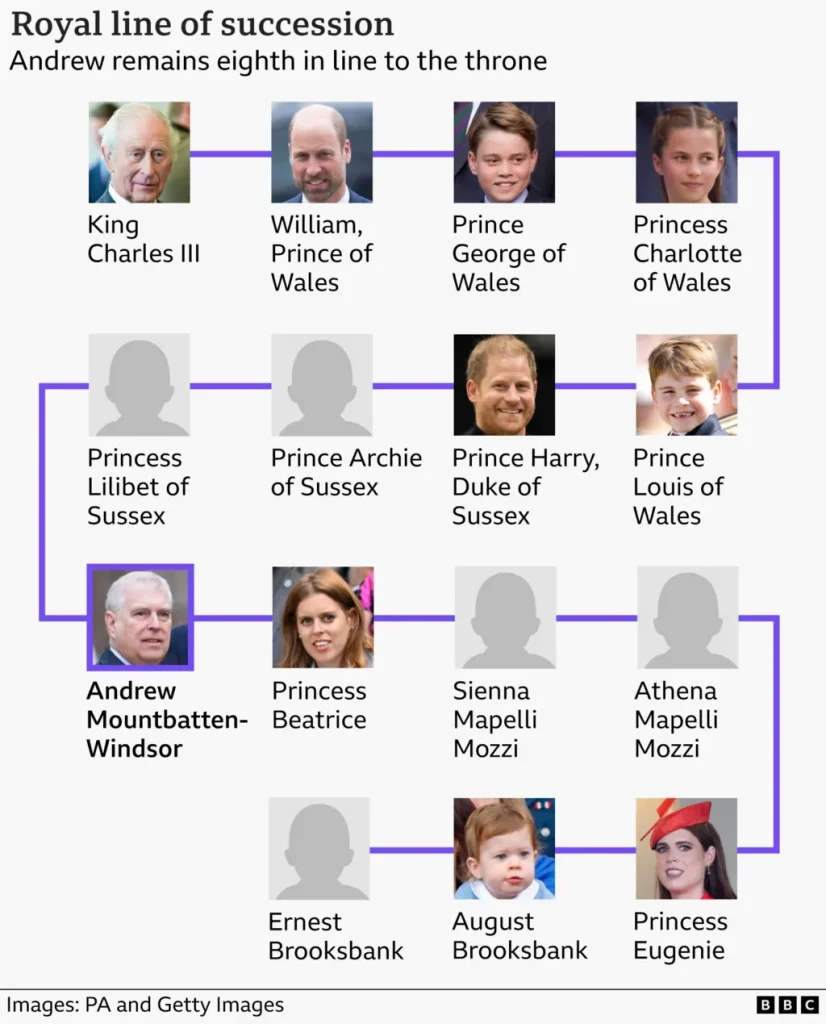
Currently eighth in line to the throne, Andrew’s position remains unchanged despite being stripped of his royal titles last October amid renewed scrutiny over his past association with convicted sex offender Jeffrey Epstein. He has consistently denied any wrongdoing.
Pollard said the proposed legislation would be “the right thing to do,” though he stressed that any formal step should follow the conclusion of the live police investigation.
Speaking on BBC Radio 4, the minister suggested there was cross-party appetite for action, but acknowledged the constitutional sensitivity of intervening in the line of succession — a matter governed by centuries-old conventions and statute.
Under British law, altering the succession requires an Act of Parliament. Any such bill would need approval from both the House of Commons and the House of Lords, before receiving royal assent from King Charles III.
Crucially, because the monarch is head of state in 14 other Commonwealth realms — including Canada, Australia, and New Zealand — those countries would also need to assent to the change.
The last major reform came with the 2013 Succession to the Crown Act 2013, which ended the system of male primogeniture and lifted restrictions affecting heirs who married Catholics.
The last time someone was formally removed from the line of succession was in 1936, following the abdication of Edward VIII.
Investigation Continues at Royal Lodge
Andrew was arrested this week on suspicion of misconduct in public office before being released under investigation after 11 hours in custody. Police searches have continued at Royal Lodge, the 30-room Windsor property long associated with the Duke.
Unmarked police vehicles have been seen entering and leaving the estate, with Thames Valley Police expected to continue inquiries into the coming days. Other forces across the UK are reportedly assessing whether to launch parallel investigations.
Danny Shaw, a former Home Office adviser, warned that the situation risked “spiralling out of control,” noting that multiple investigations could stretch on for a considerable period.
For Downing Street, the political dilemma is delicate. Only months ago, officials had indicated there were no plans to alter the succession. The latest developments, however, appear to have shifted calculations.
Political Divides Emerge
Support for legislative action has emerged from several opposition parties. The Liberal Democrats and the Scottish National Party have both indicated they would back measures to remove Andrew from the succession if required.
Sir Ed Davey, leader of the Liberal Democrats, said Parliament would need to consider the issue “when the time is right,” while emphasising that police must be allowed to complete their work independently.
Within the governing Labour Party, views are more mixed. Some MPs have questioned whether legislative action is necessary, noting that Andrew’s position — eighth in line — makes it highly unlikely he would ever come close to the throne.
Still, others argue that constitutional symbolism matters. Labour MP Rachael Maskell said she would support legislation not only to remove Andrew from the succession but also from the role of Counsellor of State — a position that allows designated royals to act on behalf of the monarch when required.
According to the House of Commons Library, removing Andrew from the line of succession would automatically strip him of that role.
Drawing a Firewall Around the Monarchy
For the Palace, the stakes extend beyond legal technicalities. Historian David Olusoga suggested there is a growing desire within both government and the royal household to create a “firewall” between the institution and the ongoing controversy.
Andrew stepped back from public duties in 2019 following widespread criticism of his interview on BBC Newsnight regarding his relationship with Epstein. Since then, he has largely disappeared from public royal life, though his constitutional status has technically remained intact.
Former royal communications secretary Julian Payne said the monarchy is likely to view the situation through a strictly institutional lens, separating personal family matters from constitutional responsibility.
Queen Camilla, he added, is acutely aware of public sentiment and would be advising the King accordingly as discussions continue behind palace walls.
A Rare Test of Constitutional Balance
The unfolding debate highlights the fragile balance between democratic authority and hereditary tradition in the United Kingdom’s constitutional monarchy.
While the monarchy operates largely above politics, Parliament retains ultimate sovereignty — including over succession. Yet intervening directly in the royal line carries symbolic weight not seen in nearly a century.
Whether legislation ultimately proceeds may depend on the outcome of the police investigation and the political consensus that follows. For now, ministers appear cautious, signalling intent while allowing legal processes to run their course.
Buckingham Palace has declined to comment publicly on the government’s considerations.
As scrutiny continues and the investigation unfolds, the question confronting Westminster is no longer simply about one individual — but about the integrity and future stability of the institution he once represented.