US and Cambodia Discuss Lasting Peace for Thailand Border at Washington Meeting
WASHINGTON, D.C. — The United States and Cambodia have reaffirmed their commitment to securing lasting peace along the sensitive Cambodia–Thailand border, following high-level talks in Washington that underscored diplomatic momentum and regional stability efforts.
The discussions took place on Thursday afternoon as Christopher Landau, the US Deputy Secretary of State, met with Cambodian Prime Minister Hun Manet on the sidelines of the inaugural Board of Peace meeting in the US capital.
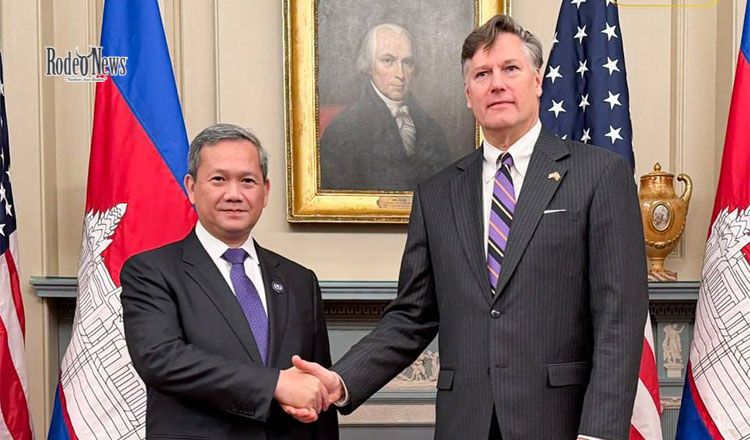
The meeting, held amid renewed global focus on conflict prevention and diplomatic engagement, highlighted Washington’s stated commitment to supporting sustainable stability in Southeast Asia — particularly along historically contested border areas between Cambodia and Thailand.
A Renewed Diplomatic Commitment
Landau expressed appreciation for Cambodia’s role as a founding member of the newly established peace board and commended Hun Manet for his participation in the summit discussions. The gathering aimed to strengthen multilateral coordination on conflict resolution and long-term peacebuilding initiatives.
According to officials familiar with the talks, Landau conveyed that President Donald J. Trump remains proud of American diplomatic efforts that previously contributed to easing tensions between the two Southeast Asian neighbours.
While neither side disclosed specific operational details regarding border initiatives, the tone of the meeting suggested a shared interest in preventing future escalations and ensuring mechanisms remain in place to address disputes through diplomatic channels.
Landau emphasized that the United States understands the strategic and economic importance of stability in mainland Southeast Asia, describing peace along the Cambodia–Thailand frontier as “essential for broader regional security and prosperity.”
Border Stability as a Regional Priority
The Cambodia–Thailand border has long carried political and historical sensitivities, periodically testing bilateral ties. Though relations between Phnom Penh and Bangkok have improved in recent years, sporadic tensions in previous decades underscored the fragility of unresolved boundary demarcations.
In Washington, Hun Manet reaffirmed Cambodia’s consistent position: all border matters must be resolved peacefully and strictly in accordance with international law, conventions, and existing bilateral agreements.
The Prime Minister also briefed Landau on recent developments on the ground, though no immediate concerns were publicly cited. Cambodian officials have maintained that mechanisms already exist for managing border cooperation and preventing misunderstandings.
Hun Manet thanked the US administration for its continued involvement in supporting dialogue efforts and requested sustained engagement, particularly in technical and diplomatic initiatives that reinforce confidence-building measures between Phnom Penh and Bangkok.
The Role of International Law
Central to Cambodia’s message was its insistence on adherence to established treaties and conventions. The Prime Minister reiterated that Phnom Penh remains committed to resolving disputes under international frameworks, reflecting a strategy aimed at ensuring transparency and legitimacy in any future negotiations.
Observers note that Washington’s backing of peaceful dispute resolution aligns with its broader foreign policy approach in the Indo-Pacific, where stability and rules-based order remain recurring themes in diplomatic engagements.
By framing border peace as both a bilateral and regional imperative, US officials appear keen to reinforce Southeast Asia as a zone of cooperation rather than competition.
Washington’s Broader Southeast Asia Strategy
The meeting also signaled Washington’s continued diplomatic presence in Southeast Asia at a time when geopolitical competition is intensifying across the region. While the talks were focused on Cambodia and Thailand, they reflect a wider US interest in preventing localized disputes from escalating into broader security challenges.
Landau’s remarks suggested that the United States views sustained dialogue as the most effective path forward, positioning itself as a supportive partner rather than a direct mediator.
Analysts say the symbolic value of the Washington meeting should not be underestimated. By convening discussions at a high-level forum dedicated to peacebuilding, both sides reinforced a shared narrative of diplomacy over confrontation.
Looking Ahead
Though no new agreements were formally announced, Thursday’s meeting appears to have strengthened political will on both sides to maintain calm along the border.
For Cambodia, the discussions offered an opportunity to showcase its commitment to peaceful dispute resolution on an international stage. For the United States, the engagement reaffirmed its role as a diplomatic partner invested in regional stability.
As Southeast Asia continues to navigate complex geopolitical dynamics, sustained dialogue between Washington, Phnom Penh, and Bangkok may prove critical in ensuring that historical disputes remain firmly in the realm of diplomacy rather than discord.
For now, both sides leave Washington projecting confidence that cooperation — guided by international law and mutual respect — remains the cornerstone of peace along the Cambodia–Thailand border.