Roman Space Telescope: Stunning New Space Photo Revealed
The Roman Space Telescope has officially left its rocket behind after a successful launch into space, and NASA has captured a remarkable image of the observatory separating from its SpaceX Falcon Heavy upper stage. The dramatic photograph shows the next-generation telescope floating against the darkness of space shortly after its Aug. 30, 2026, launch from NASA’s Kennedy Space Center in Florida.
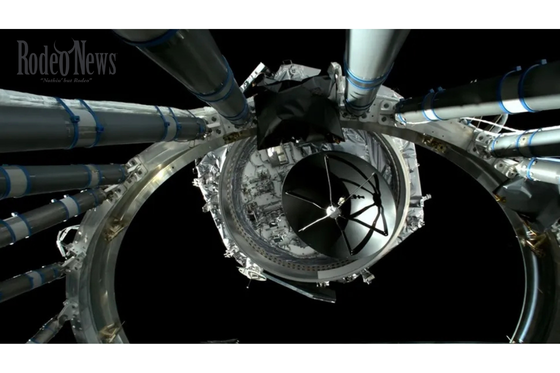
The image provides a striking visual moment in one of NASA’s most ambitious astronomy missions.
The Nancy Grace Roman Space Telescope lifted off at 7:26 a.m. EDT aboard a SpaceX Falcon Heavy from Launch Complex 39A. After completing its planned ascent sequence, the spacecraft separated from the rocket’s second stage and began its journey toward its final operating location.
For NASA scientists, the successful separation marks the beginning of a much longer phase.
Roman is now traveling toward a position approximately 1 million miles from Earth, where it will conduct wide-field observations of the universe. Its mission will focus on some of astronomy’s biggest unanswered questions, including the nature of dark energy, the behavior of dark matter and the population of planets beyond our solar system.
Roman Space Telescope Leaves Falcon Heavy Behind
The photograph featured by Space.com captures the exact moment after the Roman Space Telescope separated from the Falcon Heavy upper stage.
NASA’s image shows the spacecraft appearing to drift away from a large metallic ring-shaped structure belonging to the rocket. Against the completely black background of space, the observatory appears almost isolated, marking the moment when the telescope became an independent spacecraft.
The successful separation occurred about 31 minutes after liftoff.
NASA reported that the Falcon Heavy performed as expected during the mission. Ground controllers at NASA’s Goddard Space Flight Center in Maryland began receiving telemetry from Roman approximately seven minutes after launch.
The rocket’s side boosters also completed their return sequence after separating from the center core.
That combination of a successful launch, upper-stage operations and spacecraft separation represented a major milestone for the mission.
Roman Space Telescope Launch Was a Major NASA Milestone
The launch on Aug. 30 was the culmination of more than a decade of development.
NASA’s Roman observatory is designed as a major space-based survey telescope. Rather than focusing primarily on individual objects, it will examine enormous portions of the sky and collect vast amounts of data.
Its wide field of view is one of its defining characteristics.
NASA says Roman’s Wide Field Instrument will be capable of producing enormous images containing hundreds of millions of pixels. A single 300-megapixel image would be so large that displaying it at full resolution would require roughly 37 individual 4K screens arranged together.
That capability will allow astronomers to survey the universe much faster than many previous space observatories.
The telescope is expected to produce thousands of images during its scientific operations.
The result could be an extraordinary new map of the universe.
Why the Roman Space Telescope Matters
The Roman Space Telescope was designed to investigate some of the most fundamental questions in modern astrophysics.
One of the mission’s biggest goals is understanding dark energy.
Dark energy is the mysterious component believed to be responsible for the accelerating expansion of the universe. Although scientists have strong evidence that the expansion is accelerating, they still do not know what dark energy actually is.
Roman will study this problem using several complementary methods.
Scientists will examine enormous populations of galaxies and other cosmic structures to understand how the universe has changed over time.
By mapping large areas of space, researchers hope to measure the history of cosmic expansion with unprecedented precision.
The telescope will also investigate dark matter.
Unlike ordinary matter, dark matter does not emit or reflect light in a way that makes it directly visible to conventional telescopes. Scientists infer its existence through its gravitational effects on galaxies and other objects.
Roman’s observations will help researchers map those gravitational effects across huge portions of the cosmos.
Roman Space Telescope Will Search for Exoplanets
Dark energy and dark matter are not the only targets.
The Roman Space Telescope will also search for worlds beyond our solar system.
One of its techniques is gravitational microlensing.
This method takes advantage of the way gravity bends light.
When a foreground star passes in front of a more distant star from Earth’s perspective, the foreground star’s gravity can temporarily magnify the background star’s light.
If a planet is orbiting the foreground star, the planet can create a tiny additional change in the brightness.
Roman’s enormous survey capability could allow astronomers to discover thousands of exoplanets using this method.
The mission could therefore expand scientists’ understanding of planetary systems well beyond what has been possible with previous surveys.
Roman Could Change How Scientists Study Alien Worlds
The telescope also carries a coronagraph instrument designed to help astronomers study planets directly.
Directly imaging an exoplanet is extraordinarily difficult because planets are usually much fainter than the stars they orbit.
A star can overwhelm the light from a nearby planet by an enormous amount.
A coronagraph attempts to block or suppress the star’s light so that much fainter objects can potentially be observed nearby.
Roman’s coronagraph technology will serve as an important demonstration for future space telescopes.
The lessons learned could help NASA develop future observatories designed specifically to search for potentially habitable Earth-like worlds.
That makes Roman important not only for its own scientific discoveries but also for the next generation of space astronomy.
Roman Space Telescope Is Heading to Lagrange Point 2
After separating from Falcon Heavy, the Roman Space Telescope began its journey toward the Sun-Earth L2 point.
L2 is located roughly 1 million miles from Earth on the side of Earth opposite the Sun.
The location is useful for space observatories because spacecraft operating around L2 can maintain a relatively stable relationship with Earth and the Sun while keeping their instruments pointed away from intense sources of heat and light.
Roman will operate in a halo orbit around this region.
The journey will take approximately three months.
During that period, NASA teams will prepare the observatory for its scientific mission.
The spacecraft must deploy and activate its systems, check its instruments and complete calibration before scientists can begin relying on its observations.
Three Months of Commissioning Ahead
The successful launch does not mean Roman is ready to begin collecting its full science data immediately.
The spacecraft must first go through a detailed commissioning process.
NASA teams will deploy the telescope’s various systems and make sure they function correctly in the space environment.
The instruments must also be calibrated.
This stage is essential because astronomers need to know exactly how the telescope responds to light before they can interpret scientific observations.
Small differences in detector performance, optical alignment or instrument behavior can affect measurements.
The commissioning period therefore serves as a critical bridge between launch and scientific operations.
NASA expects Roman’s first scientific images in early 2027.
The Stunning Roman Space Telescope Photo
The photograph selected as Space.com’s Aug. 31 Space Photo of the Day offers more than an attractive image.
It documents an important transition.
During launch, the Roman observatory was physically attached to a Falcon Heavy rocket and depended on the vehicle to provide the initial energy needed to escape Earth’s immediate gravitational environment.
After separation, Roman became an independent spacecraft.
The photograph captures that transition in a visually simple way.
The spacecraft is visible against a completely dark background while the remains of its launch vehicle appear nearby.
The image illustrates the enormous distance between the observatory and Earth even though the spacecraft had only recently departed from Florida.
NASA’s ability to capture and transmit such imagery also demonstrates the importance of cameras and telemetry systems used during modern spaceflight missions.
NASA and SpaceX Complete a Complex Mission
The mission also demonstrates the growing partnership between NASA and commercial launch providers.
SpaceX’s Falcon Heavy carried Roman away from Earth and provided the powerful launch capability required for the mission.
The Falcon Heavy is built around a central core with two side boosters.
During the Roman mission, the side boosters separated from the center core during ascent before beginning their return sequence. NASA reported that the boosters safely returned for refurbishment.
The upper stage then continued carrying Roman toward its intended trajectory.
After the final planned upper-stage burn, the spacecraft separated.
Each stage had to perform correctly for the mission to progress.
The successful sequence is therefore an important accomplishment for both NASA and SpaceX.
Roman Space Telescope Builds on Hubble and Webb
The Roman Space Telescope is not intended to replace the James Webb Space Telescope or the Hubble Space Telescope.
Instead, it will complement them.
Hubble has transformed astronomy with detailed observations across a broad range of wavelengths.
James Webb has opened a new window into the infrared universe and has produced detailed observations of distant galaxies, stars and planetary systems.
Roman will approach astronomy differently.
Its major advantage is its extremely wide field of view.
Rather than spending long periods observing a small target, Roman can survey enormous areas of sky.
That makes it particularly valuable for large statistical studies.
Astronomers will be able to examine huge populations of galaxies and stars rather than relying only on individual observations.
The combination of Roman, Webb, Hubble and ground-based observatories could therefore provide a much more complete picture of cosmic history.
A Telescope Designed for Big Cosmic Questions
The scale of Roman’s planned surveys is one of its most exciting features.
Scientists want to understand how the universe evolved from its early stages to the enormous cosmic structure visible today.
Galaxies are not distributed randomly.
They form patterns influenced by gravity, dark matter and the expansion of the universe.
By measuring those patterns over enormous distances, scientists can investigate how cosmic structure developed.
Roman’s data could help determine whether current models of cosmology accurately describe the universe.
If observations disagree with existing theories, the results could point toward new physics.
That is one reason astronomers are watching the mission so closely.
Roman Could Reveal Thousands of Cosmic Mysteries
Because Roman is designed to survey large areas of sky, its scientific return could extend far beyond the mission’s primary objectives.
The observatory may discover new galaxies.
It could identify previously unknown exoplanets.
It may reveal unusual stellar objects and transient events.
It could also provide important information about how stars and galaxies evolve.
Large astronomical surveys frequently produce discoveries that scientists did not specifically anticipate.
That is because the universe contains enormous numbers of objects, and studying them at scale can reveal unexpected patterns.
Roman’s mission could therefore generate a stream of discoveries over many years.
First Images Expected in Early 2027
The public will have to wait before seeing Roman’s first official science images.
NASA currently expects the telescope to spend roughly three months completing its journey and commissioning activities.
The first scientific images are anticipated in early 2027.
That waiting period is normal for a sophisticated space observatory.
The telescope must be carefully prepared before scientific observations can begin.
Once commissioning is complete, however, Roman is expected to begin its ambitious surveys of the universe.
Those observations could become some of the most important astronomical datasets of the decade.
Why the Roman Space Telescope Photo Is Significant
At first glance, the NASA photograph may appear to be simply a picture of a spacecraft floating in space.
Its significance is much greater.
It records the moment a multibillion-dollar scientific observatory completed one of the most dangerous portions of its mission.
Launch is only one part of a space mission, but it is one of the most difficult.
The spacecraft must survive powerful vibrations, extreme acceleration and rapidly changing conditions.
Then the rocket must deliver it onto the correct trajectory.
Finally, the spacecraft must separate safely.
Roman accomplished those critical steps.
The photograph provides a visual record of that success.
What Comes Next for Roman?
The next stage will be less dramatic visually but just as important scientifically.
Roman will continue traveling toward its operating region around L2.
NASA engineers will monitor the spacecraft’s health and complete its commissioning procedures.
The telescope’s solar panels, instruments and communications systems must all operate correctly.
Scientists will then begin preparing observations and survey strategies.
Once the observatory starts collecting scientific data, researchers around the world will have access to a new source of information about the universe.
The mission could help answer questions that have remained unresolved for decades.
A New Era for Wide-Field Space Astronomy
The launch of the Roman Space Telescope represents a major step forward for wide-field space astronomy.
Its ability to survey enormous regions of the universe will allow scientists to study cosmic evolution on a scale that has been difficult to achieve with earlier observatories.
Its observations of dark energy could improve scientists’ understanding of why the universe is expanding at an accelerating rate.
Its dark-matter studies could help reveal how invisible matter shapes galaxies and large-scale cosmic structures.
Its exoplanet surveys could uncover thousands of distant worlds.
And its coronagraph technology could help prepare NASA for future missions capable of directly studying potentially habitable planets.
The possibilities are enormous.
Roman Space Telescope Begins Its Historic Journey
The Roman Space Telescope has now completed one of the most important early milestones of its mission.
After launching from Florida aboard a SpaceX Falcon Heavy on Aug. 30, the observatory separated successfully from the rocket’s second stage and began traveling independently toward its destination.
NASA’s striking photograph of that moment offers a rare view of a spacecraft just after leaving its launch vehicle.
But the image is only the beginning.
Over the coming months, Roman will travel approximately 1 million miles from Earth, complete its commissioning process and prepare to survey the universe.
Its mission will investigate dark energy, dark matter and exoplanets while producing enormous quantities of astronomical data.
If everything proceeds as planned, the first scientific images could arrive in early 2027.
Those images may reveal galaxies, stars and planetary systems in unprecedented numbers.
More importantly, the data could challenge existing ideas about how the universe works.
For now, however, the most important milestone has already been achieved.
Roman is flying on its own.
The telescope has left its rocket behind, and its historic exploration of the universe has officially begun.