France Urged to Intervene in Cambodia Thailand Border Dispute
France is under growing pressure to intervene in a border dispute between Cambodia and Thailand.
The disagreement has worsened in recent months. It has also damaged relations between the two neighbours.
A senior Cambodian adviser has now called on France to step in.
He said Paris has a historical responsibility to help resolve the dispute.
France’s Role in the Cambodia Thailand Border Dispute
Pou Sothirak is a former Cambodian diplomat.
He now serves as a Distinguished Senior Adviser to the Cambodian Centre for Regional Studies.
According to Sothirak, France played a key role in defining Cambodia’s borders.
As a result, France still holds important documents related to the dispute.
Cambodia was a French protectorate from 1863 to 1953.
During that period, French authorities drew and verified many official maps.
In addition, France signed several treaties with Siam, now Thailand, on Cambodia’s behalf.
“These documents form the legal basis of Cambodia’s borders,” Sothirak said.
Colonial-Era Maps and Treaties Still Matter
The roots of the dispute date back to the late 19th century.
At that time, France and Siam competed for control in mainland Southeast Asia.
After the 1893 Paknam Incident, Siam ceded territory east of the Mekong River.
It also accepted a demilitarised buffer zone.
Later, France and Siam signed the 1904 Franco-Siamese Convention.
They followed it with the 1907 Franco-Siamese Treaty.
Under that treaty, Siam transferred Battambang, Siem Reap and Sisophon to French Indochina.
In return, Siam received Dan Sai and Trat.
Most importantly, the treaty included an official document known as the Annex I Map.
The map placed the Preah Vihear Temple inside Cambodian territory.
ICJ Rulings and Legal Precedent
In 1962, the International Court of Justice ruled in Cambodia’s favour.
The court confirmed Cambodia’s sovereignty over the Preah Vihear Temple.
It cited Thailand’s acceptance of the Annex I Map as a key factor.
Much later, both countries sought a peaceful solution.
In 2000, Cambodia and Thailand signed a Memorandum of Understanding.
The agreement is commonly known as MoU 2000.
It aimed to guide joint border surveys and demarcation efforts.
According to Sothirak, both the 1907 treaty and MoU 2000 remain legally valid.
“Cambodia continues to respect these agreements,” he said.
“Thailand is relying on unilaterally drawn maps instead.”
France Yet to Take Concrete Action
Meanwhile, Cambodian Ambassador to France Luy David said Paris is willing to help.
He said France is ready to share historical maps and documents.
These materials could support legal proceedings or negotiations.
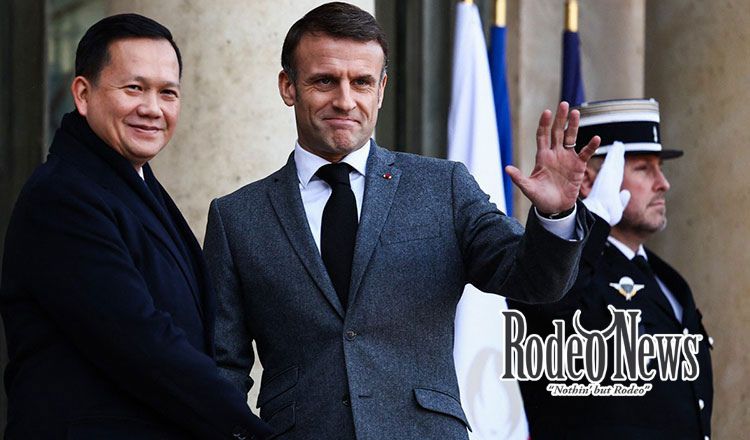
French President Emmanuel Macron also raised the issue last year.
He reassured Prime Minister Hun Manet during a Paris meeting.
Macron said France would help provide key documents to both sides.
However, Sothirak said no concrete steps have followed.
As a result, tensions have continued to rise.
Military clashes occurred in July and December along the border.
Cambodia Steps Up Diplomatic Efforts
At the same time, Cambodia has intensified its diplomatic campaign.
Government spokesman Pen Bona said nearly 700 official statements were issued.
These came from various ministries over the past six months.
The Ministry of National Defence issued the largest number.
Other statements came from foreign affairs, interior and cultural agencies.
In addition, more than 200 press briefings were held.
Cambodia has also briefed foreign diplomats on the situation.
Several visits to affected border areas were organised.
Calls for Stronger French Engagement
Sothirak said France should move beyond a passive observer role.
He called on Paris to clarify and explain the historical documents.
According to him, this step would help both sides move forward.
“France has a moral responsibility,” he said.
“For now, that responsibility remains unmet.”
Cambodian officials believe stronger French involvement could reduce tensions.
They say it could also help prevent further escalation.