Cambodia Prioritizes Peaceful, Law-Based Resolution of Border Issues, PM Hun Manet States
In a statement made this morning, Cambodian Prime Minister Hun Manet reaffirmed his government’s dedication to resolving border issues with Thailand through peaceful, lawful means, underscoring the importance of national sovereignty and territorial integrity. He emphasized that the Royal Government of Cambodia (RGC) and the Joint Boundary Commission (JBC) have consistently approached border matters with professional integrity and a commitment to protecting Cambodia’s territorial sovereignty.
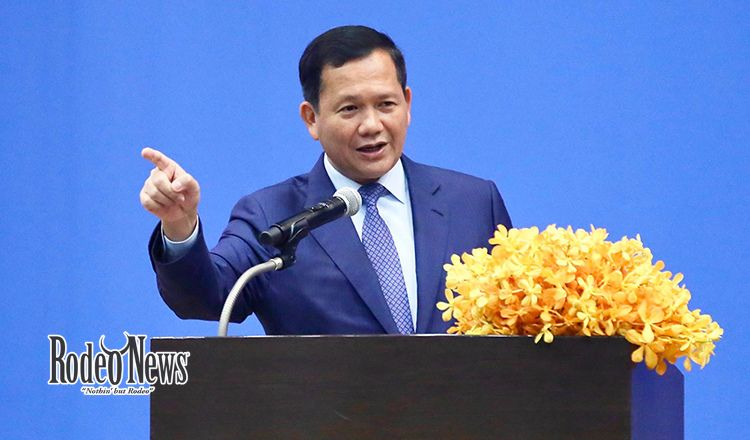
The prime minister outlined that the RGC strictly adheres to international law, particularly respecting the unchangeable nature of borders as established by historical treaties, including the Cambodia-Thailand international boundary line. This line, he noted, was set by the Commission of Delimitation between Indochina and Siam, dating back to the early 20th century.
Addressing the Complexity of the Issue
Hun Manet acknowledged that the border issue between Cambodia and Thailand is complex, shaped by centuries of history. However, he stressed the need for cooperation between both nations to resolve these challenges for the long-term peace and stability of people living along the border.
“The border issue is a complex matter inherited from hundreds of years ago, which both countries must resolve together so that people along the border can live peacefully in the long term,” the prime minister said. His comments were particularly focused on areas such as Chouk Chey and Prey Chan villages, where residents have endured uncertainty due to the unresolved border dispute.
Commitment to Peaceful Measures
Emphasizing the government’s stance, Hun Manet reiterated that Cambodia’s approach to resolving border conflicts is rooted in peaceful measures, in accordance with existing treaties and international conventions. The use of force or violence, he added, was never an option for achieving a fair solution. The prime minister pointed out that Cambodia and Thailand had made significant strides in addressing the border issue through diplomatic channels, including the work of the JBC, which has been active for nearly two decades.
Joint Survey Efforts and Temporary Markers
In recent months, public discussions surrounding border surveys and temporary markers have sparked curiosity and concern among citizens, particularly on social media. The Prime Minister sought to clarify that these actions were not new initiatives but rather part of an ongoing effort to ensure accurate and clear border demarcation.
“Survey and installation of temporary border markers is not a new mission. It is a continuation of the technical work that the border working groups of both countries have been undertaking together for nearly 20 years,” Hun Manet explained.
The joint survey teams, which have been conducting on-the-ground verification since 2006, aim to pinpoint the exact locations of the 74 concrete markers placed by the Commission of Delimitation between Indochina and Siam between 1919 and 1920. However, as the prime minister noted, while efforts have been made to identify the locations of these markers, the actual process of border demarcation has not yet been completed.
A Phased Approach to Demarcation
The current border survey and the installation of temporary markers are part of a phased process aimed at achieving full demarcation of the Cambodia-Thailand border. This process, according to Hun Manet, is in line with the Memorandum of Understanding (MoU) signed in 2000, the Terms of Reference (2003), and the minutes from previous meetings between the Cambodia-Thailand Joint Boundary Commission.
Hun Manet reassured the public that this technical work was being conducted with meticulous attention to legal documents from the French protectorate era, including key records from the Delimitation Commission of 1908–1909 and 1919–1920. He emphasized that the goal of the survey and marker installation was not to claim land but to establish a clear and precise boundary based on historical and international legal standards.
Protection of Sovereignty and Non-Violence
Throughout his remarks, Hun Manet underscored Cambodia’s unwavering commitment to protecting its territorial integrity and sovereignty. He made it clear that while Cambodia respects its neighbors’ sovereignty, it would not compromise on its own territorial rights.
The prime minister concluded by reiterating that the survey and temporary marker installation were not only important for resolving the current border disputes but also for ensuring long-lasting peace and stability in the region. He also noted that after the survey process is completed, joint teams would evaluate the situation on the ground, taking into account the actual occupation of land on both sides of the border, in an effort to find a mutually agreeable solution.
“Through mutual respect for sovereignty and territorial integrity, we will find a solution that works for both countries and, most importantly, ensures the well-being of our people,” Hun Manet said.