Mystery of the Sun’s Hot Atmosphere May Finally Be Solved
For decades, scientists have grappled with one of the Sun’s most perplexing phenomena: why its outer atmosphere, the corona, is much hotter than its surface. Now, a groundbreaking discovery may provide the answer.
Despite being far from the Sun’s core, the Sun’s corona reaches temperatures of over 1 million degrees Fahrenheit (500,000 Celsius), vastly outstripping the Sun’s surface, or photosphere, which hovers at around 10,000°F (5,500°C). Understanding this temperature anomaly has puzzled astrophysicists for years. But thanks to the latest findings from the National Science Foundation’s Daniel K. Inouye Solar Telescope (DKIST) in Hawaii, the mystery could be nearing a solution.

Magnetic Waves: The Key to the Sun’s Heat?
In a recent study published on October 24 in Nature Astronomy, scientists revealed that they have successfully observed “magnetic waves” in the Sun’s corona. These waves, known as Alfvén waves, may be responsible for the extraordinary heating of the Sun’s outer atmosphere. The discovery is the culmination of years of research and advances in solar observation technology.
Richard Morton, a solar physicist at Northumbria University in the UK, led the research team that conducted the study. Morton explains that for years, the scientific community was puzzled by the immense heat emanating from the Sun’s corona. Researchers had hypothesized that energy from the Sun’s surface might be responsible for this heat transfer, but proving this theory has proven to be challenging.
The Role of Alfvén Waves
The concept of magnetic waves influencing the Sun’s heating was first proposed by Nobel laureate Hannes Alfvén in 1942. These waves, which travel along magnetic field lines, were suspected of playing a key role in transporting energy into the corona. However, it wasn’t until recently that scientists were able to directly detect them.
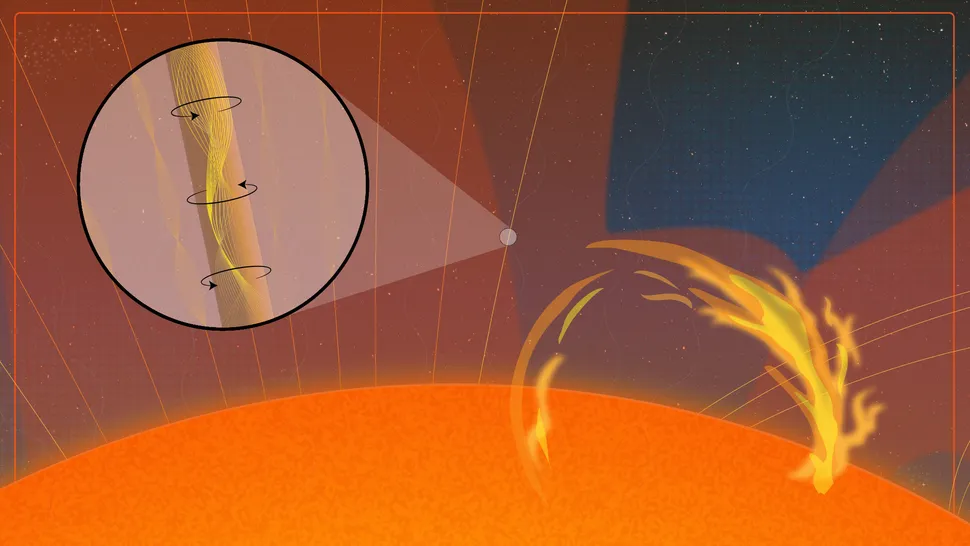
The advanced imaging capabilities of the DKIST telescope have allowed researchers to observe the subtle movements of these waves in the corona. The telescope’s Cryogenic Near Infrared Spectropolarimeter (Cryo-NIRSP) was instrumental in capturing the necessary data, revealing how the Alfvén waves create twisting motions in the Sun’s magnetic fields.
“Cryo-NIRSP provided the data to observe the twisting of magnetic fields in the corona,” Morton said. “This phenomenon appeared as alternating red and blue Doppler shifts, a clear signature of Alfvén waves.” These waves are now believed to be a constant presence throughout the Sun’s atmosphere, potentially contributing a significant amount of energy to heat the corona.
How Magnetic Waves Contribute to Solar Heating
The new findings suggest that these Alfvén waves may be a major contributor to the Sun’s corona heating, offering a plausible explanation for the extreme temperatures observed. Previous models and space weather forecasting tools had speculated about the existence of Alfvén waves, but it was not until DKIST’s high-resolution images that their direct presence could be confirmed.
The research team noted that Alfvén waves could carry substantial energy, potentially accounting for up to half of the energy required to heat the Sun’s corona. This finding challenges earlier assumptions that magnetic reconnection—the snapping and rejoining of magnetic field lines—was the sole mechanism responsible for the heating process. While magnetic reconnection remains an important factor, the new data suggest that both processes, waves and reconnection, work together in the Sun’s complex energy dynamics.
The Bigger Picture: Implications for Solar and Space Weather
Understanding the Sun’s energy transport mechanisms is not only crucial for solar physics but also for space weather prediction. The Sun’s corona produces the solar wind, a constant stream of charged particles that flows outward from the Sun at speeds exceeding 1 million miles per hour (1.6 million km/h). The intensity and variability of solar wind can have significant impacts on space weather, affecting satellite operations, communications, and even power grids on Earth.
By refining models of the Sun’s energy output and coronal heating, scientists hope to improve our understanding of how stars—both in our solar system and beyond—evolve over time. Morton and his team believe their findings could also enhance predictions about solar wind behavior, which is critical for space weather forecasting.
“Further studies like this one will help improve our models and provide better predictions of solar wind production,” Morton said.
The Sun’s Enigmatic Energy
As researchers continue to analyze the data collected by DKIST, the role of Alfvén waves in solar heating will remain a key area of focus. While much progress has been made, the exact amount of energy associated with these waves remains difficult to quantify. Still, the breakthrough observation of Alfvén waves marks a major step forward in solving one of the Sun’s longest-standing mysteries.
In the coming years, new solar observatories, such as NASA’s Parker Solar Probe and the European Space Agency’s Solar Orbiter, will work in tandem with ground-based instruments like DKIST to provide an even clearer picture of the Sun’s enigmatic energy processes.