Roman Space Telescope: 5 Stunning Launch Revelations

The Roman Space Telescope has successfully begun its journey into space, marking a major milestone for NASA and an especially striking moment for a mission that previously faced repeated attempts to cancel or restrict its funding. The observatory launched aboard a SpaceX Falcon Heavy rocket from NASA’s Kennedy Space Center in Florida on Aug. 30, 2026. RReuters+1
Only hours later, President Donald Trump unexpectedly called into NASA’s post-launch news conference to congratulate the team.
The moment was notable because the administration had previously proposed eliminating funding for the telescope. NASA officials and Congress ultimately kept the project alive, allowing the observatory to reach the launch pad and begin what scientists expect to be an extraordinary survey of the universe. TTimes of News+1
The contrast between the mission’s turbulent funding history and its celebratory launch created one of the most unusual moments in recent NASA history.
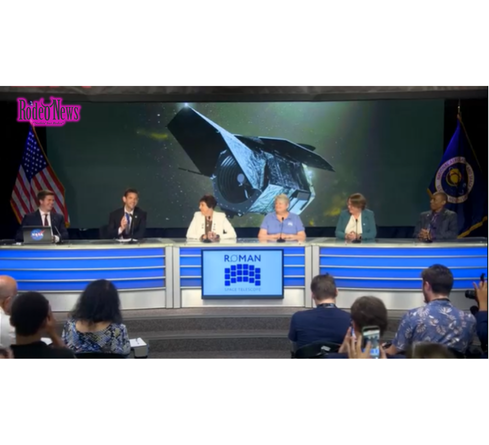
Roman Space Telescope Gets Surprise Trump Call
NASA Administrator Jared Isaacman was participating in the post-launch briefing when he received a phone call from Trump.
The call initially appeared to be a private conversation. Instead, Isaacman returned to the room and announced that the president wanted to congratulate everyone involved in the mission.
The president was then put on speakerphone.
Trump praised the launch and the NASA team, saying the mission looked impressive on television and praising the work being done by the agency. He also spoke about his broader vision for NASA and the United States’ position in space. TTimes of News
The unexpected intervention immediately attracted attention because of the history between the Trump administration and the Roman mission.
The telescope was not always guaranteed a place in NASA’s future.
In fact, it survived several efforts to eliminate it.
The Roman Space Telescope Survived Multiple Cancellation Attempts
The history of the Roman Space Telescope stretches back years before its launch.
The project was previously known as WFIRST, or the Wide Field Infrared Survey Telescope. During Trump’s first administration, budget proposals sought to cancel the mission on multiple occasions.
According to Space.com, Roman was targeted in three separate budget requests between 2019 and 2021. Congress rejected those proposed cancellations and continued funding the project. TTimes of News
The telescope encountered another serious threat in 2025.
Reports about proposed NASA budget reductions indicated that science programs could face extremely deep cuts. Such reductions could have placed Roman’s future in jeopardy after years of development and billions of dollars of investment. SSpace
But once again, the mission survived.
Congress ultimately approved NASA funding that kept the project moving toward launch.
That made Sunday’s successful liftoff more than just another rocket launch. For the scientists and engineers who had worked on the observatory for years, it represented the completion of a project that had repeatedly faced uncertainty.
Trump Praises a Mission His Administration Once Opposed
The president’s phone call created an unusual political contrast.
On one hand, Trump was celebrating the successful launch and praising NASA’s work.
On the other, the administration’s previous budget proposals had included efforts to eliminate Roman’s funding.
A reporter raised that issue directly with Isaacman after Trump’s call.
SpaceNews reporter Jeff Foust asked the NASA administrator what had changed and why the president was now so enthusiastic about a mission that had previously faced cancellation proposals. Isaacman did not directly answer the question. Instead, he emphasized his appreciation for Trump’s current support for NASA, space policy and resources. TTimes of News
That exchange highlighted the complicated path the observatory took to reach orbit.
For the Roman team, however, the immediate focus was no longer politics.
The telescope had launched successfully.
Now the scientific mission could begin.
Why the Roman Space Telescope Matters
The Roman Space Telescope is designed to investigate some of the biggest unanswered questions in modern astronomy.
Its primary scientific goals include studying dark energy, dark matter and exoplanets.
Dark energy is particularly important because the expansion of the universe is accelerating. Scientists know that something is driving this acceleration, but its fundamental nature remains one of cosmology’s greatest mysteries.
Roman will help researchers investigate that mystery by conducting enormous surveys of galaxies and measuring how cosmic structures have changed over time.
The telescope will also contribute to research into dark matter.
Although dark matter cannot be observed directly with conventional telescopes, astronomers can detect its gravitational influence on visible matter and light.
By mapping enormous numbers of galaxies and studying gravitational effects, Roman could provide new information about how dark matter is distributed throughout the universe.
That information could help scientists understand how galaxies formed and evolved.
Roman Will See the Universe Differently From Webb
The Roman Space Telescope is not designed to replace the James Webb Space Telescope.
Instead, the two observatories are expected to complement each other.
Webb is exceptionally powerful for detailed observations of individual objects and relatively small regions of the sky. Roman, by contrast, is designed to survey huge areas.
NASA says Roman will provide a deep, panoramic view of the cosmos, allowing researchers to study enormous numbers of objects and structures across the universe. NNASA
Reuters reports that Roman’s wide-field capabilities will allow it to survey the sky dramatically faster than Hubble while covering a much larger area. RReuters
That combination could transform how astronomers approach major surveys.
Instead of spending enormous amounts of observing time examining one small region, scientists can use Roman to identify interesting targets across a much wider section of the sky.
Those discoveries can then be studied in greater detail by Roman, Webb, Hubble and other observatories.
Roman Could Find Thousands of Exoplanets
Another major objective is the study of planets beyond our solar system.
These worlds are known as exoplanets.
Roman’s instruments will allow scientists to search for planetary systems using techniques including gravitational microlensing. This method can reveal planets that might otherwise be extremely difficult to detect.
The observatory also carries a coronagraph designed to help scientists directly image some exoplanets by reducing the overwhelming glare from their parent stars.
That technology could improve astronomers’ ability to study distant planetary systems.
Roman is not specifically designed to prove whether extraterrestrial life exists.
However, its discoveries could help scientists identify promising targets for future observations.
In other words, Roman may help answer a different but equally important question: Where should scientists look next?
The Telescope Is Headed Toward a Special Point in Space
After launch, the Roman Space Telescope will travel toward the Sun-Earth L2 point.
This region of space is approximately one million miles from Earth.
It is also where NASA’s James Webb Space Telescope operates.
L2 provides an advantageous location for space observatories because a spacecraft can maintain a useful relationship with Earth and the Sun while conducting observations of deep space.
Roman’s journey will therefore continue long after its dramatic Falcon Heavy launch.
The spacecraft must complete its post-launch deployment sequence and travel to its operational location before beginning its major scientific surveys.
NASA expects the observatory to operate for at least five years, with the possibility of extending its mission if spacecraft resources permit. RReuters
A $4 Billion Observatory Built for Cosmic Discovery
The scale of the project is enormous.
Roman represents an investment of roughly $4 billion, according to Reuters. RReuters+1
The telescope is also notable for the technology behind it.
Its primary mirror originated from technology developed for the U.S. National Reconnaissance Office. The equipment was later transferred to NASA and adapted for scientific use.
That history makes Roman an unusual example of technology originally associated with national security being transformed into an astronomical observatory.
Its wide-field instrument contains a 300-megapixel camera designed to capture enormous panoramic views of the universe.
Those images will not simply be visually spectacular.
They will become scientific datasets that researchers can analyze to investigate galaxies, stars, planets and the large-scale structure of the cosmos.
Roman’s Launch Marks a New Chapter for NASA
The successful launch arrives at an important moment for NASA.
The agency is balancing ambitious human-spaceflight plans with a large portfolio of robotic science missions.
Roman represents one of NASA’s major investments in astrophysics and could remain scientifically important for decades because its observations may be combined with data from future telescopes.
The launch also demonstrates what can happen when a long-running scientific program survives political and financial uncertainty.
The mission began as an idea decades ago.
It changed names.
It faced cancellation proposals.
It survived budget battles.
And finally, it reached space.
What Happens Next?
The most dramatic part of the mission may actually be just beginning.
The rocket launch was only the first major step.
Roman now has to deploy its systems, travel toward L2 and complete preparations for scientific operations.
Once those stages are completed, researchers will begin using the observatory to map enormous portions of the sky.
The resulting data could reshape scientific understanding of the universe.
Astronomers hope Roman will help create an enormous three-dimensional picture of cosmic structure, improve measurements of dark energy and dark matter, and identify large numbers of previously unknown exoplanets. Reuters reports that the telescope could survey billions of galaxies during its mission. RReuters+1
The telescope could therefore become one of the most productive astronomical observatories of its generation.
A Political Contradiction Turns Into a Scientific Victory
The most memorable image from Roman’s launch may not be the Falcon Heavy rising into the Florida sky.
It may be the sight of NASA’s administrator holding a phone to a microphone while the president congratulated a team working on a telescope his administration had previously sought to cancel.
That contradiction captures the complicated history of major government-funded science projects.
Large missions can take decades to develop.
Their budgets cross multiple administrations.
Their scientific benefits often extend far beyond the political cycles that determine their funding.
Roman’s successful launch demonstrates that reality.
For the scientists and engineers behind the telescope, the immediate priority is now discovery.
They have spent years building an observatory capable of surveying the universe on an extraordinary scale.
Now the telescope is finally on its way.
The Universe Is Waiting
The successful launch of the Roman Space Telescope marks the beginning of what could become one of NASA’s most important astronomical missions of the decade.
It will investigate dark energy.
It will map dark matter.
It will search for distant worlds.
And it will survey enormous sections of the universe at a speed and scale that previous observatories could not match.
The mission’s journey to space was anything but simple.
It survived cancellation proposals, budget uncertainty and years of development.
Yet on Aug. 30, the telescope lifted away from Florida aboard a Falcon Heavy rocket and began its journey toward L2.
Trump’s unexpected call added an extraordinary political footnote to the launch.
But ultimately, the significance of Roman will not be determined by that phone call.
It will be determined by what the telescope discovers.
If the mission performs as planned, the coming years could bring a new view of the universe — one that reveals hidden galaxies, distant planets and clues about the mysterious forces shaping cosmic history.
For NASA, the launch is a celebration.
For astronomers, it is the beginning of a massive scientific experiment.
And for everyone looking toward the night sky, the Roman Space Telescope may soon provide a radically broader picture of what lies beyond Earth.