
New Moon Crater: NASA Reveals Rare 222m Impact
NASA has revealed a new Moon crater that scientists say represents an extraordinarily rare opportunity to study a fresh impact on the lunar surface. Named McGetchin crater, the feature is about 222 meters (728 feet) wide and up to 43 meters (141 feet) deep.
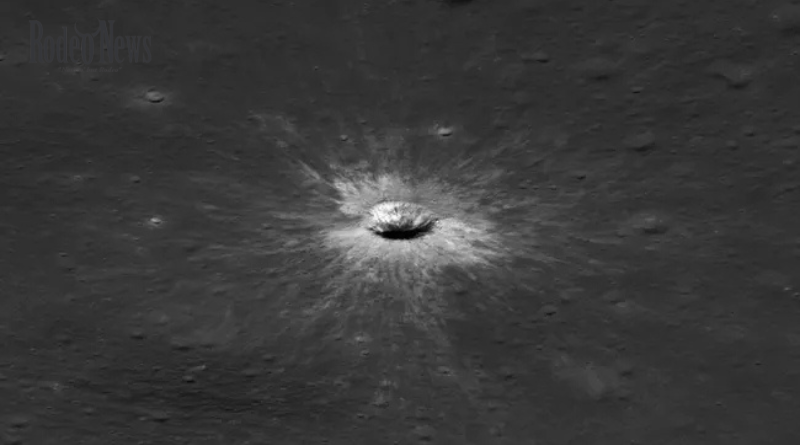
The crater was created when a fragment of an asteroid or comet struck the Moon between April 11 and May 22, 2024. However, scientists did not immediately recognize the feature. It was identified more than a year later after researchers compared images collected by NASA’s Lunar Reconnaissance Orbiter (LRO).
The discovery has attracted significant attention because the crater is considered the largest newly formed impact crater identified in the solar system. Researchers estimate that an impact capable of creating a crater this size occurs on the Moon only about once every century, making the event unusually valuable for planetary science.
New Moon crater was hidden in NASA’s data
The story of the new Moon crater began with a routine review of LRO imagery.
NASA’s Lunar Reconnaissance Orbiter has been studying the Moon since 2009. Over more than 17 years, the spacecraft has collected an enormous amount of information about the lunar surface, including images, temperature measurements, topography and other observations.
During a routine data-quality check on Oct. 24, 2025, image-processing specialist Robert Wagner noticed something unusual in a large map of the Moon.
The feature appeared as an unusually bright area surrounded by a darker halo.
That combination suggested that something had recently disturbed the surface.
Rather than being an ordinary old crater, the feature appeared to represent a relatively recent impact. Researchers then began comparing older images with newer observations to determine when the change had occurred.
The discovery demonstrates why long-running spacecraft missions can be extremely valuable. A spacecraft does not necessarily need to witness an impact in real time to identify it later.
In this case, scientists had something particularly useful: images of the same area before and after the collision.
How big is the McGetchin crater?
The newly identified McGetchin crater measures approximately:
- 222 meters (728 feet) wide
- 43 meters (141 feet) deep
- More than 100 kilometers (66 miles) of surrounding lunar terrain affected by the impact
The crater is roughly three times larger than the previous record-holder for a newly formed crater discovered by LRO.
Although the Moon contains many craters that are vastly larger and billions of years older, McGetchin is significant because it is extremely young in geological terms.
Scientists can therefore examine the immediate consequences of an impact rather than attempting to reconstruct an ancient event from a heavily altered landscape.
NASA said the crater was named after Thomas McGetchin, a lunar scientist and former director of Houston’s Lunar and Planetary Institute.
A building-sized object may have created the new Moon crater
Researchers believe the impactor was a fragment of an asteroid or comet approximately comparable in size to a three- to six-story building.
It collided with the Moon at enormous speed, excavating material from the surface and sending dust and rock outward.
Unlike Earth, the Moon has virtually no atmosphere. That means incoming space rocks do not encounter the same thick atmospheric resistance that objects experience before reaching Earth’s surface.
The result can be a direct and violent collision between an incoming object and the lunar regolith.
Scientists estimate that an impact capable of producing a crater of McGetchin’s size occurs roughly once every 132 years, although the precise interval is statistical rather than a prediction of when the next impact will occur.
That rarity is one reason the discovery is so important.
Researchers effectively obtained a natural experiment that began with a known period and left behind a freshly disturbed section of the lunar surface.
Why scientists are excited about the new Moon crater
Studying ancient lunar craters can reveal enormous amounts about the Moon’s history. However, ancient features have been modified by billions of years of additional impacts and exposure to the space environment.
McGetchin is different.
Scientists know approximately when it formed, allowing them to examine the physical consequences of a major lunar impact almost immediately on a geological timescale.
The research was described in two studies published in Science Advances. One examined the crater and material thrown from the impact, while another investigated a much broader region affected by the event.
This gives scientists an opportunity to improve their understanding of several processes, including:
- How lunar impact craters form
- How far ejecta travels
- How lunar soil is redistributed
- How impacts change the Moon’s surface temperature
- How quickly the lunar landscape evolves
- How future spacecraft and astronauts could encounter disturbed terrain
The Moon’s surface is not as static as it may appear from Earth.
The impact changed the Moon far beyond the crater
One of the most interesting findings is that the effects of the impact extended far beyond the 222-meter-wide hole.
Researchers found evidence that material from the collision was thrown across an area extending for more than 100 kilometers.
According to NASA and researchers involved in the studies, some of the ejecta traveled at higher angles than scientists expected.
That matters because the distribution of material around a crater can reveal information about the energy and geometry of the original impact.
In other words, the crater itself tells only part of the story.
The surrounding landscape contains a much larger record of what happened when the space rock struck.
A mysterious cold spot surrounds the crater
The second study added another intriguing detail.
Scientists identified a temperature-related feature extending approximately 7 kilometers (4 miles) around the crater.
The area is associated with changes to the upper lunar soil, or regolith.
Researchers have compared the process to gardening because an impact effectively churns the Moon’s surface, moving material from below toward the top while redistributing older surface material.
This process is important for understanding how the lunar regolith changes over time.
Research on lunar impacts has long shown that collisions are a major force behind the formation and evolution of the Moon’s surface.
What the new Moon crater reveals about lunar soil
The lunar surface is covered by regolith, a layer of fragmented rock and dust produced by billions of years of impacts.
Every new collision can disturb that layer.
According to the findings associated with McGetchin crater, impacts can overturn the Moon’s uppermost soil more frequently than scientists once assumed. AP reported that researchers estimate the Moon’s top inch of soil can be overturned by impacts on a timescale of roughly 80,000 years.
That may sound extremely slow from a human perspective.
Geologically, however, it is an important rate.
The Moon lacks the active atmosphere, rainfall, flowing water and biological processes that constantly reshape Earth’s surface. Instead, impacts and space weathering play major roles in changing the lunar landscape.
That makes fresh craters particularly valuable scientific markers.
Why the discovery matters for future Moon missions
The new Moon crater is not just a geological curiosity.
NASA and other space agencies are preparing for more extensive lunar exploration, including robotic missions and future crewed operations.
Understanding how impacts modify the surface can help researchers assess the environment future spacecraft will operate in.
A major impact can distribute debris over a surprisingly large area. It can also change the physical characteristics of the regolith around the impact site.
That information could become useful when scientists evaluate landing areas, rover routes and potential infrastructure locations.
The McGetchin discovery therefore arrives at an important time, as lunar exploration moves toward more sustained activity.
The crater was not visible immediately
One of the most surprising aspects of the discovery is that the impact itself was not detected in real time.
The Moon was struck in 2024, but the evidence remained buried in the enormous volume of data collected by LRO.
NASA’s spacecraft had already photographed the region after the impact. The challenge was recognizing the significance of the change.
The relevant imagery was identified in 2025, when researchers noticed the unusual bright-and-dark pattern.
More detailed observations were subsequently obtained using LRO’s Narrow-Angle Camera, which can provide imagery at roughly three feet per pixel in suitable observations.
This illustrates an increasingly important aspect of planetary science: discoveries can emerge not only from new spacecraft observations but also from reexamining years of archived data.
Why the Moon is an ideal impact laboratory
The Moon is effectively a natural laboratory for studying cosmic collisions.
Its surface contains an enormous record of impacts stretching back billions of years.
Scientists studying lunar craters can use that record to investigate the history of the Moon and, more broadly, the collision environment of the inner solar system.
Because the Moon has almost no atmosphere and lacks Earth’s active surface processes, impact scars can remain visible for extremely long periods.
Researchers have previously described the Moon as an important “witness plate” for studying impact history. Understanding lunar impact rates can help scientists refine estimates of how planetary surfaces evolve over time.
McGetchin offers something even more unusual: a crater whose formation date is tightly constrained.
What happens next?
Scientists will continue studying the crater and the surrounding ejecta to extract as much information as possible from the fresh impact site.
Future observations could help researchers determine how the crater and surrounding material change with time.
That creates another advantage.
Instead of examining only a single snapshot, researchers can return to the site repeatedly and monitor how the surface evolves.
The crater could therefore become an important reference point for studying how fresh lunar impacts mature.
For NASA, the discovery also reinforces the scientific value of maintaining long-duration lunar observation missions.
LRO’s extended mission has made it possible to compare observations collected years apart and identify changes that would otherwise be almost impossible to recognize.
A rare glimpse into the Moon’s changing surface
The discovery of the new Moon crater is remarkable not because it is the largest crater on the Moon. It is not.
The Moon contains ancient impact structures hundreds and even thousands of kilometers across.
What makes McGetchin exceptional is its age, size and the quality of the observations available.
Scientists can identify the approximate period when it formed, compare the lunar surface before and after the event, map the debris thrown outward and investigate changes in the surrounding regolith.
That combination is extraordinarily difficult to obtain.
The 222-meter crater is therefore more than a fresh scar on the lunar surface. It is a rare natural experiment that allows scientists to watch the aftermath of a major cosmic collision.
As lunar exploration expands, information from McGetchin could also help researchers better understand the environment that future spacecraft, rovers and astronauts will encounter.
For now, the crater stands as a striking reminder that the Moon is not a frozen relic of the distant past. Even today, objects from space continue to strike its surface, quietly reshaping a world that humans are only beginning to explore in greater detail.