
Moon Crater Discovery: NASA Reveals Rare New Impact
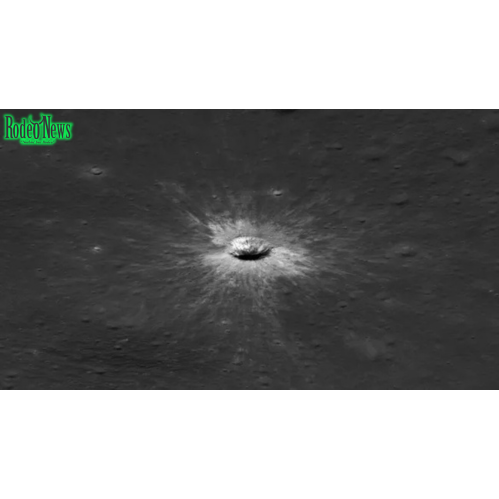
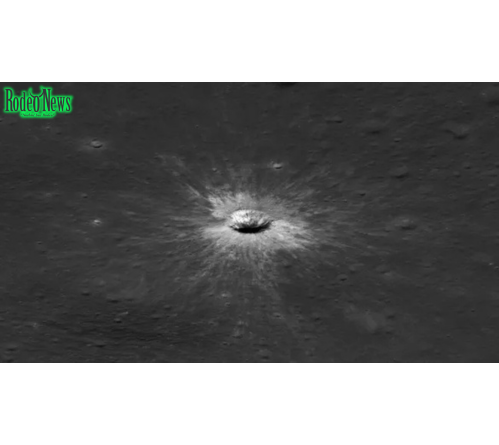
A remarkable Moon crater discovery is giving scientists an unusually detailed look at what happens when a large space rock crashes into the lunar surface. NASA’s Lunar Reconnaissance Orbiter has identified a newly formed crater that scientists say is the largest newly formed impact crater ever found in the solar system.
The crater, officially named McGetchin crater, was created sometime between April 11 and May 22, 2024. Scientists believe an asteroid or comet fragment roughly the size of a three- to six-story building slammed into the Moon and carved out the enormous depression.
The resulting crater measures approximately 728 feet, or 222 meters, across and reaches about 141 feet, or 43 meters, deep. That makes it roughly the length of two football fields from edge to edge.
What makes the discovery particularly valuable is not simply its size.
Scientists were able to compare images of the same lunar landscape before and after the impact. That gives researchers an opportunity to study a fresh lunar crater rather than relying on ancient geological evidence that has been altered by billions of years of impacts.
Moon Crater Discovery Reveals a Rare Lunar Event
The Moon has been struck by asteroids and comet fragments throughout its history.
Unlike Earth, however, the Moon has virtually no atmosphere to slow down incoming objects or burn them up before they reach the ground. As a result, even relatively small pieces of space debris can strike the lunar surface at high speed.
Most impacts are tiny.
NASA says the smallest new craters that can generally be distinguished in Lunar Reconnaissance Orbiter images are around 30 feet across. Scientists estimate that impacts capable of producing craters at that scale occur roughly 140 times across the Moon every year.
The event that created McGetchin crater was considerably larger and much rarer. Scientists estimate an impact of this magnitude occurs approximately once every century or longer.
That rarity is a major reason the Moon crater discovery has attracted so much scientific attention.
Researchers essentially have a geological time capsule.
The crater formed only about two years before the discovery was confirmed, allowing scientists to investigate the immediate consequences of a major lunar impact.
NASA’s Lunar Reconnaissance Orbiter Made the Discovery Possible
The discovery was made possible by NASA’s Lunar Reconnaissance Orbiter, commonly known as LRO.
The spacecraft has been orbiting the Moon for more than 17 years. During that time, it has collected enormous quantities of data about the lunar surface, including information about topography, composition, temperature and radiation.
Its Lunar Reconnaissance Orbiter Camera system has played an especially important role.
Scientists can compare images collected at different times to identify changes on the Moon. Most of these changes are extremely subtle, and automated software can generate large numbers of false signals caused by differences in illumination, shadows or imaging conditions.
That means human analysis remains important.
Robert Wagner, an image-processing specialist working with the LRO camera system, was conducting a routine data-quality check when he noticed something unusual in a global map.
A bright area surrounded by a darker halo suggested that material had recently been disturbed.
The pattern turned out to be something much more significant.
It was the debris surrounding McGetchin crater.
NASA said Wagner discovered the feature while examining data on Oct. 24, 2025, after comparing hundreds of images taken at different times.
The Crater Was Formed in 2024
One of the most fascinating aspects of the Moon crater discovery is that the impact itself was not observed in real time.
The collision happened sometime between April 11 and May 22, 2024.
The incoming object may have been an asteroid or a fragment of a comet. Scientists estimate that the object could have been comparable in size to a three- to six-story building before it struck the lunar surface.
Yet the impact was not immediately recognized from observations made around Earth or from spacecraft imagery.
Instead, researchers later found its evidence hidden within the massive archive of LRO observations.
According to NASA, the crater was first identified in global images and then examined in much greater detail with LRO’s Narrow-Angle Camera.
The high-resolution observations helped scientists determine the crater’s dimensions, shape and surrounding debris.
McGetchin Crater Is Larger Than Previous Recent Discoveries
McGetchin crater is not merely another addition to the Moon’s enormous collection of impact scars.
It is the largest newly formed impact crater ever identified in the solar system, according to NASA’s account of the research.
The crater was named after Thomas McGetchin, a pioneering lunar scientist and former director of the Lunar and Planetary Institute.
Its 222-meter width makes it substantially larger than the previous record-holder for a newly formed crater identified by LRO.
The Moon itself contains much larger craters.
Some ancient lunar impact structures stretch for hundreds or even thousands of kilometers. But those features were created long ago, making it impossible to observe the original impact directly.
McGetchin is different.
Scientists have images of the landscape before the impact and observations afterward.
That provides an unusually valuable natural experiment.
The Impact Changed More Than the Crater
Perhaps the most surprising part of the Moon crater discovery is how far the impact’s effects extend.
Researchers found evidence that the collision disturbed the lunar surface across an area exceeding the immediate crater.
The impact launched debris outward and altered the upper layer of lunar soil, known as regolith.
According to NASA, the disturbance extended across more than 100 kilometers of the lunar surface.
That finding matters because the Moon’s surface is often treated as relatively static.
It certainly changes much more slowly than Earth’s surface.
But impacts, landslides and other processes continue to reshape the lunar landscape.
The new crater provides scientists with a chance to watch those changes much closer to the moment they occurred.
A Strange Cold Spot Surrounds the Crater
The Moon crater discovery produced another unexpected result.
After the crater was identified, scientists examined the region using NASA’s Diviner instrument aboard the Lunar Reconnaissance Orbiter.
They discovered a broad cold spot surrounding the new crater.
The affected region stretches roughly four miles, or seven kilometers, across. At night, the area is about 16 degrees Fahrenheit colder than nearby terrain.
The explanation involves the lunar soil.
The impact effectively loosened and disturbed the regolith surrounding the crater. That material became less dense and therefore less efficient at retaining heat.
As a result, the disturbed region cools differently from the surrounding surface.
This discovery demonstrates that an impact can influence the Moon’s thermal environment beyond the visible crater itself.
Why the Cold Spot Matters for Future Moon Missions
The finding could have implications for future lunar exploration.
NASA and other space agencies are preparing for increasingly sophisticated activity on the Moon, including robotic missions and future human exploration.
Understanding how impacts alter lunar soil could help researchers predict how spacecraft, rovers and other equipment interact with the surface.
Loose regolith can behave differently from compacted soil.
That matters for wheels, landing systems and surface infrastructure.
The new observations could therefore contribute to a better understanding of the environment future lunar explorers will encounter.
The Moon crater discovery is not simply about finding another hole in the lunar surface.
It offers scientists information about how the Moon’s environment changes and how those changes could affect future exploration.
The Moon Is Still an Active Scientific Laboratory
The discovery also challenges the popular image of the Moon as a completely unchanging world.
The lunar surface has preserved evidence of impacts for billions of years, largely because it lacks the atmospheric weather and active geological processes that erase many features on Earth.
But that does not mean nothing happens there.
Fresh impacts continue to occur.
LRO has identified at least 1,000 new impact craters during its mission, according to NASA, along with tens of thousands of other surface changes associated with impacts and debris.
Most of those events are much smaller than the collision that created McGetchin crater.
Still, collectively they demonstrate that the Moon is constantly being modified.
What the Moon Crater Discovery Can Teach Scientists
Fresh craters are valuable because scientists can connect cause and effect.
With ancient craters, researchers must reconstruct what happened using geological clues.
With McGetchin, the timeline is much tighter.
Scientists know approximately when the impact happened.
That combination provides a much richer scientific dataset.
It could also improve estimates of how frequently relatively large objects strike the Moon.
Those estimates are important for understanding the broader population of objects moving through the Earth-Moon neighborhood.
The Moon effectively provides another location where scientists can observe the impact environment of the solar system.
Why Scientists Missed the Impact at First
The fact that such a large crater went unnoticed for more than a year may seem surprising.
However, the Moon is enormous, and monitoring its entire surface at very high resolution is challenging.
LRO continuously gathers data, but scientists must process enormous quantities of imagery.
Global mapping can reveal large changes, while detailed camera observations provide the close-up information needed to confirm them.
Wagner’s discovery illustrates how scientific progress can come from analyzing older data in new ways.
The crater was already there.
What changed was the ability to recognize its signature.
The Discovery Highlights the Value of Long-Term Missions
LRO’s longevity was crucial to this research.
Because the spacecraft has been observing the Moon for many years, researchers have a huge archive of images that can be compared against newer observations.
Without those historical images, identifying a recently created crater would be much harder.
This makes long-running space missions scientifically valuable even when they are not making dramatic discoveries every day.
A spacecraft can continue collecting data that becomes more useful as new questions arise.
The McGetchin discovery is a strong example.
Images collected years ago provided the baseline needed to identify what had changed later.
A Rare Window Into the Moon’s Future
The newly discovered crater is also relevant as NASA and other organizations prepare for a new era of lunar exploration.
Future missions will operate on a surface that continues to receive impacts from space debris.
Most impacts will be small.
But the discovery of McGetchin shows that larger events remain possible.
Understanding the frequency and consequences of these impacts could help scientists assess environmental risks for future lunar infrastructure.
The crater also provides a natural test case for studying how lunar dust and soil respond to major collisions.
That knowledge could become increasingly important as humans spend more time on the Moon.
What Happens Next?
Researchers will continue analyzing McGetchin crater and the surrounding terrain.
The high-resolution LRO imagery already provides detailed information about the crater’s structure and ejecta.
Scientists can also use thermal observations to study how the disturbed soil changes over time.
Future research could help determine how quickly the cold region disappears and how long other physical changes remain detectable.
The impactor itself may also receive further attention.
Scientists can use the crater’s characteristics and ejecta pattern to estimate the size and energy of the object that struck the Moon.
Further analysis could refine those estimates.
A Once-in-a-Century Discovery
The Moon crater discovery offers something scientists rarely get: a fresh impact observed through multiple stages of investigation.
McGetchin crater was formed in 2024 when a space rock struck the Moon. It was later discovered in LRO imagery and examined using higher-resolution cameras and thermal observations.
At about 222 meters wide and 43 meters deep, the crater is enormous by the standards of newly formed lunar impacts. Its surrounding disturbance extends much farther, while the discovery of a four-mile-wide cold spot reveals how dramatically the impact altered the lunar soil.
More importantly, the discovery demonstrates why continuing to observe the Moon matters.
The lunar surface may appear frozen in time when viewed from Earth, but it is still being shaped by impacts and other physical processes.
NASA’s long-running Lunar Reconnaissance Orbiter has now captured one of the clearest examples yet.
For scientists, McGetchin crater is more than a new feature on a lunar map. It is a rare opportunity to study the aftermath of a major cosmic collision almost as it happened — and to learn what that could mean for the Moon’s future as humanity prepares to explore it more extensively.