Northern Lights Forecast: 10 States Could See Aurora
The northern lights forecast for Friday night, August 28, offered skywatchers across parts of the northern United States another chance to see the spectacular aurora borealis. According to NOAA data cited by Forbes, mild auroral activity could make the lights visible across parts of 10 states, particularly close to the Canadian border.
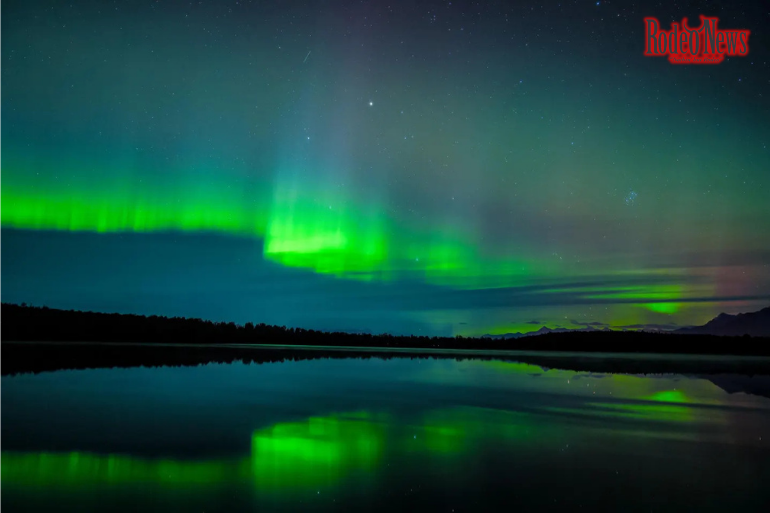
The forecast called for a Kp index of 5, a level associated with more noticeable auroral activity when viewing conditions are favorable. Moderate geomagnetic storm impacts were also expected, potentially strengthening the northern lights display.
For observers hoping to catch the phenomenon, however, timing and location were critical. The best opportunity was expected between roughly 10 p.m. and 2 a.m., with darker skies and locations away from city lights offering the best chance of spotting the aurora.
The forecast also came shortly after a dramatic period for skywatchers, when northern lights activity coincided with a deep partial lunar eclipse across much of North America.
Northern Lights Forecast Shows 10 States in View
NOAA’s aurora forecast identified several northern U.S. areas where the aurora could potentially become visible Friday night.
The forecast area included:
- Northern Washington
- Northern Idaho
- Montana
- Parts of Wyoming near the Montana border
- North Dakota
- Northern South Dakota
- Northern Minnesota
- Northern Wisconsin
- Michigan’s Upper Peninsula
- Northern Michigan
Alaska remained in a much stronger position to see the northern lights, with significantly higher aurora visibility than most locations in the lower 48 states.
That does not mean everyone inside the forecast area was guaranteed a spectacular show.
Aurora forecasts describe the probability and potential geographic reach of an event. Actual visibility depends on several factors, including geomagnetic conditions, cloud cover, light pollution, moonlight and the precise location of the observer.
For that reason, people living near the northern edge of the United States generally had a better opportunity than those farther south.
Northern Lights Forecast Favors Northern U.S.
The reason these states appeared on the northern lights forecast is closely connected to the Earth’s magnetic field.
Auroras occur when charged particles associated with solar activity interact with Earth’s magnetosphere and upper atmosphere. The particles can travel along magnetic field lines toward the polar regions, where they collide with gases in the atmosphere.
Those collisions produce the colorful lights visible in the night sky.
During stronger geomagnetic activity, the auroral oval can expand farther away from the poles. That allows people in parts of the northern United States to see the aurora even when they are hundreds of miles south of the Arctic Circle.
What Does a Kp 5 Forecast Mean?
One of the most important figures in the Friday northern lights forecast was the Kp index.
The Kp index measures global geomagnetic activity on a scale from 0 to 9. Higher values generally indicate stronger disturbances in Earth’s magnetic environment and a greater possibility that auroras will become visible farther from the poles.
NOAA’s Friday forecast called for a Kp index of 5. Forbes noted that NOAA describes this level as potentially producing an aurora that can be particularly pleasing to observe in suitable locations.
A Kp 5 event can therefore create substantially better viewing opportunities than ordinary low-level auroral activity.
However, the number should not be interpreted as a guarantee.
Aurora intensity can change quickly. A location with a favorable Kp value can still have poor visibility if clouds cover the sky or artificial light overwhelms the display.
Why Geomagnetic Storms Matter
Geomagnetic storms are caused by disturbances originating from the Sun.
Solar flares and coronal mass ejections, commonly known as CMEs, can send enormous amounts of energy and charged particles toward Earth. When those particles interact with Earth’s magnetic field, they can trigger geomagnetic storms.
The resulting activity can intensify auroras.
In the days leading up to Friday’s forecast, space-weather experts were monitoring solar activity and expected periods of elevated geomagnetic conditions. Space.com reported that NOAA had issued geomagnetic storm watches associated with solar activity and incoming CMEs around August 27 and 28.
That solar activity helped create the conditions behind the potential northern lights display.
Best Time to See the Northern Lights
According to the Friday forecast, the recommended viewing period was approximately 10 p.m. to 2 a.m.
That window generally offers darker skies, making faint auroral structures easier to detect.
However, skywatchers should not necessarily leave immediately after sunset or assume the display will last continuously.
Auroras can appear, weaken and brighten again over relatively short periods. Patience is therefore important.
Finding a location with an unobstructed view toward the northern horizon can also help.
A dark rural area is usually much better than a brightly illuminated city center.
7
How to Improve Your Aurora Viewing Chances
The northern lights forecast may identify where the aurora could appear, but observers still need favorable local conditions.
One of the simplest ways to improve visibility is to escape artificial light.
Cities produce light pollution that can wash out faint auroral colors. A location several miles away from major population centers can provide dramatically darker skies.
High vantage points can also help.
Observers should ideally choose an area with a broad, unobstructed view of the northern sky. Mountains, buildings and tall trees can block portions of the horizon.
Weather is another major consideration.
Even a strong aurora can remain invisible if thick clouds cover the sky. Checking a local weather forecast before heading outside is therefore just as important as checking the space-weather forecast.
The Full Moon Could Make Viewing Harder
There was another challenge for Friday night: the Moon.
The forecast coincided with a full moon, which meant that natural moonlight could make relatively faint auroral activity more difficult to see.
This does not mean the aurora could not be observed.
A sufficiently strong display can still be visible under a bright Moon. But weaker colors and structures may be harder to distinguish against the brighter sky.
For photographers, the situation can be somewhat different.
Modern smartphone cameras and dedicated cameras can capture light that is difficult for the human eye to see. Night modes and longer exposures may reveal auroral colors even when the display appears faint in person.