NASA is preparing for a major new chapter in space astronomy as the Roman Space Telescope launch approaches. The Nancy Grace Roman Space Telescope is scheduled to lift off aboard a SpaceX Falcon Heavy rocket on Sunday, Aug. 30, from NASA’s Kennedy Space Center in Florida.
The mission is designed to give scientists a much wider view of the universe while investigating some of modern astronomy’s biggest questions. NASA says Roman will study dark energy and dark matter, search for and characterize exoplanets, map billions of galaxies and examine black holes.
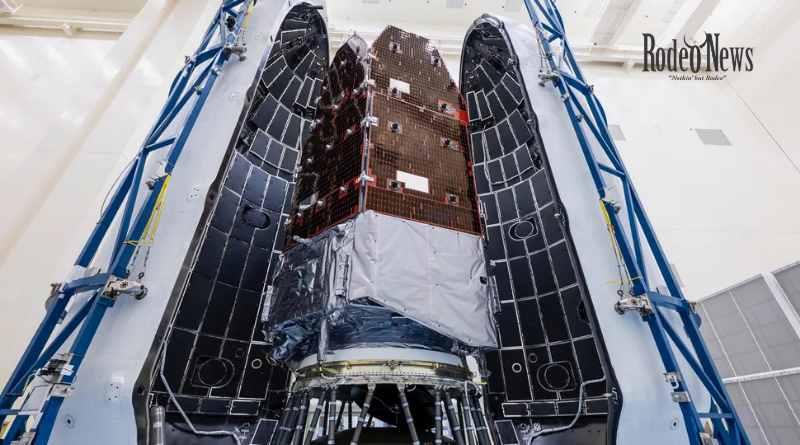
For viewers hoping to watch the event live, timing will be critical. The launch is currently targeted for 7:26 a.m. EDT (1126 GMT) on Aug. 30, with NASA’s live coverage scheduled to begin at 6:20 a.m. EDT.
The launch is also expected to be an important demonstration for SpaceX’s powerful Falcon Heavy, which will send the observatory on a trajectory toward a point roughly one million miles from Earth.
Roman Space Telescope launch time: When will it happen?
The Roman Space Telescope launch is currently scheduled for 7:26 a.m. EDT on Sunday, Aug. 30, 2026.
That corresponds to 1126 GMT. The rocket will depart from Launch Complex 39A at NASA’s Kennedy Space Center in Florida, the historic launch site that has supported some of the most important missions in U.S. spaceflight.
NASA has designated the launch as “no earlier than” 7:26 a.m. EDT. That wording is important because rocket launches can be delayed by weather, technical issues or other operational concerns.
For viewers outside the United States, the timing will fall later in the day depending on the local time zone. The launch is scheduled for 7:26 p.m. Cambodia time on Aug. 30.
NASA plans to begin its official launch coverage about an hour before liftoff. That means viewers should tune in by 6:20 a.m. EDT, or 6:20 p.m. in Cambodia, to avoid missing the countdown.
Roman Space Telescope launch livestream: How to watch
NASA will provide live coverage of the mission beginning at 6:20 a.m. EDT on launch day.
The webcast is expected to continue through the launch and into post-launch activities. NASA says coverage will be available through its website and social media channels, while NASA+ and other streaming platforms are also expected to carry the event.
SpaceX will also provide its own launch coverage, while Space.com plans to carry a simulcast of NASA’s broadcast.
The launch is therefore expected to be widely accessible to viewers around the world.
For people who want more than just the rocket’s liftoff, NASA has also scheduled a post-launch news conference for 9:30 a.m. EDT, or 1330 GMT. Officials and mission leaders are expected to discuss the mission and its early progress.
What happens during the Roman Space Telescope launch?
The Falcon Heavy flight is expected to last approximately 31 minutes and 31 seconds before the Roman Space Telescope separates from the rocket.
The first major event occurs shortly after liftoff. At approximately 1 minute and 8 seconds, the rocket reaches “Max Q,” the point at which aerodynamic stress on the vehicle reaches its maximum.
The Falcon Heavy then begins a series of precisely timed maneuvers involving its three first-stage boosters.
At about 2 minutes and 27 seconds after liftoff, the two side boosters separate. They subsequently perform boostback and entry maneuvers before attempting to return to landing zones in Florida.
The side boosters are expected to touch down approximately 7 minutes and 40 seconds after liftoff. SpaceX plans to land them at Landing Zones 2 and 40 at Cape Canaveral Space Force Station.
Meanwhile, the Falcon Heavy’s upper stage continues the journey toward deep space.
At approximately 4 minutes and 15 seconds, the payload fairing is expected to separate, exposing the Roman observatory to space.
The upper stage engine will later shut down and enter a cruise period. After more than 24 minutes of flight, the engine is expected to restart for another burn before shutting down again.
Finally, at 31 minutes and 31 seconds after liftoff, Roman is expected to separate from the launch vehicle.
Roman Space Telescope launch timeline
The mission’s major milestones are tightly scheduled.
According to SpaceX’s published flight profile, fueling preparations begin well before liftoff. First-stage rocket-grade kerosene loading is scheduled to start around 50 minutes before launch, followed by liquid oxygen loading.
The final minutes are even more tightly controlled.
At seven minutes before liftoff, Falcon Heavy begins engine chilldown. At 59 seconds before launch, the flight computer starts final prelaunch checks.
The launch director’s final go occurs at 45 seconds before liftoff. The propellant tanks are pressurized 20 seconds before launch, while the engine controller starts the ignition sequence six seconds before liftoff.
Key Roman Space Telescope launch times
| Mission Event | Approximate Time After Liftoff |
|---|---|
| Liftoff | T+0 |
| Max Q | T+1:08 |
| Side booster shutdown | T+2:24 |
| Side booster separation | T+2:27 |
| Main engine cutoff | T+3:51 |
| Stage separation | T+3:54 |
| Upper-stage engine ignition | T+4:00 |
| Payload fairing separation | T+4:15 |
| Side booster landing burn | T+7:23 |
| Side booster touchdown | T+7:40 |
| First upper-stage engine cutoff | T+8:28 |
| Upper-stage engine restart | T+24:33 |
| Final engine cutoff | T+26:33 |
| Roman deployment | T+31:31 |
The timeline illustrates how quickly the launch transitions from a ground-based countdown into a complex deep-space mission.
Why the Roman Space Telescope matters
The Roman telescope is designed to complement NASA’s Hubble and James Webb space telescopes rather than simply replace them.
Its major advantage is its extremely wide field of view. NASA says Roman will combine sharp infrared vision with a field of view at least 100 times larger than Hubble’s.
That capability will allow Roman to survey enormous sections of the sky much faster than previous observatories could.
Scientists hope those surveys will help answer fundamental questions about how the universe evolved and why its expansion is accelerating.
Dark energy is one of the mission’s central scientific targets. Although scientists know that something is driving the accelerating expansion of the universe, the physical nature of dark energy remains one of cosmology’s biggest mysteries.
Roman will also investigate dark matter, another invisible component that appears to influence the structure and movement of galaxies.
Its observations could help scientists better understand how galaxies formed, how cosmic structures evolved and how the universe changed over billions of years.
Roman will also search for exoplanets
Another major objective is the search for planets beyond our solar system.
Roman will be able to survey large regions of the Milky Way and identify planetary systems through astronomical techniques such as gravitational microlensing.
That could give scientists a new population of exoplanets to study.
The observatory also carries a Coronagraph Instrument designed to demonstrate technologies for directly imaging exoplanets. Such observations could eventually help researchers investigate planets that are difficult to detect because they are overwhelmed by the light of their host stars.
NASA says Roman’s scientific program will range from objects within our own solar system to distant galaxies near the edge of the observable universe.
Where will Roman go after launch?
The Roman Space Telescope will not remain in low Earth orbit after its Falcon Heavy launch.
Instead, the observatory will travel toward the second Sun-Earth Lagrange point, known as L2.
L2 is located roughly one million miles, or 1.5 million kilometers, from Earth in the direction away from the Sun. The location provides an advantageous environment for a space observatory conducting long-duration observations.
Roman will undergo a carefully planned sequence of deployments and tests after launch.
NASA expects the observatory to spend approximately three months completing deployments, calibrations and commissioning activities before reaching its final operational configuration.
The telescope has a primary mission lifetime of five years, with NASA aiming for the spacecraft to potentially operate for as long as 10 years, depending on available resources and mission conditions.
What if the Roman Space Telescope launch is delayed?
The Aug. 30 launch date is not the only opportunity.
If the mission cannot launch Sunday, SpaceX has identified a backup opportunity on Monday, Aug. 31. The backup liftoff time is currently targeted for 7:22 a.m. EDT, or 1122 GMT.
Weather remains one of the key factors that could affect the schedule.
NASA reported that meteorologists with the U.S. Space Force’s 45th Weather Squadron were forecasting a 60% chance of favorable conditions for the Aug. 30 attempt in an update issued Aug. 28.
Because the forecast can change rapidly, officials will continue monitoring weather conditions as the countdown approaches.
A delay would not necessarily mean a major problem with the telescope or Falcon Heavy. Launch windows are routinely adjusted when weather or other conditions do not meet safety requirements.
A major milestone for NASA and SpaceX
The Roman Space Telescope launch represents more than another rocket flight.
For NASA, it marks the beginning of a major astronomical mission designed to survey the universe on an unprecedented scale. For SpaceX, it represents another high-profile Falcon Heavy mission carrying an extremely valuable scientific spacecraft.
The Falcon Heavy’s three-booster configuration provides the power needed to send Roman toward its distant destination.
Once the observatory separates from the rocket, however, the most important phase of the mission will just be beginning.
Roman must deploy its solar arrays, sunshade and other systems before completing a series of tests and calibrations. It will then begin the long-term scientific campaign that researchers hope will reshape our understanding of dark energy, dark matter, galaxies and planets beyond the solar system.
For viewers, the key moment remains 7:26 a.m. EDT on Aug. 30, with NASA coverage beginning at 6:20 a.m. EDT.
For those watching from Cambodia, that translates to 7:26 p.m. Sunday evening, with coverage beginning at 6:20 p.m. If weather or other conditions prevent liftoff, the next planned opportunity is Monday at 7:22 a.m. EDT.
The countdown is now entering its final stage. If the schedule holds, a powerful Falcon Heavy launch will soon send one of NASA’s most ambitious astronomical observatories on its way to a new vantage point in space — where its wide-field vision could reveal some of the universe’s most important secrets.
Sources: NASA, SpaceX and Space.com.