The Debut review: Julianne Moore takes center stage
The The Debut review story coming out of the 2026 Telluride Film Festival is remarkably consistent: Jesse Eisenberg’s new movie is an unusual, ambitious comedy that becomes increasingly unpredictable, while Julianne Moore delivers the performance that gives the film its emotional and comic force.
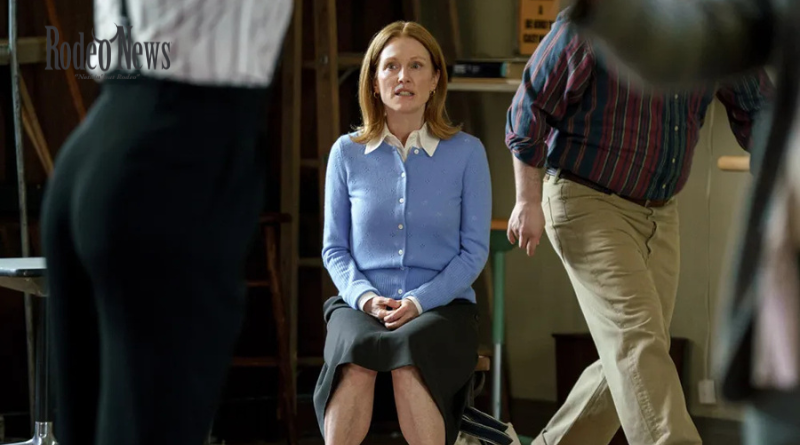
The Debut premiered at the 53rd Telluride Film Festival on September 5, 2026. Written and directed by Eisenberg, the film stars Moore as Mona Friedman, a quiet suburban woman whose decision to join a community theater production sends her life in an increasingly strange direction. Paul Giamatti plays Jerry, the demanding director who pushes Mona far beyond her comfort zone.
At first glance, the premise sounds relatively familiar. An unhappy person discovers an unexpected passion through performance. However, Eisenberg quickly takes the story somewhere much stranger.
Rather than presenting community theater as a simple feel-good escape, The Debut turns acting into a psychological experiment. Mona becomes increasingly committed to her small role, and her determination gradually changes the way she sees herself, the people around her and the boundary between performance and reality.
That combination gives the film its distinctive energy.
The Debut review highlights Julianne Moore’s transformation
The biggest reason The Debut works is Julianne Moore.
Moore plays Mona as someone who initially appears harmless, cheerful and somewhat invisible. She is not presented as an obvious rebel or someone waiting for a dramatic reinvention. Instead, she seems like a person who has spent years accommodating everyone else.
The theater gives her something she has not had before: permission to be seen.
Once Mona becomes involved in the production, however, that newfound confidence develops into something considerably more complicated.
Her commitment to acting becomes intense. Her relationship with her character becomes increasingly personal. What begins as a modest opportunity turns into an obsession with getting the performance right.
The result is a role that allows Moore to move through several distinct versions of the same character.
Vulture’s review similarly praised Moore’s performance as an unusually expansive showcase for the actress, noting how the film changes stylistically alongside Mona’s transformation.
That is an important part of Eisenberg’s filmmaking strategy. Mona does not simply change because the screenplay tells audiences that she has changed. The movie itself changes around her.
The comedy becomes more exaggerated. The filmmaking becomes more adventurous. Reality becomes less stable.
Moore has to carry all of those changes without losing the emotional core of Mona.
She does.
Paul Giamatti brings controlled chaos
While Moore is the center of the movie, Paul Giamatti provides an essential counterbalance.
His character, Jerry, is a community theater director who takes his production extremely seriously. He sees something in Mona that she does not initially recognize herself.
Jerry’s approach is demanding and sometimes bizarre. Instead of allowing Mona to remain comfortable, he challenges her to dig deeper into the character.
That relationship becomes one of the film’s most entertaining elements.
Giamatti has a natural ability to make obsessive characters both funny and believable. In The Debut, that quality fits perfectly with Eisenberg’s heightened style.
Jerry could easily have become a stereotypical eccentric theater director. Instead, Giamatti gives him enough sincerity to make his behavior understandable, even when it becomes excessive.
The chemistry between Giamatti and Moore is consequently one of the film’s strongest assets.
Several early reviews have emphasized the pairing. Deadline described the film as an affectionate comedy about local theater, while other critics have highlighted how Moore and Giamatti keep the increasingly outrageous story grounded.
Jesse Eisenberg turns community theater into something stranger
Eisenberg’s evolution as a filmmaker is another major part of the The Debut review conversation.
His previous directorial work, particularly A Real Pain, demonstrated an interest in uncomfortable humor and complicated human relationships. With The Debut, he pushes that sensibility into more experimental territory.
The film is fundamentally a comedy, but it does not remain stylistically comfortable.
It incorporates musical elements, surreal touches and moments that approach thriller territory. Reviews have noted comparisons to filmmakers known for pushing conventional storytelling structures, while still describing Eisenberg’s result as distinctive.
That tonal instability is deliberate.
As Mona becomes more deeply immersed in her role, the audience is increasingly encouraged to experience the world from her perspective.
Scenes can become larger than life. Repeated moments can take on different meanings. The distinction between what happens onstage and what happens offstage becomes increasingly difficult to maintain.
Instead of treating this as a flaw, Eisenberg makes it part of the movie’s central idea.
Acting changes Mona.
And as Mona changes, the movie changes with her.
A comedy about wanting to be seen
Underneath its eccentric humor, The Debut has a surprisingly recognizable emotional theme.
Mona wants to matter.
Her theater role may be relatively small. Her character may not even be particularly important within the production. Yet Mona becomes determined to give the role everything she has.
That obsession is funny because it is disproportionate.
But it is also understandable.
Most people have experienced some version of feeling overlooked. The desire to be recognized, respected or appreciated can become powerful, particularly when someone discovers an environment where their effort finally appears to matter.
Eisenberg uses community theater to explore that desire without mocking the people who participate in it.
The film appears to understand why amateur theater can become so important to the people involved.
For some participants, it is not simply entertainment.
It is identity.
It is friendship.
It is escape.
And sometimes, it is the only place where someone feels completely visible.
That emotional foundation gives the movie more substance than its increasingly absurd situations might initially suggest.
The musical elements add another layer
The Debut is also unusual because it incorporates original musical material into its story.
The production within the film is built around an original musical, creating opportunities for Eisenberg to explore theater both as a narrative setting and as a filmmaking device.
That allows the movie to move between conventional comedy and performance sequences without completely settling into either mode.
The musical component is not merely decorative.
It becomes another way for Mona to express herself.
The movie’s songs and stage performances also reinforce the idea that theater gives people permission to become different versions of themselves.
That idea connects directly to Mona’s journey.
She starts by playing a role.
Eventually, the role begins to change the person playing it.
The Debut review: does the strange approach work?
For viewers expecting a straightforward comedy, The Debut may initially feel unpredictable.
The film’s willingness to shift genres is one of its defining characteristics.
It can be funny one moment and unsettling the next. A scene that begins as an ordinary rehearsal can suddenly take on a surreal quality. The filmmaking increasingly reflects Mona’s emotional state rather than simply documenting the events around her.
That will not work equally well for every viewer.
Some audiences may find the movie’s escalating absurdity exhilarating. Others may feel that its stylistic experimentation occasionally overwhelms the simpler emotional story underneath.
That is arguably the biggest risk Eisenberg takes.
But the performances make the experiment much easier to embrace.
Moore commits completely to the movie’s unusual tone. Giamatti provides a strong supporting presence. The broader ensemble adds to the chaotic community-theater atmosphere.
According to Rotten Tomatoes’ early collection of reviews, critics have broadly responded positively, with praise particularly focused on Moore, Eisenberg’s direction and the film’s unusual blend of comedy and drama.
Julianne Moore could become an awards-season talking point
It is still early in the 2026-27 awards season, but Moore’s performance is already attracting significant attention.
Variety’s Telluride coverage described the film as launching an awards conversation around Moore and highlighted what it characterized as a career-best performance.
Vulture was similarly enthusiastic, describing Moore’s work as an exceptional showcase for her range.
That conversation makes sense because the role gives Moore something many established actors rarely receive: a character who is allowed to transform dramatically without losing emotional complexity.
Mona can be funny.
She can be awkward.
She can be frighteningly committed.
She can also be deeply vulnerable.
Moore has to communicate all of those qualities, sometimes within the same sequence.
If The Debut continues to receive strong festival reactions as it moves through the fall festival circuit, her performance could become one of the movie’s biggest talking points.
The Debut release date and where to watch
The Debut had its world premiere at the 2026 Telluride Film Festival on September 5.
The film is distributed by A24 and is scheduled to open theatrically in the United States on December 11, 2026. It is also scheduled to appear at other major international festivals, including the Toronto International Film Festival and the San Sebastián International Film Festival.
The film’s festival journey is particularly significant because Telluride has historically been an important launching point for movies seeking awards-season momentum.
The Debut also has a notable cast beyond Moore and Giamatti. The ensemble includes Halle Bailey, Jesse Eisenberg, Bernadette Peters, Havana Rose Liu, Cara Buono and several performers with theater backgrounds.
The Debut review verdict
The strongest takeaway from this The Debut review is that Jesse Eisenberg has made a movie that refuses to stay in one category.
It is a comedy about community theater.
It is also a story about identity.
It becomes a musical.
Then it becomes something more surreal.
At its center is Julianne Moore, giving Mona Friedman a performance that can move from deliberately ordinary to completely unrestrained.
Paul Giamatti gives the movie an equally valuable dose of controlled eccentricity, while Eisenberg’s direction keeps pushing the material into unexpected territory.
The film will not necessarily appeal to audiences looking for a conventional, predictable comedy. Its humor is strange, its structure becomes increasingly adventurous and its emotional journey is tied closely to Mona’s willingness to lose herself in performance.
But that is also what makes The Debut interesting.
Rather than simply asking what happens when an ordinary person discovers acting, Eisenberg asks a more complicated question:
What happens when the role becomes more important than the person playing it?
That question gives the movie a surprisingly rich emotional foundation beneath its eccentric surface.
With a strong early critical response at Telluride, a standout Julianne Moore performance and a December theatrical release ahead, The Debut is shaping up as one of the more distinctive films entering the 2026 awards-season conversation.
For audiences willing to embrace its unusual rhythm and increasingly wild sense of humor, it could be one of the year’s most memorable cinematic surprises.
Final Rating: 4/5
Best for: Fans of unconventional comedy, community-theater stories, Julianne Moore, Paul Giamatti and Jesse Eisenberg’s filmmaking.
Bottom line: The Debut is an ambitious and frequently hilarious comedy that transforms a small theater production into a strange, emotional examination of identity, ambition and the desire to finally be seen.