China’s Chang’e-6 Mission Unveils Surprising Lunar Discovery: Hematite and Maghemite Found on the Moon
For decades, scientists believed that the Moon’s barren, airless surface could not support the conditions necessary for chemical reactions like oxidation. However, a groundbreaking discovery by China’s Chang’e-6 mission has turned this long-held belief upside down.
On November 14, a study published in Science Advances revealed that lunar rocks brought back by the Chang’e-6 mission contained the first clear physical evidence of two iron-oxide minerals—hematite and maghemite—formed through asteroid impacts on the Moon. This finding provides compelling new evidence that, under the right conditions, the Moon can indeed host oxidized minerals, despite its lack of atmosphere and low oxygen levels.
Digging Into the Past: The Discovery of Hematite and Maghemite
The discovery was made in lunar samples collected from the South Pole–Aitken (SPA) Basin, one of the Moon’s oldest and largest impact craters. The SPA Basin is located on the far side of the Moon and is the result of a colossal impact that occurred billions of years ago.
The research team, which included experts from the Institute of Geochemistry at the Chinese Academy of Sciences and Shandong University, used advanced techniques such as electron microscopy, Raman spectroscopy, and electron energy loss spectroscopy to analyze the samples. These minerals, though tiny—measuring just microns across—were confirmed to be native to the Moon, not brought from Earth by the mission itself.
This marks the first time that crystalline hematite and maghemite have been directly identified in lunar samples returned to Earth. The presence of these minerals raises significant questions about the Moon’s geological history and challenges previous assumptions about the lack of oxidation on the Moon’s surface.
Asteroid Impacts: The Key to Lunar Oxidation?
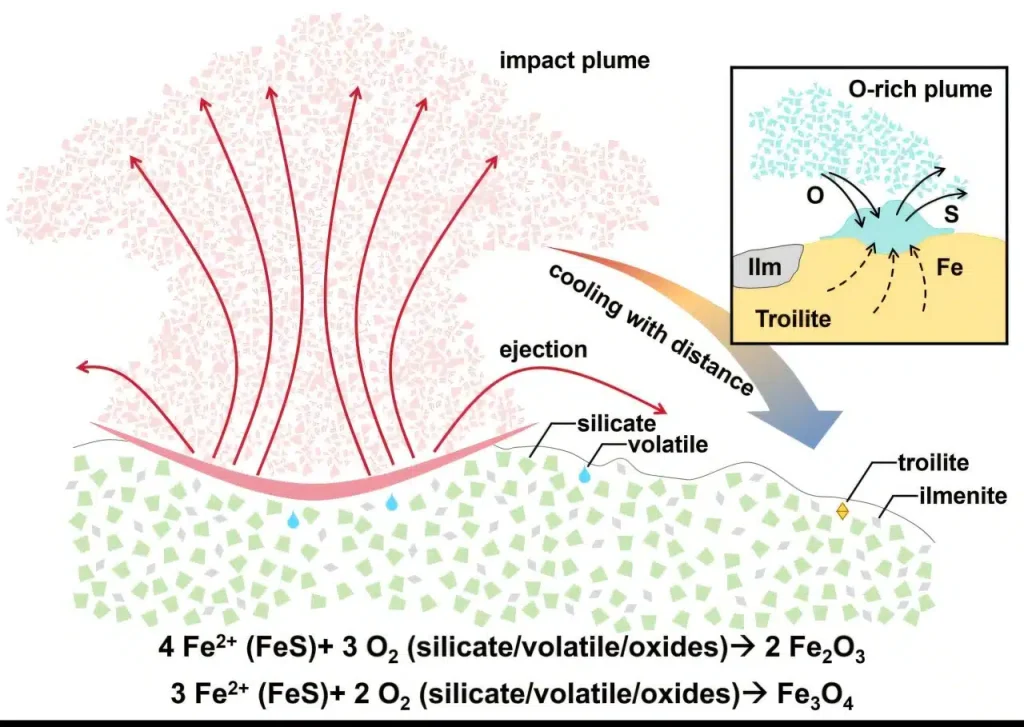
The discovery has also shed new light on how oxidation might occur on the Moon. For years, scientists have assumed that the Moon’s lack of atmosphere meant that chemical processes like oxidation were highly unlikely. However, the recent findings suggest that large asteroid impacts, which generate extreme heat, could create temporary conditions that allow for the oxidation of iron-rich minerals.
According to the study, the intense heat produced by asteroid strikes would vaporize lunar surface materials, creating a high-oxygen environment, albeit for a very brief period. In this short window, iron-rich minerals like troilite would undergo oxidation, transforming into hematite and maghemite.
Phys.org explains: “The extreme temperatures generated by large impacts would have vaporized surface materials, creating a transient high-oxygen-fugacity vapor-phase environment.” This momentary, high-temperature environment could have been enough to trigger the formation of these oxidized minerals, a process not previously considered possible on the Moon.
Alongside hematite and maghemite, researchers also found magnetite in the samples, further supporting the idea that asteroid impacts played a role in creating these oxidized minerals. The presence of these different iron-oxide minerals indicates a range of oxidation states, which all point to a common origin: violent surface events from ancient impacts.
Lunar Magnetic Anomalies: A New Explanation?
This study has also opened the door to a new understanding of the Moon’s magnetic anomalies, which have puzzled scientists for decades. In areas like the northwestern SPA Basin, researchers have detected unexplained magnetic signatures, and the discovery of hematite and maghemite may provide a key clue.
Both hematite and maghemite are known magnetic minerals, and their formation in the wake of large impacts could help explain these mysterious lunar magnetic anomalies. As the study suggests, the presence of these minerals may be linked to the Moon’s evolving magnetic history.
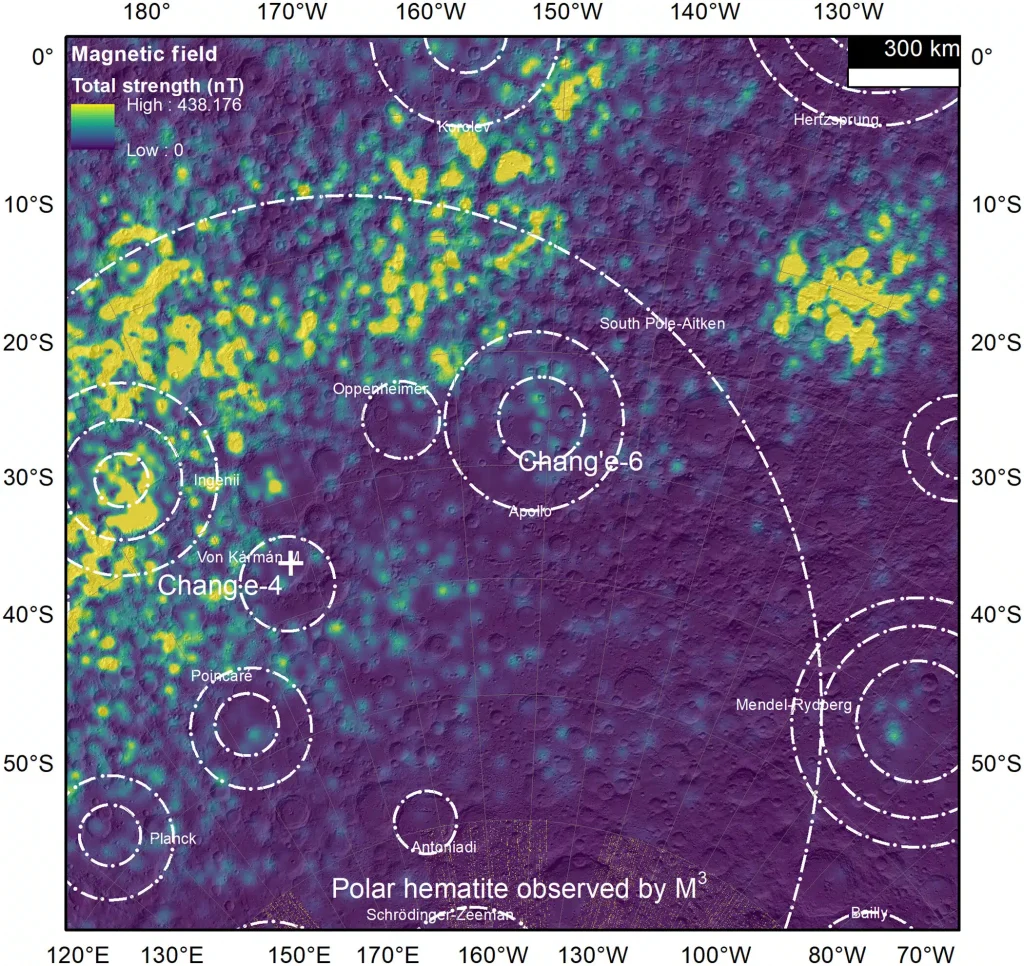
“The findings provide key sample-based evidence to clarify the carriers and evolutionary history of these lunar magnetic anomalies,” the research team noted. By connecting these oxidized minerals to ancient impact events, the study enhances our understanding of lunar geological evolution and provides new insight into the magnetic properties of the Moon.
A New Chapter in Lunar Exploration
The Chang’e-6 mission’s discovery not only challenges previous theories about lunar chemistry but also underscores the importance of continuing exploration of the Moon. As scientists continue to study the rocks and minerals returned by this mission, the findings promise to reveal more about the Moon’s geological history, its formation, and the processes that shaped its surface.
With future lunar missions planned by both China and NASA, the Chang’e-6 mission’s breakthrough opens the door to deeper exploration and a more nuanced understanding of Earth’s celestial neighbor.