Nepal Tunnel Rescue Saves Chinese National After 10 Days
The Nepal tunnel rescue operation has delivered another remarkable breakthrough after rescuers pulled a Chinese national alive from a hydropower tunnel 10 days after catastrophic flooding and debris swept through northern Nepal.
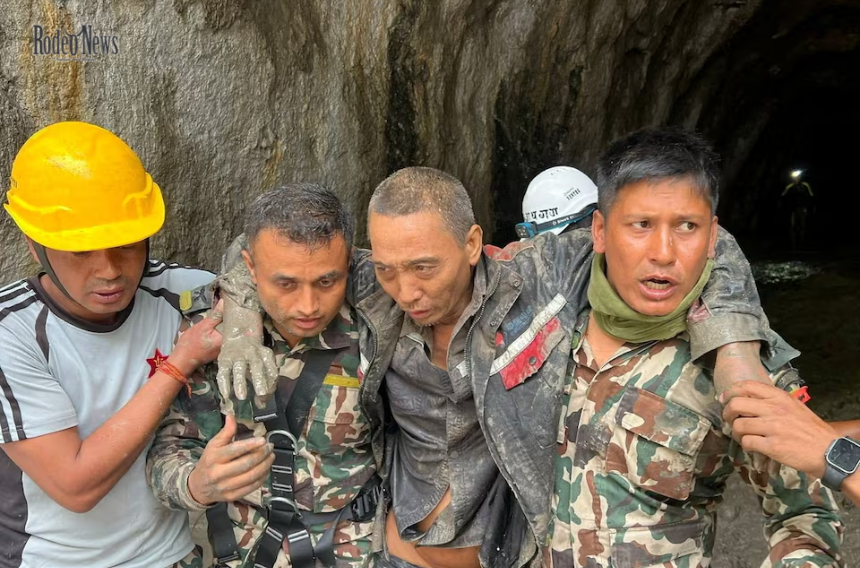
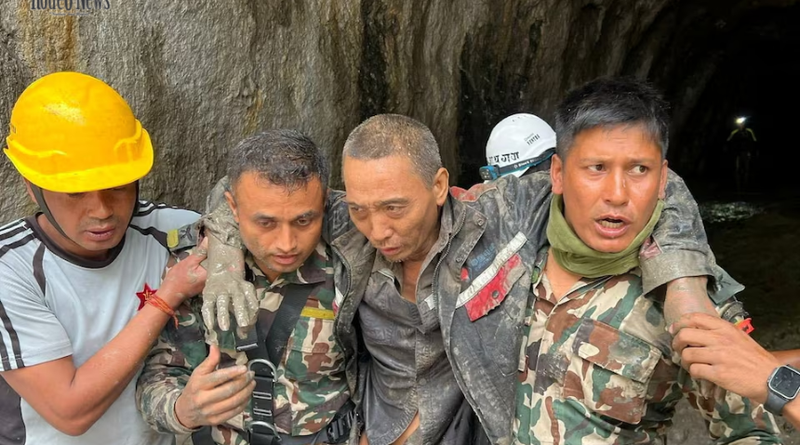
The survivor, identified by authorities as Lu Haitao, was rescued from a tunnel at the Upper Trishuli-1 Hydropower Project in Nepal’s Rasuwa district on Saturday, September 5. The rescue came one day after two Nepali hydropower workers were pulled alive from another tunnel in the same disaster zone. RReuters+1
According to Reuters, Lu was found inside a tunnel approximately 225 meters long. He was reported to be suffering from mild hypothermia but was in stable condition after being taken to an army hospital for medical treatment. RReuters
The latest rescue has given families renewed hope as emergency teams continue searching for hundreds of people believed to be missing following the devastating August 26 disaster.
Nepal Tunnel Rescue Brings New Hope
The rescue of Lu is particularly significant because he survived for roughly 10 days in extremely difficult underground conditions.
The disaster began when a massive wall of ice, rock and mud swept through a Himalayan valley near the Nepal-China border. The resulting floods and landslides destroyed homes, infrastructure and hydropower facilities across the region.
More than 1,300 people have been reported dead, while thousands remain missing. Reuters reported that approximately 900 people may have been trapped in tunnels connected to hydropower projects in the affected area. RReuters
The survival of several people deep underground has therefore become an important source of hope for relatives still waiting for news.
On Friday, rescuers pulled two Nepali workers alive from a tunnel associated with the Trishuli 3A hydropower project. Their rescue followed days of difficult excavation and search operations. RReuters
The discovery of Lu the following day has further encouraged rescue teams to continue their efforts.
Chinese Worker Found Alive Inside Upper Trishuli-1
Lu was rescued from the Upper Trishuli-1 Hydropower Project, one of several hydropower facilities affected by the disaster.
Nepal has increasingly relied on hydropower as an important source of electricity and economic development. Many projects in the mountainous country require extensive tunnel construction, creating difficult working environments even under normal conditions.
Following the August 26 disaster, several tunnel entrances were buried or blocked by enormous quantities of mud, rocks and other debris.
Rescuers have had to work through unstable terrain while attempting to determine the condition of underground structures.
The Nepalese government has mobilized the army, police, emergency personnel and specialist teams to search for missing workers. International teams from countries including India, China and South Korea have also been assisting with the tunnel operations. MMinistry of Foreign Affairs+1
The Korean tunnel rescue team was specifically working alongside Nepali rescuers at Upper Trishuli-1 before the latest breakthrough. Nepal’s Ministry of Foreign Affairs had previously confirmed that specialized tunnel teams from India, China and South Korea were supporting operations at different sites. MMinistry of Foreign Affairs
Disaster Left Thousands Missing
The scale of the disaster has made the rescue operation one of Nepal’s most challenging emergencies in recent years.
The flooding occurred on August 26 after a collapse involving a glacier and rock in the Himalayan region. A huge volume of water, ice, mud and debris moved rapidly down waterways, striking communities and infrastructure with little time for people to escape.
The Trishuli River corridor was among the hardest-hit areas.
According to Reuters, the disaster left more than 1,300 people dead and thousands missing. The exact figures have continued to change as authorities locate survivors, recover victims and update their records. RReuters+1
The damage has also been enormous.
A Reuters report published September 4 said Nepal estimated losses from the floods at around 387.5 billion Nepalese rupees, equivalent to approximately $2.56 billion. Thousands of homes and major infrastructure facilities were damaged or destroyed. RReuters
The disaster has consequently become both a humanitarian emergency and a major infrastructure crisis.
Rescuers Face Dangerous Tunnel Conditions
The Nepal tunnel rescue operation is particularly difficult because emergency teams cannot simply enter damaged tunnels without assessing structural and environmental risks.
Floodwater, mud, rocks and collapsed sections can block access routes. There is also the possibility of additional flooding or structural failure inside underground facilities.
Rescue teams therefore have to balance speed with safety.
In earlier operations at Trishuli 3A, rescuers used heavy machinery and other specialized techniques to remove debris and reach trapped workers. The successful extraction of two Nepali workers on September 4 demonstrated that people could survive for days underground despite the conditions. RReuters+1
That discovery changed the atmosphere of the wider search.
Instead of treating every blocked tunnel solely as a recovery site, rescue teams have additional reason to investigate whether people could still be alive inside.
Families Continue Waiting for Missing Relatives
Behind the large casualty figures are thousands of families still waiting for information about relatives.
For many families, the rescue of survivors has created a mixture of relief and renewed anxiety. Each successful operation demonstrates that survival is possible, while the large number of people still missing means uncertainty remains widespread.
Reuters reported that survivors from one tunnel had indicated they heard voices inside, raising hopes that additional people might still be alive. RReuters
This information is especially important because rescue operations can take days to reach isolated sections of underground facilities.
For families waiting outside, every excavator movement, tunnel breakthrough and communication from rescue officials can bring either hope or devastating news.
International Teams Join Nepal’s Rescue Effort
The response has become an international operation.
Nepali authorities have been working with specialist rescue teams from neighboring and partner countries. According to Nepal’s Ministry of Foreign Affairs, tunnel rescue teams from India, China and South Korea have been coordinating with the Nepali Army. Rescue equipment, drones, load carriers and other supplies have also been deployed. MMinistry of Foreign Affairs
The international cooperation reflects the technical complexity of the disaster.
Tunnel rescue requires specialized knowledge because teams must understand underground structures, identify safe access points and remove large quantities of debris without creating additional hazards.
At Upper Trishuli-1, South Korean specialists were involved in efforts to open the tunnel before Lu was found alive. MMinistry of Foreign Affairs
The successful rescue therefore represents not only an individual survival story but also a major achievement for the teams working under extremely difficult conditions.
What Happens After the Nepal Tunnel Rescue?
The rescue of Lu does not mean the wider operation is coming to an end.
Instead, officials are expected to continue searching tunnels and other damaged areas where people remain unaccounted for.
Nepal’s Foreign Ministry said search and rescue efforts were continuing at several locations, including Langtang, Chilime, Upper Trishuli-1, Upper Trishuli-3A and Upper Trishuli-3B. MMinistry of Foreign Affairs
The government has also received assistance from several countries for rescue, relief and recovery operations.
As conditions gradually improve in some areas, teams may gain better access to locations that were previously too dangerous or difficult to reach.
The three successful tunnel rescues in two days have provided an important psychological boost.
First, two Nepali workers were recovered alive after nine days underground. Then, Lu was found alive after approximately 10 days. These cases demonstrate that people trapped underground may survive far longer than initially expected under certain circumstances.
However, rescue officials still face difficult decisions about where to deploy limited personnel and equipment.
A Rescue That Offers a Powerful Message of Hope
The Nepal tunnel rescue of Lu Haitao is one of the most extraordinary developments since the August 26 disaster.
After 10 days underground, his survival has given families and rescuers another reason to continue searching.
The disaster has already caused immense loss, destroying communities and leaving thousands of people missing. Yet the successful recovery of survivors shows that rescue operations can still produce unexpected breakthroughs even after many days.
For Nepal’s rescue teams, the mission now continues.
For families still waiting, the message is equally powerful: the search is not over.
The rescue of one person cannot erase the enormous tragedy caused by the floods. But every survivor recovered alive represents another family reunited and another reason for rescuers to keep digging through the debris.
As specialist teams continue working across the affected hydropower sites, the hope is that more people will be found before the rescue operation finally comes to an end.