VIDEO: Trump Accuses Thailand of Reigniting Hostilities with Cambodia Despite Peace Agreement
In a surprise statement at a press conference today, US President Donald Trump accused Thailand of reigniting hostilities with Cambodia, despite the two nations having signed a peace agreement in late October 2025. The agreement, known as the Kuala Lumpur Peace Accord, was hailed as a breakthrough in diplomatic efforts, but tensions remain high between the neighboring countries.
The peace accord, which took place in Malaysia’s capital, was witnessed by Trump, who has positioned himself as a mediator in international conflicts during his presidency. The accord was expected to bring a long-awaited resolution to the simmering tensions that have characterized Thailand and Cambodia’s relationship over territorial disputes, particularly surrounding the Preah Vihear Temple area and the broader issue of border security.
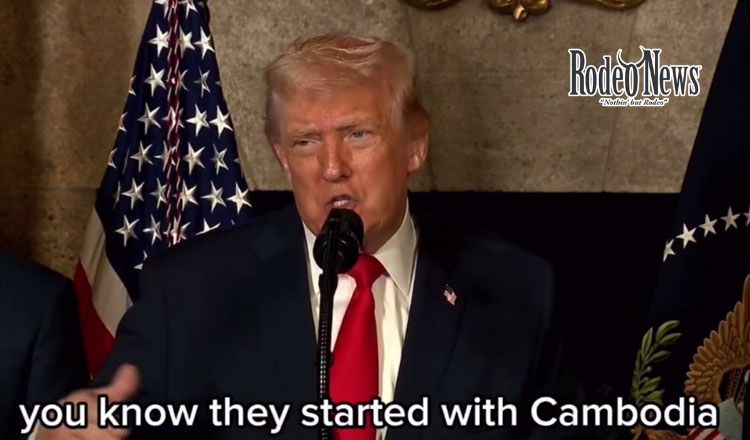
However, President Trump’s comments at the press conference today suggested that the peace was temporary. “But, you know, I’ve solved eight wars, and Thailand is starting to shape up,” Trump stated, before making a surprising claim about the renewed conflict. “You know, they started with Cambodia again,” he continued. His words reflect the complex and volatile nature of Southeast Asian geopolitics, where longstanding rivalries and territorial disputes often remain unresolved despite formal agreements.
Trump did not provide specific details on the current nature of the conflict between Thailand and Cambodia, but his remarks highlight ongoing concerns about the potential for violence to flare up again. Despite the peace agreement, both nations have struggled with mutual distrust and a history of military skirmishes.
In the interview, the President also touched on the longstanding animosity between the two nations. “There’s a lot of hatred between those two people, and, when there’s hatred, there’s, you know, problems,” Trump remarked, pointing to the deep-seated issues that continue to hinder diplomatic relations.
A Fragile Peace
The Kuala Lumpur Peace Accord, signed with great optimism, was seen as a pivotal moment for the region. The two countries had agreed to cease hostilities, open communication channels, and allow for joint oversight of disputed areas. The agreement was touted as a diplomatic victory for all parties involved, including the US, which has long sought to stabilize the region and prevent conflicts from escalating.
However, the challenges that come with such a peace agreement are significant. As Trump acknowledged, the animosity between Thailand and Cambodia is not easily erased. Historical grievances, especially regarding the Preah Vihear Temple, which has been at the center of a bitter territorial dispute for decades, continue to stoke nationalist sentiments and resistance to compromise on both sides.
While both countries agreed to demilitarize certain areas and create a framework for peaceful resolution, there are still unresolved issues, particularly around the sovereignty of certain border regions. In recent weeks, reports have surfaced indicating increased military presence and sporadic clashes along the Thai-Cambodia border, despite the peace deal.
The Role of the United States in Southeast Asia
President Trump’s remarks also underline the United States’ role in Southeast Asia, where it continues to exert influence on diplomatic matters, particularly when it comes to stability in the region. The US has long viewed the stability of Southeast Asia as critical to its strategic interests, particularly in relation to China’s growing presence in the South China Sea and its increasing influence in neighboring countries.
The President’s comments on the Thailand-Cambodia situation also reflect a broader geopolitical strategy. By positioning himself as a peace broker, Trump reinforces the notion of the US as a key mediator in international disputes, a stance he has emphasized throughout his presidency.
Moving Forward
As the situation continues to evolve, it remains to be seen whether the Kuala Lumpur Peace Accord will hold, or if further escalation between Thailand and Cambodia is imminent. With Trump’s remarks highlighting the fragility of the agreement, the eyes of the international community are once again turned toward Southeast Asia.
The region’s complex history of territorial disputes and ethnic tensions poses a significant challenge to lasting peace. Both Thailand and Cambodia will have to navigate their domestic political landscapes and address the deep-seated historical issues that continue to divide them. For now, the future of the Thailand-Cambodia peace agreement remains uncertain, and the world waits to see whether Trump’s concerns will manifest into a renewed conflict or whether diplomacy will prevail.