‘Attacks Day After Day’: Odesa in Russia’s Crosshairs as War Refocuses on the Black Sea
ODESA — In the early morning cold outside the Kadorr apartment complex, just a few hundred metres from Odesa’s seafront, residents stand silently among shattered glass and broken concrete. A section of wall high on the 25th floor has been torn open by a Russian drone strike, leaving apartments exposed to the winter air. Below, crushed cars lie half-buried beneath fallen masonry.
For many in this Black Sea city, scenes like this have become routine.
“I thought I was dreaming at first,” said Anastasia, 35, who was asleep when the building began to shake. “I didn’t hear the explosion, but I heard another Shahed drone passing — it was extremely loud.”
Displaced from Donetsk after Russia’s occupation of eastern Ukraine, Anastasia sought safety in Odesa. Now she is reconsidering her future once again.
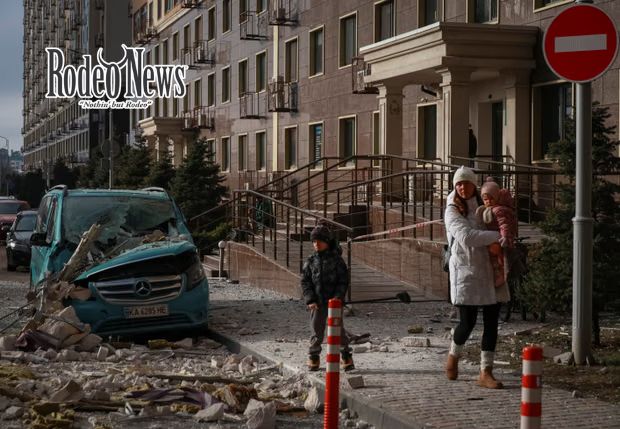
“It used to be quieter here,” she said. “Recently it feels more dangerous. I haven’t decided whether to move, but right now I’m scared.”
Her fear reflects a broader reality. Russian attacks on Odesa have intensified sharply in recent months, signalling a renewed focus on the Black Sea after a long period of relative stalemate.
A city out of reach — but not out of range
Despite repeated threats from the Kremlin, taking Odesa by force or imposing a naval blockade remains beyond Moscow’s capabilities. Early in the war, Ukraine’s naval missile batteries pushed Russian warships away from the north-western Black Sea, most notably with the sinking of the flagship cruiser Moskva.
Unable to approach the city directly, Russia has turned to long-range missiles and Iranian-designed Shahed drones, launched from occupied Crimea and from Russian territory. The result has been near-daily strikes targeting both military and civilian infrastructure.
The most devastating recent attack came on 13 December, when a barrage of 160 drones and missiles struck energy facilities across the region. Large parts of Odesa were left without electricity, heating, and water for days — marking the beginning of an almost continuous campaign.
In his office overlooking the port, Ukrainian navy spokesperson Dmytro Pletenchuk flips through a January calendar, pointing to the near-constant pattern of attacks.
“Shahed. Shahed. Shahed,” he says, marking day after day. “There were only two days this month without an attack.”
By 19 January, Odesa had endured strikes on 16 separate days.
“The Russians believe that because it is cold, we will capitulate,” Pletenchuk said. “They attack energy infrastructure night after night.”
A ‘grey zone’ at sea
The fighting around Odesa reflects a broader shift back toward the Black Sea, now described by Ukrainian officials as a strategic “grey zone”.
“We pushed Russian warships back to Novorossiysk,” Pletenchuk said. “But Russian aviation still controls large parts of the airspace. No one can move freely. Twenty-five thousand square kilometres of sea have effectively become a grey zone.”
Ukraine has used long-range strikes to hit Russian oil tankers and naval facilities, while Moscow has sought to disrupt Ukraine’s economic lifeline: maritime exports.
Nearly 90% of Ukraine’s agricultural produce is shipped by sea through ports in the Odesa region. Targeting port infrastructure, Ukrainian officials say, is aimed not only at military objectives but at strangling the economy.
“The escalation began in autumn, when Russia increased shelling of Ukrainian ports,” Pletenchuk said.
Power cuts and pressure on civilians
Alongside military targets, Russian strikes have repeatedly hit civilian energy infrastructure — a strategy Ukrainian officials describe as an attempt to disconnect the country from the grid.
According to Oleh Kiper, governor of the Odesa region, the city’s geography complicates its defence.
“The sea is both our protection and our weakness,” Kiper said. Unlike Kyiv, which is surrounded by layered air defences, Odesa’s coastal position makes it harder to build defence in depth.
“The worst attack was 13 December,” he said. “At least 60% of the region was left without electricity, no water, no heating. Even now, some areas face outages of up to 10 hours a day.”
Lt Col Denys Nosicov, who oversees territorial defence units in southern Ukraine, said the strikes are designed to erode morale.
“The enemy uses combined attacks — rockets and Shahed drones together,” he said. “This is psychological pressure. Every day there are attacks, and alongside them, Russian psychological operations on social media.”
Moscow’s enduring ambition
Ukrainian leaders believe Odesa remains central to Russia’s long-term war aims.
In a recent statement, Ukraine’s chief of staff Oleksandr Syrski said Moscow had planned to impose its terms “from a position of strength” by seizing key territories and cutting Ukraine off from the sea.
President Volodymyr Zelenskyy echoed that assessment earlier this month.
“They want to cut off Odesa and other cities in terms of infrastructure,” he said. “They are striking not only people, but our economy, reducing our export capabilities.”
Despite the threat, Ukrainian forces continue to prepare for all scenarios. Nosicov said defensive measures around Odesa include anti-tank obstacles, kill zones, and minefields.
“We treat the Russian threat seriously on land, sea, and air,” he said. “Even if an order to take Odesa would likely be Russia’s greatest defeat in this region.”
‘They are freezing civilians’
For residents, the cost of the renewed campaign is measured in cold classrooms, dark apartments, and shattered livelihoods.
At the Lyceum for Construction and Architecture in central Odesa, director Igor Chernenko supervises repairs after three Shahed drones struck the building earlier this month.
With no heating, smoke still lingers in the air as he stands bundled in winter clothing inside his office.
“The strike happened at around 2.40am,” he said. “When I arrived, the building was still burning.”
Two drones punched through the roof, destroying classrooms and obliterating an archive dating back to 1945.
“I don’t know why they hit us,” Chernenko said. “Maybe they don’t want us to train the people who will rebuild Ukraine.”
Outside, snow covers the damaged roof. Nearby buildings bear scars from flying shrapnel.
“Before, attacks were once a week,” he said. “Now it’s every night. Odesa is a pearl by the sea. The Russians still think it belongs to them.”
For now, the war remains one of distance — missiles, drones, and freezing nights — but for civilians in Odesa, the impact is immediate and relentless.