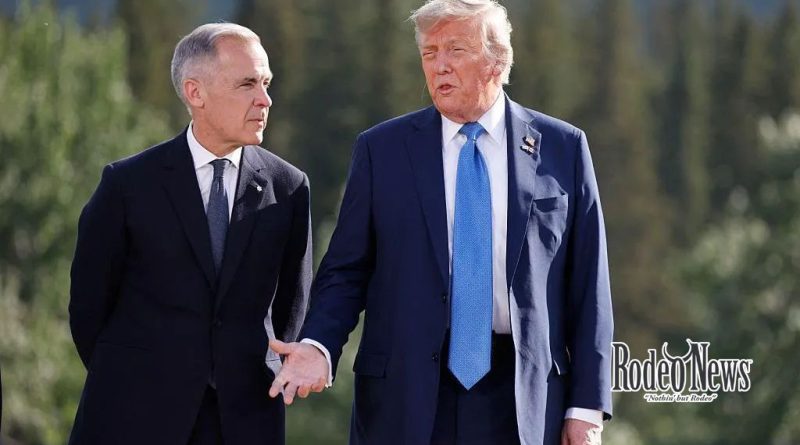
Trump Threatens Canada With 100% Tariffs Over Potential China Trade Deal
US President Donald Trump has escalated trade tensions with Canada, warning that Ottawa would face sweeping 100% tariffs if it moves forward with a trade deal with China. The threat, delivered via Trump’s Truth Social platform on Saturday, marks the latest flashpoint in a rapidly deteriorating relationship between the two longtime allies.
“If Canada makes a deal with China, it will immediately be hit with a 100% Tariff against all Canadian goods and products coming into the U.S.A.,” Trump wrote, without specifying what agreement he was referring to.
The White House has not clarified whether the president was referencing a formal free trade agreement or a narrower set of tariff adjustments announced last week by Canadian Prime Minister Mark Carney. Ottawa, for its part, has pushed back strongly against Trump’s characterization.
Canada’s US trade minister, Dominic LeBlanc, said there is “no pursuit of a free trade deal with China,” describing recent talks instead as a limited effort to resolve long-standing tariff disputes.
“What was achieved was resolution on several important tariff issues,” LeBlanc said in a statement, adding that Canada remains focused on strengthening trade relationships “throughout the world.”
A fragile détente unravels
The warning represents a sharp shift in tone from Trump, who only days earlier appeared to welcome Canada’s renewed engagement with Beijing. After Carney announced a “strategic partnership” with China last week, Trump initially called the development “a good thing.”
That détente quickly unraveled.
Under the agreement reached between Carney and Chinese President Xi Jinping, China agreed to reduce tariffs on Canadian canola oil from 85% to 15% by March. Canada, in return, will lower duties on Chinese electric vehicles to the most-favoured-nation rate of 6.1%, down from the punitive 100% levy imposed during a previous round of trade disputes.
The deal was widely viewed as a breakthrough after years of strained ties between Ottawa and Beijing, which had been locked in tit-for-tat tariffs and diplomatic freezes. It also raised the prospect of renewed Chinese investment in Canada’s agricultural and clean energy sectors.
But Trump’s latest remarks suggest Washington sees the move less as economic pragmatism and more as a strategic threat.
On Saturday, the US president accused Carney of attempting to turn Canada into a backdoor for Chinese exports entering the American market.
“If Carney thinks he is going to make Canada a ‘Drop Off Port’ for China to send goods and products into the United States, he is sorely mistaken,” Trump wrote.
Growing political friction
The tariff threat comes amid broader political friction between Trump and Carney, whose rhetoric has increasingly diverged from Washington’s worldview.
Speaking earlier this week at the World Economic Forum in Davos, Carney warned that the US-led global order had been “ruptured,” calling on other “middle powers” to work together against economic coercion by larger states. While he did not mention Trump directly, the remarks were widely interpreted as a critique of Washington’s increasingly unilateral trade policies.
Trump responded the following day with a blunt rejoinder.
“Canada lives because of the United States,” he said during a speech, underscoring his long-held view that America’s northern neighbor is economically dependent on US markets.
The relationship deteriorated further when Trump withdrew an invitation for Canada to join his newly announced “Board of Peace,” a symbolic diplomatic initiative that the White House has yet to fully explain.
Canada seeks to diversify
For Canada, the dispute highlights a long-running dilemma: how to reduce reliance on its largest trading partner without provoking retaliation.
The United States remains Canada’s dominant export destination, accounting for roughly three-quarters of its foreign trade. Trump’s repeated use of tariffs — often imposed abruptly and then withdrawn — has injected uncertainty into that relationship, prompting Ottawa to seek alternative markets.
Carney has argued that diversifying trade is not only prudent but necessary in a more fragmented global economy.
Canada has been actively expanding ties in Asia and Europe, and officials say engagement with China, while complex, is unavoidable given the scale of the world’s second-largest economy.
“The progress made with China sets Canada up well for the new world order,” Carney said after meeting Xi last week.
High stakes for both sides
Economists warn that a 100% US tariff on Canadian goods would be economically devastating, disrupting deeply integrated supply chains across industries ranging from automotive manufacturing to agriculture and energy.
Such a move would also likely violate existing trade agreements, including the USMCA, potentially triggering legal challenges and retaliation from Ottawa.
For Trump, however, the threat fits a familiar pattern: using tariffs as leverage to shape allies’ foreign and economic policies, particularly where China is involved.
Whether the warning becomes policy remains unclear. The BBC has contacted both the White House and Carney’s office for comment, but neither had responded at the time of publication.
For now, Canada is attempting to strike a careful balance — maintaining access to US markets while asserting greater independence in a rapidly shifting global trade landscape. Trump’s latest salvo suggests that balance may be increasingly difficult to sustain.