Iceland EU Talks Rejected as Voters Choose Independence
Iceland EU talks have suffered a major setback after voters rejected a government proposal to restart negotiations on European Union membership.
In a closely fought referendum, 52.8% of voters opposed reopening accession talks with Brussels, while 47.2% supported the proposal. Turnout reached a high 82.5%, underlining the importance of the vote to Icelanders.
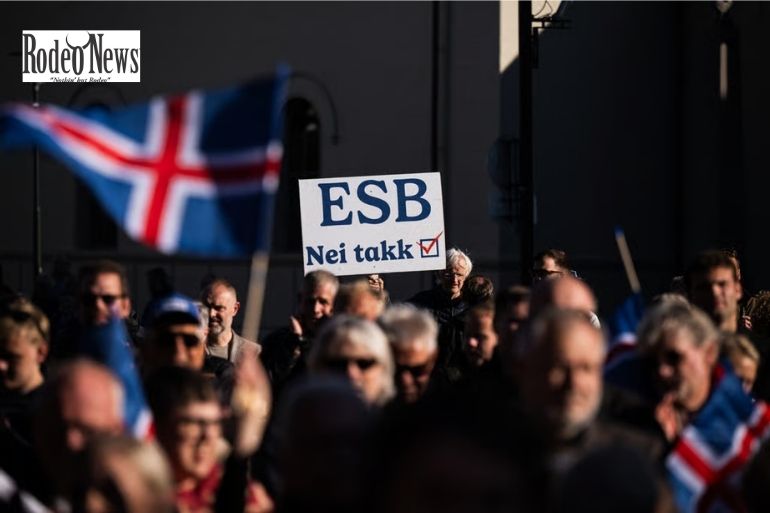
The result does not represent a direct vote on EU membership. Instead, Icelanders were asked whether their government should restart negotiations with the bloc. A successful “yes” would have led to negotiations and potentially another referendum on actual membership.
Instead, the “no” result puts Iceland’s long-running EU debate on hold and represents a significant political setback for Prime Minister Kristrun Frostadottir’s centre-left government.
Iceland EU Talks End With Clear Rejection
The referendum was expected to be extremely close. Opinion polls in the weeks before voting showed support shifting between the two sides.
A Gallup poll published shortly before the vote had put opposition to restarting negotiations at 51.6%, compared with 48.4% supporting the proposal. The final result therefore confirmed the late movement toward the “no” camp.
The geographical divide was also striking.
Only the two constituencies in central Reykjavik recorded majority support for restarting negotiations. Rural areas and Reykjavik’s suburbs largely voted against the proposal.
For opponents, the issue was about more than economic calculations. Fishing, national sovereignty and control over Iceland’s natural resources became central themes during the campaign.
Why Icelanders Rejected EU Membership Talks
Iceland has a complicated relationship with the European Union.
The country is already deeply integrated with Europe through the European Economic Area and the Schengen Area. That means Iceland has access to the EU single market and participates in European free movement arrangements without being a member of the bloc.
For many voters, that existing relationship reduces the urgency of full EU membership.
The country’s fishing industry was an even more important concern.
Fishing has long been closely linked to Iceland’s economy, national identity and independence. Reuters reported that the industry contributes around 15% of Iceland’s GDP through direct and indirect activity and accounts for approximately 40% of export revenue.
Opponents of EU accession feared that membership could eventually weaken Iceland’s control over its fishing waters.
The concern is rooted partly in history. Iceland fought several confrontations with Britain during the so-called Cod Wars in the 20th century as it expanded its exclusive fishing zones.
Those disputes helped cement the idea that control of Icelandic waters is an essential part of national sovereignty.
That history remains powerful today.
Fishing Becomes the Defining Issue
Under EU membership, Iceland would have to operate within the bloc’s Common Fisheries Policy.
Supporters of negotiations argued that Iceland would still have significant leverage because of the country’s existing fishing practices and the fact that other EU countries have not traditionally fished extensively in Icelandic waters.
However, opponents remained skeptical.
They argued that promises of special arrangements or flexibility could change over time once Iceland became a full member.
This fear proved difficult for the pro-EU campaign to overcome.
For many voters, the question was not simply whether EU membership could produce economic benefits. It was whether those benefits were worth potentially giving up a degree of national control.
That distinction became one of the most important factors behind the referendum result.
Cost of Living Put EU Membership Back on the Agenda
Economic pressures helped revive the debate over Iceland EU talks after years of relative political quiet.
Iceland previously applied to join the European Union in 2009, following the country’s devastating financial crisis. Negotiations continued for several years before a Eurosceptic government halted the process in 2013.
More than a decade later, inflation and high interest rates again made the EU question politically relevant.
Iceland’s central bank interest rate was around 8% during the referendum campaign, significantly above the European Central Bank’s 2.25% rate cited by Reuters. Supporters argued that closer European integration and eventually adopting the euro could help reduce economic volatility and borrowing costs.
However, critics rejected the idea that joining the EU would automatically solve Iceland’s economic problems.
They argued that high prices, inflation and structural weaknesses were domestic challenges that Icelandic politicians should address themselves.
That argument resonated with voters who believed economic independence remained more valuable than the potential advantages of EU membership.
Security Was Another Major Factor
The referendum also took place against a dramatically changed geopolitical background.
Iceland is a NATO member but does not maintain a standing army. Its location in the North Atlantic gives it considerable strategic importance.
The island sits near the Greenland-Iceland-United Kingdom gap, commonly known as the GIUK gap, an important North Atlantic maritime area.
Supporters of EU accession argued that Iceland could strengthen its economic and geopolitical position by becoming more closely integrated with Europe.
The argument became particularly relevant as tensions in the Arctic increased and uncertainty surrounding transatlantic security grew.
The war in Ukraine, competition in the Arctic and concerns about the future of NATO all contributed to renewed interest in Iceland’s relationship with Europe.
Yet security arguments ultimately failed to outweigh concerns about sovereignty and fishing.
What the Referendum Means for Iceland
The immediate consequence is straightforward: the government will not restart EU accession negotiations.
Prime Minister Kristrun Frostadottir had described the referendum as a critical moment and indicated that a “no” vote would effectively end the issue for the duration of the current coalition government’s time in office.
That means Iceland is likely to remain outside the European Union while continuing its existing economic relationship with the bloc.
For Icelandic voters, this represents a decision to preserve the country’s current model rather than take the potentially transformative step toward full EU membership.
However, the referendum does not necessarily end the debate forever.
Economic conditions, geopolitical developments and future governments could eventually bring the issue back into national politics.
A Setback for Brussels and EU Enlargement
The result is also significant for the European Union.
EU officials had hoped that Iceland could provide a positive example for enlargement at a time when the bloc is dealing with complex accession processes involving countries in Eastern Europe and the Western Balkans.
Iceland would have been a relatively unusual candidate.
The country is wealthy, democratic, already closely integrated with the European single market and a member of NATO. Compared with some other potential EU entrants, it would likely require fewer institutional and economic reforms.
Reuters previously reported that EU officials viewed an Icelandic accession process as potentially useful for strengthening the bloc’s position in the Arctic.
The referendum result therefore represents more than a domestic Icelandic political defeat.
It shows that close economic integration with Europe does not automatically translate into support for political integration.
Iceland Chooses Cooperation Without Membership
The most important message from the vote may be that Icelanders are not rejecting Europe itself.
Iceland remains economically and politically connected to European countries.
The country participates in the European Economic Area, giving it access to the EU single market, while Schengen allows it to participate in Europe’s passport-free travel system.
What voters rejected was the next step: opening negotiations that could eventually lead to full EU membership.
That distinction matters.
The debate was ultimately about how much political authority Iceland should share with Brussels and whether the potential economic and strategic benefits justified that transfer of power.
The referendum answer was clear, although not overwhelming.
What Happens Next?
For now, the Iceland EU talks process is effectively frozen.
There will be no immediate return to accession negotiations, and Iceland will continue operating outside the European Union while maintaining its existing arrangements with the bloc.
The narrow 52.8% result also shows that the issue remains politically divisive.
Almost half of participating voters supported reopening negotiations. Reykjavik’s stronger support demonstrates that attitudes toward Europe differ significantly between urban and rural communities.
That means the EU question may not disappear permanently from Icelandic politics.
For the moment, however, Iceland has chosen independence over another attempt at membership.
The decision reinforces a long-standing feature of Iceland’s relationship with Europe: the country wants close economic and diplomatic ties with its European neighbors, but many voters remain unwilling to surrender control over issues they consider fundamental to national sovereignty.
For Brussels, meanwhile, the referendum is a reminder that EU enlargement cannot be assumed even where economic and political integration is already deep.
Iceland’s decision is therefore both a domestic victory for Eurosceptic forces and a broader statement about the limits of European integration.
Final Takeaway
Iceland’s rejection of restarting EU membership negotiations closes another chapter in a debate that has lasted for more than a decade.
With 52.8% voting against the proposal and 47.2% supporting it, the result was close but decisive.
Fishing, sovereignty, economic independence and concerns about EU decision-making proved more persuasive than arguments over lower interest rates, greater European influence and Arctic security.
For now, Iceland will remain outside the European Union.
But the narrow margin suggests the question is unlikely to vanish forever. If economic pressures or geopolitical realities change significantly, a future Icelandic government could once again ask whether closer integration with Europe is worth the price.
For the present, however, the answer from Iceland’s voters is unmistakable: not yet.
Suggested External Sources
Reuters — Iceland rejects EU-accession talks in close-fought referendum. Reuters report
Reuters — Explainer: What you need to know about Iceland’s EU referendum. Reuters explainer
Reuters — Fish, ships and sovereignty: Iceland weighs its European future. Reuters analysis
Image ALT Text
Iceland EU talks referendum as voters reject restarting European Union membership negotiations
Internal Link Suggestions
Because no target website/domain was supplied, internal URLs cannot be safely generated without inventing links. Recommended internal-link anchors:
- Iceland politics and latest news
- Iceland economy and cost of living
- European Union enlargement
- Arctic security and geopolitics
- Iceland fishing industry