Bob Vylan Defends Controversial Glastonbury Chant: “I’d Do It Again”
In an exclusive interview with Louis Theroux, Bob Vylan frontman Bobby Vylan addresses the fallout from his Glastonbury chant, calling the backlash “disproportionate” and defending his actions as a form of free speech.
In his first public interview since the infamous incident, Bobby Vylan, the frontman of punk duo Bob Vylan, opened up about the controversial moment that ignited a global backlash during the 2023 Glastonbury Festival. Vylan, known for his politically charged music, led the crowd in a chant of “death, death, death to the IDF” during his band’s performance. The statement, which was directed at the Israeli Defense Forces (IDF), quickly became the focal point of heated debates over freedom of expression, race, and politics within the music scene.
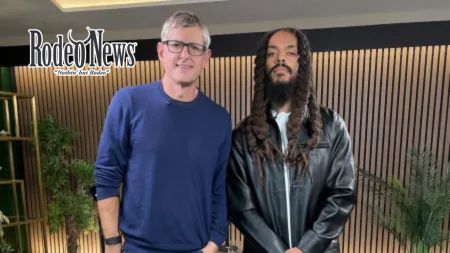
While the chant led to a series of consequences for the band—ranging from public condemnation to the cancellation of their U.S. tour—Vylan told Theroux that he had no regrets. In fact, he would repeat the performance “tomorrow, twice on Sundays.”
“If I was to go on Glastonbury again tomorrow, yes, I would do it again,” he said. “I’m not regretful of it. What is there to regret? Oh, because I’ve upset some right-wing politician or some right-wing media? The subsequent backlash I’ve faced is minimal. It’s minimal compared to what people in Palestine are going through.”
Vylan’s comments emphasize his view that the larger issue—the ongoing conflict in Gaza—is far more pressing than the chant itself. The political statement was part of a broader trend of musicians and activists publicly criticizing Israel’s actions in Gaza. Vylan’s stance, however, sparked a firestorm of controversy, which ultimately overshadowed the plight of the Palestinian people.
A Backlash Like No Other
The backlash to Bob Vylan’s actions was swift and severe. Glastonbury issued a statement condemning the chant, and the band was dropped by its agency, UTA, the day after the performance. The U.S. State Department also revoked the band’s visas, forcing them to cancel their planned North American tour. Additionally, the BBC—who broadcasted the performance live—admitted to breaching its own editorial guidelines, although it stopped short of deeming the broadcast as incitement.
Despite the professional fallout, Vylan remains resolute in his defense. He argues that the uproar was disproportionate and distracting from the real issue—the suffering of Palestinians. “My whole issue with this thing is that the chant is so unimportant,” he explained. “What is important is the conditions that exist to allow that chant to even take place on that stage. Where the Palestinian people are being killed at an alarming rate. Who cares about the chant?”
The controversy also highlighted the racial dynamics at play. Vylan suggested that his band’s race played a significant role in how they were treated, noting that they were seen as an “easier villain” for the British public. “As with everything, race comes into play,” he said. “We are an easier villain, no pun intended, than they are because we are already the enemy.”
The Music Industry’s Divided Response
The reaction within the music industry was mixed. Some musicians, including Blur’s Damon Albarn, were sharply critical of the performance. Albarn described the incident as “one of the most spectacular misfires I’ve seen in my life,” while also drawing a controversial comparison between Vylan’s on-stage movements and Nazi imagery, calling it “goose-stepping.”
Vylan did not hold back in his response, calling Albarn’s remarks “disgusting” and questioning the use of such inflammatory language. “It’s only used around Nazi Germany… I think his response was disgusting,” Vylan said.
On the other hand, Vylan found support from Public Enemy’s Chuck D, who defended the band’s message. Chuck D argued that the chant was a call against “imperialism” and “colonialism,” not against an entire people. “You can’t really kill anybody with a guitar or a microphone,” Chuck D said, emphasizing the power of words over violence.
For Vylan, Chuck D’s understanding was not just a matter of alignment, but of empathy. “Naturally, of course, Chuck D from Public Enemy is going to understand where we are coming from with our politics,” Vylan said, contrasting Chuck D’s nuanced take with Albarn’s criticism.
Politics, Free Speech, and the Role of Race
The controversy surrounding Bob Vylan’s Glastonbury performance also raised broader questions about politics, race, and free speech in the music industry. Vylan’s stance echoes a deeper debate about the role of musicians as political figures and the extent to which they should be allowed to express their views without facing professional and personal repercussions.
In his interview with Louis Theroux, Vylan made it clear that his views on Palestinian liberation are deeply personal, and he stands by his right to express them. “It’s important for people to speak up, especially in a world where silence often feels like complicity,” he said. “I believe in free speech. If you believe in freedom, you have to believe in my right to say what I said.”
As the conversation continues to unfold, the questions surrounding free speech, race, and political expression in music remain as contentious as ever. Bob Vylan’s actions, and the fallout from his Glastonbury performance, have sparked a larger discussion about the boundaries of protest and the responsibility of artists to navigate the increasingly polarized political landscape.
For now, Vylan remains steadfast. “I stand by everything I said and did that day,” he affirmed. “If I had to do it again, I would. It’s part of my commitment to what I believe in.”