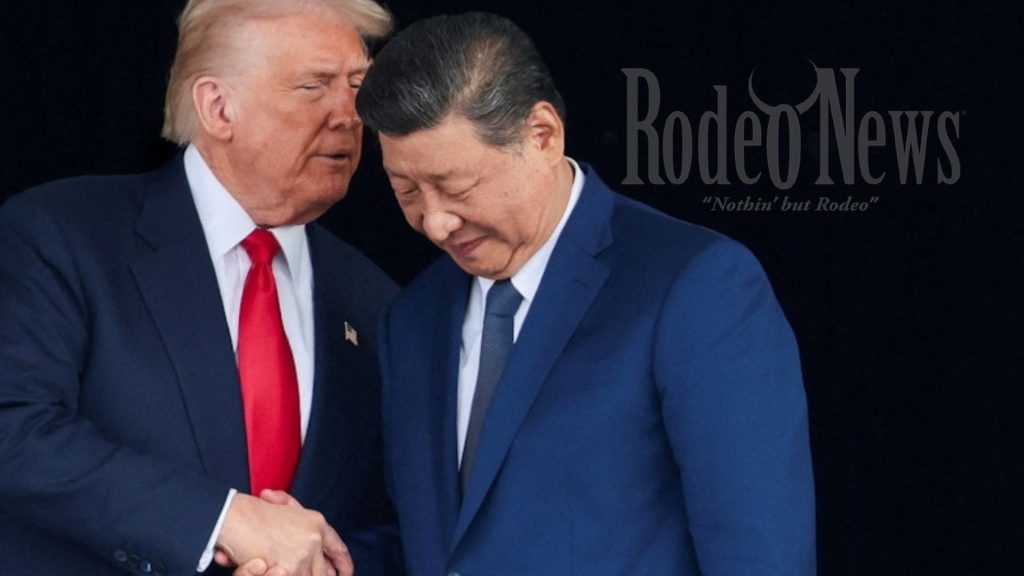
On October 30, 2025, U.S. President Donald Trump and Chinese President Xi Jinping met at Gimhae International Airport in the South Korean city of Busan, on the sidelines of the APEC South Korea 2025 summit. The two leaders’ first face-to-face meeting since Trump’s return to office set the stage for what was portrayed as a significant step toward easing tensions between the world’s two largest economies. Reuters+2Reuters+2
Key Announcements and Framework
- Trump announced that tariffs on many Chinese imports would be cut to 47 % from 57 %. Reuters
- A special tariff rate related to trade in fentanyl-precursor drugs would be halved to 10 %. Reuters
- China agreed to resume purchases of U.S. soybeans and to lift or pause export curbs on rare earth materials for one year. Reuters
- The meeting was described by Trump as “amazing” and rated by him as “12 out of 10.” Reuters
Strategic Implications
The framework reflects more of a tactical truce than a full strategic reset of U.S.–China economic relations. According to analysts:
- It essentially returns relations to a status similar to that before major escalations earlier in 2025 rather than resolving deeper structural issues such as China’s industrial policy, high-tech manufacturing ambitions or export controls
- Key issues left unaddressed include broader tariffs covering the roughly $580 billion bilateral trade, advanced technology export controls (notably chips), probes into U.S. firms operating in China, and the Taiwan/China issue. Reuters
- Both sides signalled follow-up visits: Trump said he will visit China in April, and Xi is expected to visit the U.S. thereafter. ABC
Why This Matters
- For U.S. farmers and agribusiness, China’s renewed interest in buying U.S. soybeans is a meaningful concession.
- For industries dependent on rare-earth supplies — including electronics, defense and renewable energy — the pause in export curbs provides breathing room.
- For markets and global supply chains, it offers a momentary easing of geopolitical risk, though the underlying tensions remain deep. Reuters
What Comes Next
- The framework needs to be translated into binding agreements, and enforcement will be key.
- Both countries must work through the bigger structural disagreements: technology transfers, market access, export controls, and strategic competition.
- Companies and investors will watch closely for signs of implementation — and whether this détente will hold or give way to renewed friction.
Conclusion
The Busan meeting between Trump and Xi delivered headline-grabbing announcements — tariff cuts, rare-earth export relief, and soy purchases — signalling a step toward reducing trade war tensions. Yet beneath the positive optics lies a more tentative arrangement: a pause, not a resolution. The real test will come in follow-up talks, concrete commitments and whether both sides address the tougher issues that have long driven U.S.–China economic rivalry.
If you like, I can adapt this article into multiple formats (e.g., a shorter news brief, a blog post for social media, or a timed follow-up piece) and generate related pieces such as “What this means for U.S. farmers” or “Rare earths: China’s leverage and the global supply chain”. Would you like me to proceed?