BepiColombo Mercury Mission: 8-Year Journey Revealed
The BepiColombo Mercury mission has reached one of the most important stages of its extraordinary journey. After spending nearly eight years traveling through the inner solar system, the European and Japanese spacecraft are finally beginning the complex sequence that will place two scientific orbiters around Mercury.
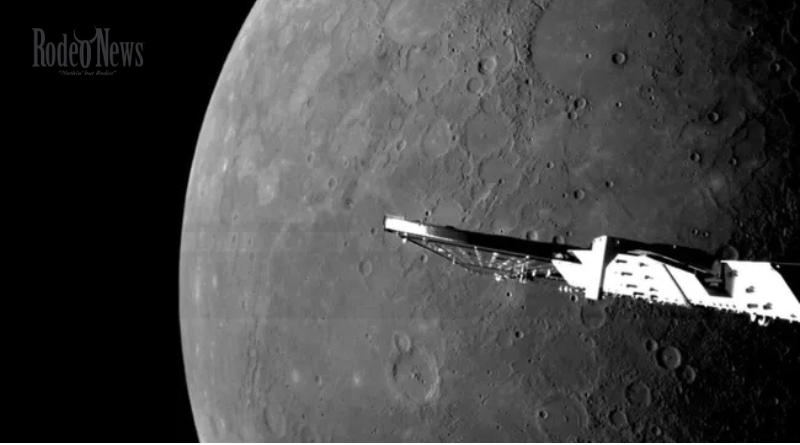
The mission, a joint project between the European Space Agency (ESA) and Japan Aerospace Exploration Agency (JAXA), launched on Oct. 20, 2018. Its journey has required a carefully designed series of planetary flybys and powerful propulsion systems because reaching Mercury is considerably harder than simply flying toward the planet.
On Sept. 3, 2026, the mission entered its arrival phase when the Mercury Transfer Module separated from the spacecraft carrying ESA’s Mercury Planetary Orbiter, or MPO, and JAXA’s Mercury Magnetospheric Orbiter, known as Mio. That separation marks the beginning of the final sequence leading to Mercury orbit insertion in November.
The payoff could be enormous. Mercury remains one of the least-explored planets in the inner solar system, and scientists still have fundamental questions about how it formed, why it has such a disproportionately large metallic core and how its unusual magnetic environment works.
Why the BepiColombo Mercury mission matters
Mercury is the smallest planet in the solar system and the closest planet to the Sun. It is also an exceptionally difficult world to explore.
The planet’s proximity to the Sun creates an extreme thermal environment, while the Sun’s powerful gravitational pull makes it difficult for spacecraft approaching from Earth to slow down enough to enter Mercury orbit.
That is why BepiColombo did not simply point toward Mercury and fly there.
Instead, the spacecraft followed an elaborate trajectory involving nine planetary flybys: one of Earth, two of Venus and six of Mercury. These encounters helped gradually reshape the spacecraft’s orbit and reduce its energy relative to Mercury.
The journey has therefore taken about eight years despite Mercury being relatively close to Earth on a cosmic scale.
That lengthy route is one of the defining characteristics of the BepiColombo Mercury mission.
Two spacecraft with different jobs
One of the mission’s most important features is that BepiColombo will eventually operate as two separate scientific spacecraft.
The first is ESA’s Mercury Planetary Orbiter, or MPO. It is designed primarily to study Mercury itself, including its surface, interior, composition and magnetic environment.
The second is JAXA’s Mercury Magnetospheric Orbiter, Mio. Its primary focus is Mercury’s surrounding environment, including the planet’s magnetosphere, plasma and extremely thin atmosphere.
Working together, the two orbiters should give scientists a much broader picture of Mercury than a single spacecraft could provide.
That is particularly important when studying the planet’s magnetic field. Two spacecraft observing the environment from different positions can help researchers understand how Mercury’s magnetic system changes through space and time.
What happened after eight years in space?
For most of its journey, BepiColombo was effectively a single spacecraft stack.
The Mercury Transfer Module provided the propulsion needed to travel through the solar system. The two scientific orbiters remained attached during the cruise, allowing the mission to conserve mass and use the transfer system to reach Mercury.
But that configuration was never intended to last forever.
The major transition began Sept. 3, when the Mercury Transfer Module separated from the scientific spacecraft. ESA said the separation marked the beginning of the Mercury arrival phase.
The next major milestone is Mercury orbit insertion, currently scheduled for Nov. 21, 2026.
The spacecraft will initially enter Mercury orbit with MPO and Mio still together. In December, the two spacecraft will separate and move into their respective operational configurations.
According to ESA’s current timeline, Mio is scheduled for deployment on Dec. 9–10. MPO will then continue maneuvering toward its dedicated science orbit, with routine scientific operations expected to begin in April 2027.
BepiColombo will investigate Mercury’s mysterious surface
Mercury may look like a heavily cratered, relatively simple rocky world, but previous missions have shown that its geology is surprisingly complicated.
NASA’s Mariner 10 became the first spacecraft to visit Mercury in the 1970s. Decades later, NASA’s MESSENGER spacecraft entered orbit in 2011 and transformed scientists’ understanding of the planet.
MESSENGER mapped Mercury’s surface and discovered unusual geological features called “hollows.” It also found evidence that volatile elements are much more abundant on Mercury than scientists had expected.
BepiColombo is designed to investigate those discoveries in greater detail.
ESA’s MPO carries 11 scientific instruments. They will examine Mercury’s terrain, minerals, gravity field, surface composition and interactions with particles from the Sun.
Among its instruments are cameras and spectrometers capable of studying the chemical and mineralogical composition of the surface.
This could help answer a fundamental question: How did Mercury form?
Mercury’s enormous core remains a major mystery
Mercury is unusual because it has an exceptionally large metallic core relative to the planet’s overall size.
Scientists know the core is large, but exactly why Mercury developed this unusual structure remains uncertain.
The planet’s composition could provide clues about conditions in the early solar system. Understanding Mercury may therefore tell researchers more than just the history of one small planet.
It could provide evidence about the processes that shaped the terrestrial planets, including Earth.
BepiColombo’s instruments are designed to measure Mercury’s surface composition and internal structure in ways that earlier missions could not.
Researchers hope these measurements will help distinguish between competing ideas about Mercury’s formation.
The southern hemisphere could reveal new secrets
One limitation of MESSENGER’s mission was that its observations did not provide equally detailed coverage of every part of Mercury.
BepiColombo is expected to improve the picture, particularly over regions that have remained comparatively poorly observed.
Scientists are especially interested in Mercury’s polar areas.
Because the planet has very little axial tilt, some deep polar craters can remain permanently shadowed. These regions are extremely cold despite Mercury being the closest planet to the Sun.
MESSENGER found evidence for water ice in permanently shadowed polar craters, a discovery that challenged simple assumptions about Mercury’s environment.
BepiColombo’s observations could provide a much more detailed understanding of these deposits and the conditions that allow them to survive.
Mio will study Mercury’s space environment
While MPO concentrates heavily on the planet itself, Mio has a different mission.
JAXA’s orbiter will study Mercury’s magnetosphere and the interaction between the planet and the solar wind.
The solar wind is a continuous stream of charged particles flowing outward from the Sun. When those particles encounter Mercury’s magnetic field, they create a dynamic environment that can change rapidly.
Mio carries instruments designed to measure magnetic fields, plasma waves, particles, Mercury’s thin atmosphere and dust.
These observations could help scientists understand how Mercury’s magnetic field works and how the planet responds to the powerful solar environment so close to the Sun.
The mission has already faced major challenges
BepiColombo’s eight-year journey has not been completely straightforward.
The spacecraft experienced a propulsion problem that prevented its solar-electric propulsion system from operating at its planned full power. Engineers developed a revised trajectory to keep the mission on course.
In June 2026, ESA announced that BepiColombo had completed its final solar-electric propulsion thrust arc. The mission subsequently transitioned toward its arrival sequence, relying on other propulsion systems for the critical maneuvers ahead.
That engineering work illustrates why Mercury missions are so demanding.
A spacecraft traveling toward the innermost planet must deal with intense solar radiation, difficult orbital dynamics and the challenge of slowing down sufficiently to be captured by Mercury’s relatively weak gravity.
The fact that BepiColombo has reached its arrival phase after these difficulties is itself a significant engineering achievement.
A rare opportunity to study Mercury with two orbiters
The BepiColombo Mercury mission is especially valuable because it will allow Europe and Japan to operate dedicated spacecraft around Mercury at the same time.
ESA describes BepiColombo as the first mission to orbit Mercury with two spacecraft. It will also be only the second mission to enter orbit around the planet, following NASA’s MESSENGER.
The two-orbiter approach offers scientists something previous Mercury missions could not easily provide: simultaneous observations from different locations.
That matters when studying a constantly changing magnetic and plasma environment.
Instead of looking at Mercury’s space environment from one point, scientists can compare measurements from separate spacecraft and build a more complete three-dimensional picture.
BepiColombo timeline: What happens next?
The mission’s arrival will unfold gradually rather than in a single dramatic event.
According to ESA’s current schedule:
- Sept. 3, 2026: Mercury Transfer Module separates.
- Nov. 21, 2026: MPO and Mio are expected to enter Mercury orbit.
- Dec. 9–10, 2026: Mio separates into its dedicated orbit.
- Dec. 16, 2026: MPO releases Mio’s protective sunshield and continues its orbital maneuvering.
- March 10, 2027: MPO is expected to reach its final orbit.
- April 2027: The main science phase is scheduled to begin.
These dates can change if mission controllers need to adjust operations.
The arrival process is deliberately cautious because the spacecraft will be performing a series of complex maneuvers millions of miles from Earth.
Why Mercury deserves more attention
Mars often dominates public attention because of its potential connection to future human exploration. Venus receives interest because of its extreme atmosphere and possible lessons about Earth’s climate.
Mercury, by comparison, can seem overlooked.
But the tiny planet may hold important clues about how rocky worlds are built.
Its enormous core, unusual surface chemistry, magnetic field, extreme temperatures and permanently shadowed regions make it one of the solar system’s most fascinating laboratories.
The BepiColombo Mercury mission could therefore change how scientists understand not only Mercury but also the broader history of the inner solar system.
As the spacecraft moves into its final approach, the long wait is finally coming to an end.
After eight years of travel, BepiColombo is no longer simply heading toward Mercury.
It is preparing to become a two-spacecraft scientific observatory around one of the solar system’s most mysterious worlds.
And the most important discoveries may only begin once the two orbiters start collecting their full scientific data in 2027.