Xi Jinping Egypt Visit Signals a Major China Push Before Trump Summit
The Xi Jinping Egypt visit is emerging as one of the most closely watched diplomatic moves in China’s latest international push, with the Chinese president seeking to strengthen ties across the Middle East ahead of a planned meeting with U.S. President Donald Trump.
Xi arrived in Cairo this week for his first visit to Egypt in about a decade. His trip comes during a broader burst of overseas diplomacy that includes meetings in Central Asia and an expected appearance at the BRICS summit in India.
The timing is significant.
China and the United States remain strategic competitors, while the Middle East is experiencing major geopolitical disruption. Against that backdrop, Beijing is presenting itself as a partner focused on economic cooperation, regional stability and multilateral diplomacy.
The visit also highlights Egypt’s growing importance to China’s strategy.
Egypt controls the Suez Canal, one of the world’s most important trade routes. It also provides Beijing with access to a major Arab market and a gateway toward Africa.
Xi Jinping Egypt Visit Comes at a Critical Moment
Xi’s arrival in Cairo follows his participation in a Shanghai Cooperation Organisation gathering in Kyrgyzstan.
The diplomatic schedule is unusually busy for the Chinese leader. The Financial Times described the current period as one of Xi’s most extensive periods of overseas travel in years, coming as Beijing prepares for further high-level engagement with Washington.
The Egyptian leg is particularly important because Cairo has traditionally maintained a close relationship with Washington while simultaneously deepening its ties with Beijing.
That gives Egypt a valuable position between two competing global powers.
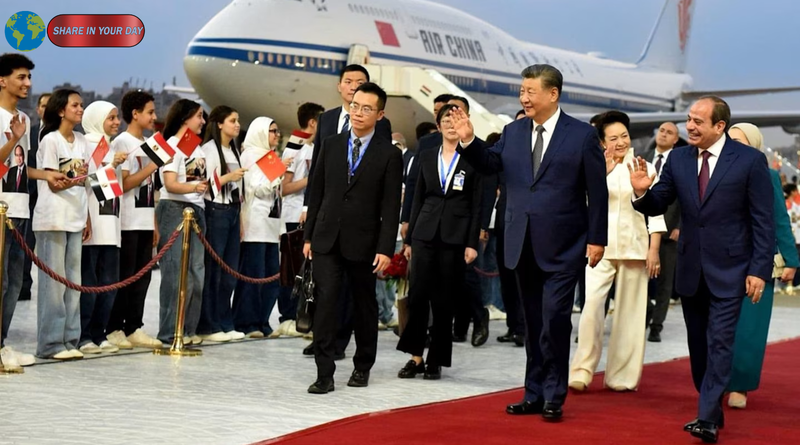
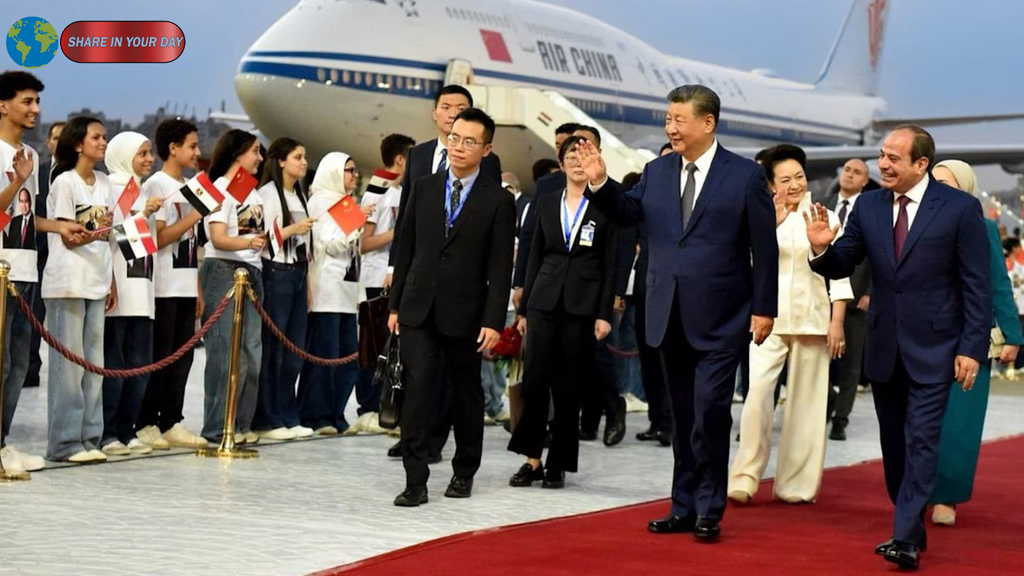
During his visit, Xi met Egyptian President Abdel Fattah el-Sisi. Egyptian officials welcomed the Chinese leader with a formal ceremony at Cairo International Airport.
Xi’s trip is expected to focus on economic cooperation, technology, infrastructure and regional diplomacy.
Xi Jinping Egypt Visit Strengthens Beijing-Cairo Relations
China and Egypt have developed increasingly close economic ties over the past decade.
Beijing has invested heavily in infrastructure projects in Egypt, including developments connected to the country’s new administrative capital and the Suez Canal Economic Zone.
The relationship is part of China’s broader Belt and Road strategy, which seeks to expand trade, infrastructure and investment connections across Asia, Africa, Europe and the Middle East.
For Egypt, Chinese investment offers another source of capital at a time when the country’s economy faces significant pressures.
For China, Egypt offers something equally valuable: strategic geography.
The Suez Canal provides a direct maritime connection between the Mediterranean and Red Sea. It is a critical route for trade between Asia and Europe.
That makes Egypt more than simply another diplomatic partner.
It is a strategic logistics hub.
China Wants a Bigger Role in the Middle East
The Xi Jinping Egypt visit also reflects China’s broader attempt to expand its influence across the Middle East.
For decades, the United States has maintained a dominant military and diplomatic role in the region.
China has traditionally relied more heavily on trade, investment and energy relationships.
That approach has increasingly changed.
Beijing has become more active diplomatically, including its role in helping Saudi Arabia and Iran restore diplomatic relations in 2023.
China is now attempting to portray itself as a country capable of working with competing regional powers without becoming directly involved in military conflicts.
That message could become particularly attractive as Middle Eastern governments reassess their relationships with Washington.
The current conflict involving the United States and Iran has further complicated the regional security environment. AP reported that Beijing is seeking to portray China as a stabilizing force while expanding relationships with important Middle Eastern countries.
Egypt Is Valuable Because of the Suez Canal
One of the biggest strategic reasons for China’s interest in Egypt is the Suez Canal.
The waterway is vital to international commerce because it allows ships traveling between Asia and Europe to avoid the much longer route around Africa.
For China, which depends heavily on international trade, maintaining stable commercial routes is a major economic priority.
Recent disruptions in the Middle East have demonstrated how quickly geopolitical conflicts can affect shipping and energy markets.
The Suez Canal therefore has importance far beyond Egypt itself.
Beijing’s growing relationship with Cairo can help strengthen China’s economic and diplomatic position around a crucial global trade corridor.
The relationship also fits China’s broader strategy of building partnerships across the Global South.
Technology Is Becoming a Major Part of China-Egypt Cooperation
Economic ties between China and Egypt are no longer limited to roads, factories and construction projects.
Technology is becoming increasingly important.
The Financial Times reported that cooperation discussed during Xi’s visit includes technology projects involving Huawei and artificial intelligence-related cloud services.
That development is significant because China and the United States are competing aggressively over artificial intelligence, semiconductors, cloud computing and other strategic technologies.
For Egypt, Chinese technology can provide access to infrastructure and services at potentially competitive costs.
For Beijing, technology exports can help expand China’s influence and create long-term commercial relationships.
But these partnerships can also attract scrutiny in Washington.
The United States has increasingly treated advanced technology as a national-security issue. China’s expansion into digital infrastructure in strategically important countries could therefore become another area of competition between Beijing and Washington.
Xi Is Building Relationships Ahead of Trump Talks
The timing of the Xi Jinping Egypt visit is particularly notable because Xi is expected to meet Trump later this year.
The two leaders have already held high-level discussions in 2026, but major disagreements remain.
Trade, technology, Taiwan, strategic competition and global security are all potential sources of tension.
Reuters reported in May that a Trump-Xi meeting had reduced some tensions but did not produce a major breakthrough, leaving the next encounter especially important.
Xi’s diplomatic activity before another meeting with Trump can therefore be interpreted as more than routine foreign travel.
Beijing wants to demonstrate that China has strong relationships around the world and that it can operate independently of Washington.
The message is straightforward: China has alternatives.
That does not necessarily mean Xi wants confrontation with Trump.
In fact, Beijing has strong economic reasons to stabilize relations with the United States.
But China also wants to negotiate from a position of strength.
BRICS Adds Another Layer to Xi’s Strategy
Xi’s expected participation in BRICS diplomacy adds another dimension to his international strategy.
BRICS has become an important platform for emerging economies seeking greater influence in global institutions.
China has used the group to promote a more multipolar international system.
That approach challenges the traditional dominance of Western institutions without necessarily requiring countries to formally align themselves against the United States.
Egypt’s membership in BRICS makes its relationship with China even more strategically useful.
The two countries can cooperate not only bilaterally but also through wider international groupings.
This creates additional channels for Beijing to promote its preferred vision of global governance.
China and Egypt Are Also Deepening Security Ties
Economic cooperation is only one part of the relationship.
China and Egypt have also increased military contacts.
In August, the two countries conducted air exercises involving Chinese J-16 fighter jets and Egypt’s French-made Rafale aircraft, according to AP reporting. It was the first time China’s J-16 fighters participated in such an exercise with Egypt.
The development is noteworthy because Egypt has historically purchased military equipment from a range of countries, including the United States, France and Russia.
Closer military cooperation with China demonstrates Cairo’s willingness to diversify its strategic partnerships.
For Beijing, military exercises provide opportunities to develop relationships with foreign armed forces and demonstrate China’s expanding defense capabilities.
However, the exercises do not necessarily indicate that Egypt is abandoning its long-standing security relationship with Washington.
Instead, Cairo appears to be pursuing a more flexible foreign policy.
Washington Faces a More Competitive Middle East
The Xi Jinping Egypt visit presents another challenge for U.S. influence in the Middle East.
Washington still maintains significant military, diplomatic and economic relationships throughout the region.
Egypt remains a major U.S. partner.
But China’s approach is different.
Beijing does not need to replace America’s military presence to gain influence.
Instead, China can expand through trade, infrastructure, technology, energy relationships and diplomatic engagement.
That strategy can be attractive to governments seeking economic opportunities without choosing sides in the U.S.-China rivalry.
The result is a more complicated geopolitical environment.
Middle Eastern governments increasingly have the ability to cooperate with Washington and Beijing simultaneously.
The Iran War Has Increased Egypt’s Strategic Importance
Regional instability has also increased the significance of Egypt.
The ongoing conflict involving the United States and Iran has disrupted energy markets and created new risks for international shipping.
The Strait of Hormuz is especially important because of its role in global energy flows.
When shipping routes become vulnerable, alternative trade corridors become more strategically valuable.
That puts additional attention on the Suez Canal.
China has strong economic interests in maintaining reliable commercial access between Asia and Europe.
Egypt, meanwhile, has an interest in maintaining the canal’s role as one of the world’s most important shipping routes.
The two countries therefore share an obvious economic incentive to promote regional stability.
Xi’s Message: China Wants to Be Seen as a Stabilizer
During his meetings in Egypt, Xi emphasized themes of cooperation, development and opposition to unilateralism.
That message fits China’s broader diplomatic narrative.
Beijing wants developing countries to view China as a partner that respects national sovereignty and offers economic opportunities without demanding political alignment.
The United States, by contrast, remains associated in many parts of the Middle East with military intervention and security alliances.
China is attempting to use that contrast to strengthen its appeal.
Whether that strategy succeeds remains uncertain.
Some countries welcome Chinese investment but remain cautious about becoming too dependent on Beijing.
Others value their long-standing relationship with Washington.
Egypt is attempting to balance those interests.
What the Xi Jinping Egypt Visit Means for Global Politics
The biggest significance of the Xi Jinping Egypt visit may be what it says about the changing international system.
The world is moving toward a more competitive and fragmented geopolitical environment.
China is expanding its diplomatic reach.
The United States remains the world’s leading military power.
Russia continues to seek influence.
Middle Eastern and Global South countries are increasingly pursuing policies designed to maximize their own strategic choices.
Egypt is an important example of that trend.
Cairo can maintain security cooperation with Washington while expanding economic and technological cooperation with Beijing.
It can participate in BRICS while maintaining relationships with Western institutions.
It can deepen trade with China without formally choosing Beijing over the United States.
That flexibility is becoming increasingly common.
A Strategic Signal Before the Next Trump-Xi Meeting
Xi’s trip to Egypt should therefore be viewed in the context of the larger relationship between China and the United States.
The Chinese president is traveling more extensively, strengthening relationships with developing economies and promoting China’s role in global diplomacy.
At the same time, Washington is attempting to maintain its influence and negotiate with Beijing from a position of strength.
The next Trump-Xi meeting could address trade, technology, security and broader geopolitical competition.
Xi’s recent diplomacy gives him an opportunity to arrive at those talks with another message: China has a growing network of international partnerships.
Egypt is an important part of that network.
Conclusion: Xi Jinping Egypt Visit Could Reshape Regional Influence
The Xi Jinping Egypt visit is more than a ceremonial state trip.
It highlights China’s expanding economic and diplomatic presence in the Middle East and demonstrates the strategic importance Beijing places on Egypt.
The relationship combines infrastructure, trade, technology, military cooperation and diplomatic coordination.
For Egypt, Chinese engagement provides additional economic opportunities and greater room to maneuver between major global powers.
For China, Egypt offers access to an important market, a key maritime corridor and a gateway into the Arab world and Africa.
For the United States, the visit is another reminder that global influence is becoming increasingly competitive.
The coming months will show whether Xi’s diplomatic push translates into deeper economic agreements, stronger political partnerships and greater Chinese influence.
But one thing is already clear: Beijing is not waiting for the next Trump-Xi summit to shape the global environment.
China is building its position now—and Egypt is becoming an increasingly important part of that strategy.