
Trump Canada 51st State Talk Sparks EU Shift
The Trump Canada 51st state debate has taken a new international turn after European Commission President Ursula von der Leyen proposed opening the door for Canada to become the European Union’s first associate member.
Von der Leyen made the proposal on Sept. 16 during her annual State of the European Union address in Strasbourg, France, with Canadian Prime Minister Mark Carney in attendance. The announcement came as relations between Ottawa and Washington remain strained by tariffs and President Donald Trump’s repeated comments about Canada becoming the 51st U.S. state.
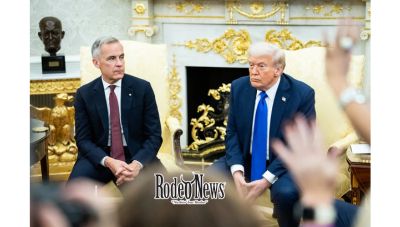
The proposal does not mean Canada is joining the European Union as a full member. Instead, European and Canadian officials are discussing a new form of closer partnership that could expand cooperation in trade, defense, technology, energy and other strategic areas.
For Canada, the move represents an effort to broaden its international relationships at a time when its economy remains deeply connected to the United States.
For the United States, meanwhile, the proposal has become another point of tension in an already complicated relationship with both Canada and Europe.
Trump Canada 51st State Rhetoric Shapes New Tensions
Trump has repeatedly spoken about the possibility of Canada becoming the 51st U.S. state. The comments, which began before his return to the White House and continued during his presidency, have become part of a broader dispute over trade and the future of the U.S.-Canada relationship.
Canada has rejected the idea of becoming part of the United States, while Canadian officials have continued to emphasize the country’s sovereignty.
The issue has also become intertwined with Trump’s trade policies.
Canada has historically depended heavily on access to the U.S. market, with the overwhelming majority of its exports going south of the border. According to reporting by the Associated Press, roughly 70% of Canadian exports go to the United States.
That dependence has made the trade dispute particularly significant for Ottawa.
Prime Minister Mark Carney has therefore sought to strengthen relationships with other major economies, including the European Union.
His government has described the approach as an effort to build greater economic and strategic resilience rather than simply replacing the United States as Canada’s main partner.
EU Offers Canada a New Path
Von der Leyen’s proposal was one of the most significant developments in the evolving Canada-EU relationship.
During her State of the European Union speech, she told Carney that she wanted to work toward making Canada the EU’s first associate member. European lawmakers responded with a standing ovation for the Canadian prime minister.
The proposed arrangement is not the same as full EU membership.
Canada is geographically outside Europe, and the European Union’s formal membership rules are designed around European states. An associate arrangement could instead provide a framework for closer cooperation without Canada becoming a conventional EU member.
The exact rights and obligations of such a status have not yet been finalized.
Reuters reported that the European Commission proposal could involve deeper cooperation in areas including defense, technology, climate policy and Arctic projects. The concept would also require discussions among EU member states and European institutions before any formal arrangement could take effect.
That means the Sept. 16 announcement is better understood as the beginning of a diplomatic process rather than a completed agreement.
Canada Already Has a Trade Relationship With Europe
Canada is not starting from zero in its relationship with the European Union.
The two sides already operate under the Comprehensive Economic and Trade Agreement, commonly known as CETA. The agreement provides a framework for trade between Canada and the EU.
The new proposal would seek to expand cooperation beyond traditional trade.
Von der Leyen described the broader initiative as an “Alliance for the Future,” with the objective of developing what she called a common prosperity and economic security space.
Potential areas of cooperation include defense supply chains, artificial intelligence, energy, critical minerals, technology and Arctic security.
Those areas have become increasingly important as governments seek to secure supply chains and reduce dependence on individual countries.
For Canada, closer European cooperation could also create additional opportunities for businesses and researchers.
However, the United States is likely to remain central to Canada’s economy because of geography, existing infrastructure and decades of cross-border investment.
Trump Responds With Warning to Europe
Trump responded to the EU proposal on Wednesday by criticizing the possibility of Canada becoming an associate member.
Speaking in Charlotte, North Carolina, Trump suggested that the European move could constitute a hostile act toward the United States if it were motivated by negative intentions.
He also threatened additional tariffs against Europe if Washington concluded that the EU was acting against American interests.
Trump dismissed the proposed Canadian-EU arrangement and continued to criticize Canada’s trade relationship with the United States.
The comments added another layer to the dispute because the European Union is already involved in difficult trade negotiations with Washington.
The situation therefore extends beyond Canada.
A deeper Canada-EU relationship could affect trade, defense procurement and supply-chain planning across North America and Europe.
Mark Carney Seeks a “Unique Alliance”
Carney has increasingly promoted what he calls a “unique alliance” between Canada and Europe.
The Canadian prime minister has argued that Canada needs stronger relationships with partners beyond the United States as the international economic environment changes.
His appearance at the European Parliament reflects that strategy.
Carney is scheduled to address European lawmakers as Canada works to expand its political and economic engagement with the continent.
The timing is significant.
For decades, Canada’s foreign and economic policy has been strongly shaped by its relationship with the United States. The two countries share the world’s longest international border and extensive economic connections.
Businesses on both sides depend on cross-border transportation, manufacturing and supply chains.
Changing those relationships would therefore be complicated.
The Canadian government is not simply moving its economy away from the United States. Instead, the current strategy involves developing additional partnerships that could give Ottawa more options in future trade and diplomatic negotiations.
What Associate Membership Could Mean
One of the biggest questions surrounding the proposal is what “associate membership” would actually provide.
The European Union has never used this exact framework for a country such as Canada.
Officials have discussed cooperation that could extend across several sectors, but the precise institutional structure remains under development.
Reuters reported that EU officials and analysts have questioned how the arrangement would work legally and politically. Any formal agreement would require broader approval within the European Union.
Possible areas include:
- Trade and economic cooperation
- Defense and security
- Artificial intelligence
- Critical minerals
- Energy
- Arctic policy
- Research and technology
- Greater movement between Canada and Europe
Some of these areas could be particularly important to Canada because the country possesses significant natural resources while also maintaining close relationships with European economies.
The Arctic is another major area of interest.
Canada and European countries increasingly view the Arctic as strategically important because of its natural resources, transportation routes and security implications.
The United States Remains Canada’s Largest Economic Partner
Despite the diplomatic shift toward Europe, Canada cannot easily replace its relationship with the United States.
The scale of cross-border trade is enormous.
Canadian manufacturers, energy companies, farmers and other businesses are deeply integrated with the U.S. economy. Supply chains often cross the border multiple times before a finished product reaches consumers.
That makes diversification a long-term process rather than an immediate alternative.
The European Union can provide new markets and strategic partnerships, but geography remains an important factor.
Canada’s proximity to the United States means that Washington will continue to be a central economic and security partner regardless of how closely Ottawa works with Europe.
This is one reason the current diplomatic developments are being closely watched by businesses and governments on both sides of the Atlantic.
The 51st State Debate Has Broader Consequences
The repeated Trump Canada 51st state comments have become more than a rhetorical dispute between two neighboring countries.
They are now part of a broader debate about Canada’s place in the international system.
Trump has presented the idea of Canadian statehood alongside arguments about trade, economic integration and the perceived advantages of closer U.S.-Canada ties.
Canadian officials, however, have continued to treat Canada as a sovereign country with its own foreign policy and economic interests.
The European proposal provides another dimension to that debate.
Instead of responding to pressure from Washington by becoming more integrated with the United States, Ottawa is simultaneously exploring deeper relationships with Europe.
That does not mean Canada is preparing to abandon North America.
Rather, the developments suggest that Canadian policymakers are looking for additional economic and strategic options.
Europe Also Has Strategic Interests
The EU’s interest in Canada is not solely about helping Ottawa respond to U.S. pressure.
European governments have their own reasons for seeking stronger Canadian ties.
Canada has substantial natural resources, advanced technological capabilities, a large Arctic territory and significant defense and intelligence relationships with European countries.
Canada is also a member of NATO and has historically worked closely with European allies on security issues.
Closer cooperation could therefore benefit both sides.
The European Union is attempting to strengthen its economic and strategic position in a world increasingly shaped by competition among major powers.
Canada, meanwhile, is seeking ways to reduce the risks associated with excessive dependence on a single major trading partner.
Those interests overlap in several areas.
October Summit Could Bring More Details
The next major test for the proposal will be whether the two sides can turn the political announcement into specific agreements.
A Canada-EU summit scheduled for October is expected to provide an opportunity to discuss the future relationship in greater detail.
The talks could clarify what associate membership would involve and which areas might receive priority.
Questions surrounding trade access, regulatory alignment, mobility, defense cooperation and investment will likely be important.
The European Union will also have to determine how the proposal fits within its existing legal and institutional framework.
For Canada, the government will need to balance deeper European cooperation with its continuing relationship with the United States.
A New Chapter in Canada-U.S.-Europe Relations
The latest developments show how quickly Canada’s international relationships are changing.
Trump’s repeated Trump Canada 51st state comments, combined with tariffs and broader trade tensions, have contributed to a period of uncertainty between Washington and Ottawa.
At the same time, Canada is receiving an unusually direct invitation from the European Union to deepen its relationship with Europe.
Von der Leyen’s proposal does not create EU membership for Canada overnight. Much of the framework remains to be negotiated, and the political and legal details are still unclear.
But the announcement is significant because it demonstrates that Canada and the EU are considering a relationship that goes beyond their existing trade agreement.
For Carney, the challenge will be managing those new opportunities while maintaining the economic relationship Canada has built with the United States over generations.
For Europe, the question will be whether an innovative partnership with Canada can be turned into a practical framework.
And for Washington, the developments offer another indication that trade and foreign-policy disputes with Canada can have consequences beyond the U.S.-Canadian border.
The debate over Canada’s future relationship with the United States is therefore no longer limited to the question of whether the country could ever become the 51st state.
It is increasingly about how Canada can expand its options, strengthen its partnerships and define its role in a changing global economy.
The next stage will depend on negotiations between Canada and the European Union, as well as the continuing evolution of the relationship between Ottawa and Washington. For now, the EU’s unprecedented proposal has opened a new diplomatic chapter — one that could reshape Canada’s connections with Europe without severing its longstanding ties to North America.