Full Article
The IndyCar Freedom 250 may have been promoted as a once-in-a-lifetime celebration, but organizers are now considering whether the spectacular Washington, D.C., street race could return. The inaugural event generated enormous attention, brought large crowds to the U.S. capital and created a wave of interest around IndyCar. However, turning that success into an annual race could be far more difficult.
According to RACER, Freedom 250 event chairman Bud Denker said organizers are open-minded about the event’s future. Denker plans to discuss the possibilities with Roger Penske and President Donald Trump as IndyCar considers what could happen in 2027 and beyond.
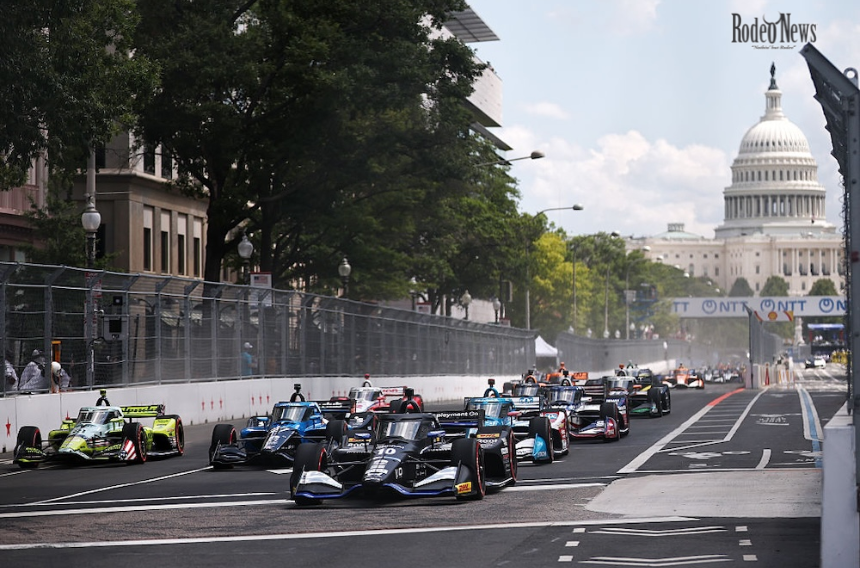
The comments come after an ambitious debut that transformed parts of downtown Washington into a temporary racing circuit. The event was designed as part of America’s 250th-anniversary celebrations and was intended to be a major one-off spectacle.
Now, the question is whether the spectacle can become a sustainable sporting event.
IndyCar Freedom 250 Leaves the Door Open
The first IndyCar Freedom 250 was never designed as a conventional commercial race weekend.
RACER reported that organizers spent an enormous amount on the event and distributed 100,000 free tickets. That model helped create a massive public celebration, but it also presents a serious financial obstacle if IndyCar wants to return every year.
Denker acknowledged that reality directly.
He explained that major events in Washington can be extremely expensive while generating insufficient revenue to cover all of the costs. That problem is not unique to IndyCar. Temporary street races require extensive infrastructure, security, road closures, permits, barriers and other preparations that permanent circuits do not necessarily require.
As a result, the success of the inaugural event cannot be measured only by ticket sales or television exposure.
Organizers must determine whether the race can eventually support a sustainable business model.
Why Washington Was Such a Major Opportunity
The appeal of the IndyCar Freedom 250 was obvious.
Rather than racing at a traditional permanent facility, IndyCar placed its cars in the heart of the nation’s capital. The temporary circuit passed major Washington landmarks, giving the event an unusual visual identity that few other races can match.
Reuters reported before the race that the circuit measured approximately 1.7 miles and featured seven turns. The race was also extended to 147 laps, producing a 250-mile event consistent with the anniversary theme.
That setting gave IndyCar something valuable: attention beyond its traditional motorsports audience.
The race was not simply promoted as another round of a championship. It was positioned as a national celebration involving politics, entertainment, military displays and American motorsport.
That combination helped create an event capable of reaching people who might not normally follow IndyCar.
For the series, that could be one of the most important legacies of the weekend.
New Fans Could Be the Biggest Victory
Denker believes the event succeeded in attracting new IndyCar followers.
RACER reported that Denker saw large crowds around Washington and pointed to strong merchandise sales as evidence of increased interest. He said more than $969,000 in merchandise was sold on the Saturday before the race, compared with about $900,000 in total merchandise sales at IndyCar’s Arlington event over the entire week.
Those numbers matter because IndyCar has long been interested in expanding its audience.
A successful race is valuable. A successful race that creates thousands of new fans could be much more valuable.
That is especially important in a market like Washington, D.C., where IndyCar does not have the same long-established identity it enjoys in traditional American racing markets.
If a significant percentage of the Freedom 250 audience continues watching IndyCar after the event, organizers could argue that the race delivered value that is not immediately visible on a traditional profit-and-loss statement.
The Financial Problem Could Decide Everything
Despite the excitement, money remains the biggest obstacle to an annual IndyCar Freedom 250.
Street races are expensive because the venue effectively has to be built from scratch.
Roads must be closed. Safety infrastructure must be installed. Temporary grandstands, fencing and hospitality areas may be required. Security requirements can also be much more complicated when an event takes place around major government buildings and national landmarks.
Washington adds another layer of complexity.
The race’s location provides spectacular television images, but operating a major motorsport event in the capital is unlikely to be cheap.
Denker’s comments make clear that organizers understand this challenge.
The inaugural event could justify extraordinary spending because it was tied to a once-in-a-generation anniversary. Repeating those expenses every year would require a very different financial model.
That could mean more sponsorship revenue, higher hospitality sales, stronger commercial partnerships or greater institutional support.
Without those elements, an annual race could become difficult to justify.
Could the Freedom 250 Become a Five-Year Event?
One of the most striking ideas discussed by Denker was the possibility of committing to a five-year run.
According to RACER, Denker said Trump had pushed the idea of holding the event for five years. The logic is straightforward: a multi-year commitment would allow organizers to build the event into a recurring fixture rather than repeatedly starting from scratch.
A five-year agreement could also give commercial partners more confidence.
Sponsors generally prefer long-term exposure instead of investing heavily in a single event. A recurring race would provide more opportunities to develop branding, hospitality programs and fan experiences.
For IndyCar, a multi-year deal could also allow the organizers to improve the event gradually.
The first race inevitably involved experimentation. A second edition could use lessons from the inaugural weekend to improve traffic management, fan access, hospitality, track operations and entertainment.
That could make the event more efficient over time.
However, a five-year commitment would also lock IndyCar into a costly arrangement. The series would need confidence that the financial and sporting benefits justify the long-term expense.
IndyCar’s Washington Race Already Made History
Regardless of what happens next, the inaugural IndyCar Freedom 250 has already achieved something significant.
It brought IndyCar racing into central Washington and created a temporary circuit around some of America’s most recognizable landmarks.
The event also produced an American winner.
Kyle Kirkwood won the inaugural Freedom 250, driving his No. 27 Honda to victory after leading 128 of the race’s 147 laps. He finished 3.09 seconds ahead of Christian Lundgaard.
The result gave the event an additional storyline.
An American driver winning a race staged as part of America’s 250th-anniversary celebration was a fitting conclusion to a weekend built around national symbolism.
More importantly for IndyCar, the race created a memorable first chapter.
If the event returns, the second edition would not have to introduce the concept to fans. Instead, it could build on an established identity.
Political Support Could Help the Event Return
The future of the IndyCar Freedom 250 is also connected to political support.
The race was created specifically as part of the 250th-anniversary celebrations, meaning its origins were unusual compared with a typical IndyCar event.
That political connection could potentially help organizers secure support for a continuation. At the same time, it could make the race more dependent on the political environment in Washington.
A recurring sporting event needs a broader foundation than one administration or one anniversary.
For IndyCar, the ideal scenario would be to turn the race from a political celebration into a recognized Washington sporting tradition.
That would require support from city officials, commercial partners, residents, fans and the motorsports community.
It would also require convincing local stakeholders that the disruption caused by road closures and construction is worth the economic and cultural benefits.
The DMV Could Become the Bigger Opportunity
Even if another race cannot be held on exactly the same Washington streets, the wider DMV region could still offer opportunities for IndyCar.
The District of Columbia, Maryland and Virginia metropolitan area represents a large population center. The inaugural event demonstrated that there is significant interest in bringing major motorsport to the region.
RACER reported that organizers are considering possibilities not only in Washington itself but also across the greater DMV area.
That could eventually lead to a different approach.
Instead of treating the Freedom 250 as a permanent downtown Washington race, IndyCar could explore other venues in the region while retaining Washington as the event’s promotional center.
Such a strategy could reduce some of the logistical challenges while maintaining access to the area’s large potential audience.
However, the unique visual appeal of racing around the National Mall would be difficult to replicate elsewhere.
That is precisely what made the inaugural event so special.
The Race Has Already Created a Valuable Brand
One of the biggest assets created by the inaugural IndyCar Freedom 250 is its name.
The event immediately became associated with Washington, America’s 250th anniversary and the unusual spectacle of IndyCars racing through the capital.
That kind of branding is difficult to manufacture.
If the event disappears after one year, IndyCar still has a memorable piece of history. But if organizers can find a sustainable business model, the Freedom 250 could become one of the championship’s signature events.
The challenge is balancing spectacle with economics.
A race cannot survive indefinitely on novelty alone.
It needs fans who return, sponsors who invest, broadcasters who value the audience and organizers who can control costs.
What Happens Next for IndyCar Freedom 250?
The immediate future appears to involve discussions rather than a confirmed return.
Denker said he expects to speak with Penske and Trump about the possibilities for 2027 and beyond. That means IndyCar has not yet committed to making the Washington race an annual fixture.
The next stage will likely focus on whether the inaugural event generated enough commercial and fan value to justify another major investment.
Several factors will matter.
First, IndyCar will need to evaluate audience growth. Second, organizers will have to examine the financial results. Third, sponsors and local authorities will need to determine whether they are willing to support another event.
Finally, the series will have to consider whether Washington provides enough long-term value compared with other potential markets.
The answer is not necessarily simple.
The inaugural event clearly generated enormous attention. But attention and profitability are not the same thing.
A Spectacular First Chapter, but No Guarantee of a Sequel
The IndyCar Freedom 250 has already proved that IndyCar can create a major spectacle in Washington.
The inaugural race attracted huge crowds, generated strong merchandise sales and introduced the series to an audience that may not have previously followed the championship closely. Organizers now believe the event may have created enough momentum to justify exploring a return.
Yet the financial challenge remains substantial.
The race was built as a special celebration, and that allowed organizers to spend at a level that may not be sustainable every year. A permanent place on the IndyCar calendar would require a more conventional commercial structure.
That is why the coming months could be crucial.
If organizers can transform the excitement surrounding the first Freedom 250 into sponsorship, hospitality, media value and long-term fan growth, Washington could become a recurring stop on the IndyCar calendar.
If they cannot, the 2026 race may remain exactly what it was originally advertised to be: a once-in-a-lifetime motorsport spectacle.
For now, however, the door remains open.
And after the impact of the inaugural IndyCar Freedom 250, IndyCar has a compelling reason to at least look through it.
Suggested External Sources
- RACER — Original report on the Freedom 250’s future
- Reuters — IndyCar’s Washington, D.C. Freedom 250 preview
Internal Link Suggestion: Link to your existing IndyCar, motorsports, or Washington D.C. coverage using anchor text such as “IndyCar latest news”, “2026 IndyCar season”, or “Washington D.C. Grand Prix.”