All-Female Spacewalk: 6th Historic ISS Mission Revealed
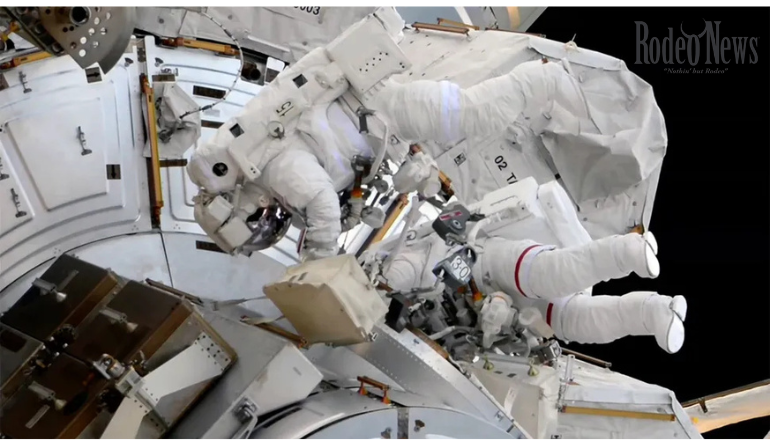
An all-female spacewalk has made history again as NASA astronaut Jessica Meir and European Space Agency astronaut Sophie Adenot stepped outside the International Space Station to complete a demanding series of maintenance and science tasks.
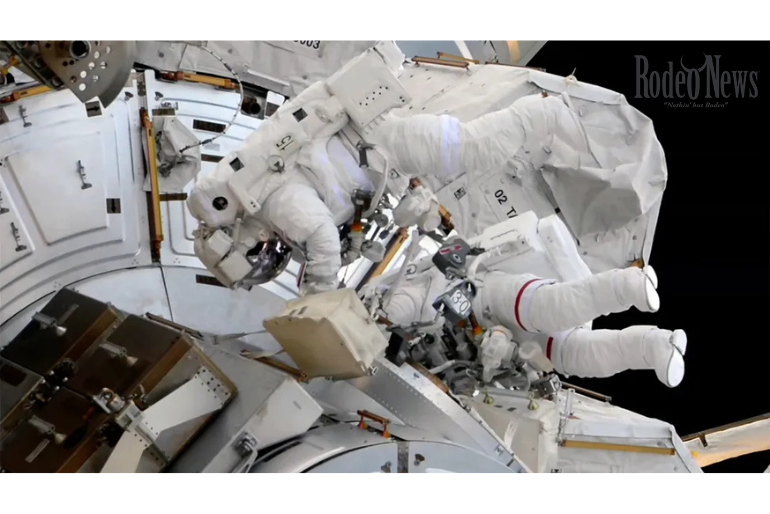
The two astronauts conducted the spacewalk on Tuesday, Sept. 1, 2026. During the 6-hour, 49-minute excursion, they replaced a spacecraft navigation aid, swapped out a high-definition camera and performed several additional jobs designed to keep the orbital laboratory operating safely and prepare it for future upgrades.
The mission marked the sixth all-female spacewalk in history, adding another milestone to the growing record of women conducting complex operations beyond Earth’s atmosphere.
The work was also significant from a technical standpoint. While the historic nature of the crew attracted attention, the astronauts were primarily focused on practical maintenance tasks that support spacecraft visiting the station, scientific research and the long-term operation of the ISS.
All-female spacewalk reaches another historic milestone
The Sept. 1 mission was designated U.S. Spacewalk 99.
NASA had planned for Meir and Adenot to spend roughly six and a half hours outside the station. The actual excursion lasted 6 hours and 49 minutes, during which the astronauts completed most of their scheduled objectives.
The spacewalk was especially notable because both crew members were women.
For Meir, the mission represented her seventh spacewalk. NASA said that accomplishment moved her into third place among female NASA astronauts for total spacewalks, behind Peggy Whitson and Suni Williams.
For Adenot, it was her third spacewalk.
The European astronaut had already conducted two spacewalks in August with NASA astronaut Anil Menon while working on the replacement of a failed Space-to-Ground Antenna. Her September mission therefore came after a remarkably busy period of activity outside the station.
Jessica Meir and Sophie Adenot lead the mission
The all-female spacewalk brought together two astronauts with different backgrounds but complementary experience.
Jessica Meir is a NASA astronaut who previously made history with Christina Koch when they participated in the first all-female spacewalk in 2019.
Her extensive EVA experience made her one of the more experienced women working outside the ISS.
Sophie Adenot, meanwhile, is an ESA astronaut from France. She arrived at the station as part of NASA’s Crew-12 mission and is conducting ESA’s εpsilon mission during her stay in orbit.
ESA said the September operation was Adenot’s third spacewalk and the 33rd spacewalk conducted by a European astronaut.
Her rapidly growing EVA experience has become one of the notable features of her first long-duration mission.
According to ESA, Adenot’s εpsilon mission is expected to last up to nine months and includes a substantial program of scientific experiments covering areas such as human physiology, climate research and technology demonstrations.
The astronauts replaced a critical navigation aid
One of the most important jobs during the all-female spacewalk involved replacing a retroreflector on the forward port of the station’s Harmony module.
The component might appear relatively small compared with the enormous structure of the ISS, but it has an important function.
A retroreflector can help spacecraft determine their position relative to the station during rendezvous and docking operations.
That makes the device particularly important as visiting spacecraft approach the ISS.
NASA explained before the mission that the replacement was intended to support spacecraft navigation during rendezvous and docking.
Adenot was assigned to the Harmony worksite.
She replaced the faulty retroreflector while Meir traveled to another area of the station to work on a high-definition camera.
The two astronauts therefore divided their responsibilities across different sections of the orbital complex.
ISS camera gets a major replacement
Another headline task was the replacement of a high-definition camera mounted on the station’s truss.
The camera, identified as Camera Port 3, or CP3, had become defective.
During the spacewalk, Meir used the station’s Canadarm2 robotic arm to reach the camera location and replace the failed unit with a spare. ESA confirmed that the camera replacement was among the maintenance tasks successfully completed during the EVA.
Cameras play an important role on the ISS.
They provide imagery that can be used by astronauts, mission controllers and engineers to monitor equipment and operations. External cameras are particularly useful because they provide views of the station’s structure and hardware that astronauts cannot see from inside the modules.
Replacing one therefore goes beyond simply restoring a video feed.
It also helps preserve the station’s ability to monitor its exterior systems.
The dramatic imagery from the all-female spacewalk also gave viewers on Earth a remarkable view of the astronauts working hundreds of kilometers above the planet.
More than a camera and navigation system
Although the camera and retroreflector were the most easily understood tasks, the astronauts had a much longer checklist.
NASA said the EVA also included work on data-relay systems, the Alpha Magnetic Spectrometer and other station equipment.
The astronauts installed jumper cables intended to improve the station’s data-relay capabilities.
They also worked on preparations for future maintenance of the Alpha Magnetic Spectrometer, a major scientific instrument attached to the station.
The instrument studies cosmic particles and can provide information about phenomena beyond Earth.
Preparing the system during a spacewalk helps reduce the amount of work that will be required during future extravehicular activities.
In other words, the Sept. 1 EVA was partly about completing immediate repairs and partly about preparing the ISS for work that has not yet happened.
Scientists also collected microorganism samples
The all-female spacewalk had a scientific component as well.
Adenot collected samples around the Quest airlock and from her gloves as part of NASA’s Microorganisms experiment.
ESA said the research is designed to investigate whether microorganisms are released through ventilation outlets from the station’s life-support systems and how far they might travel.
That may sound less dramatic than repairing equipment outside a spacecraft, but microbiology is an important part of long-duration human spaceflight.
The ISS is a closed environment inhabited continuously by people. Understanding how microorganisms behave in and around the station can help scientists learn more about spacecraft environments and how to maintain them.
Those lessons could become even more important as astronauts prepare for future long-duration missions beyond low Earth orbit.
Electrical and thermal work also completed
Adenot also moved and installed electrical and thermal jumpers during the EVA.
These components help support the station’s power and thermal-control systems.
Spacecraft operating in orbit face extreme thermal conditions. Parts exposed to direct sunlight can become extremely hot, while equipment in shadow can become dramatically colder.
The station therefore depends on carefully engineered systems to distribute heat and keep equipment within acceptable operating ranges.
The maintenance work performed during the all-female spacewalk was designed to improve those capabilities while also preparing the station for future activities.
Meanwhile, Meir worked on preparations associated with the Alpha Magnetic Spectrometer and repositioned a portable foot restraint for future spacewalk operations.
A busy month for Sophie Adenot
The latest EVA was particularly impressive because it came shortly after Adenot’s previous two spacewalks.
ESA reported that she completed three EVAs in only 15 days.
By the end of the third excursion, Adenot had accumulated 19 hours and 42 minutes of spacewalking time.
That represents an extraordinary amount of work for an astronaut during a relatively short period.
Her first two August spacewalks were focused on replacing a failed Space-to-Ground Antenna. ESA said the September EVA brought her total to three spacewalks during the same mission.
The sequence demonstrates how astronauts can be called upon to perform highly specialized external maintenance repeatedly when station hardware requires attention.
Why the ISS still needs spacewalks
The International Space Station has been continuously occupied for decades, making maintenance an enormous ongoing undertaking.
The orbital laboratory contains hundreds of systems, external structures, scientific instruments, solar-power equipment, communications hardware and docking interfaces.
Many of those components cannot simply be repaired from inside the station.
Astronauts must sometimes leave the relative safety of the ISS and work directly in the vacuum of space.
NASA classified the September excursion as the 284th spacewalk supporting the station’s assembly, maintenance and upgrades.
That number illustrates how dependent the ISS has been on EVA operations throughout its history.
Each spacewalk requires extensive planning.
Astronauts train for the tasks on Earth, while flight controllers coordinate every stage of the operation from mission control.
The spacesuits themselves provide life support, cooling, communications and protection from the harsh environment outside the spacecraft.
The significance of an all-female crew
The technical achievements of the mission remain the primary objective, but the all-female spacewalk also carries historical significance.
The first all-female spacewalk took place in October 2019, when Jessica Meir and Christina Koch exited the ISS together.
That mission became a landmark moment for NASA and human spaceflight.
Since then, additional all-female EVAs have demonstrated that women are increasingly taking leading roles in some of the most demanding operations conducted in orbit.
The milestone is therefore not simply about setting a record.
It reflects a broader transformation in the astronaut corps, where women routinely serve as pilots, commanders, scientists, engineers and spacewalkers.
Meir’s participation in both the first all-female EVA and this later milestone gives her a unique place in that history.
The ISS remains a laboratory and a worksite
The dramatic images from the all-female spacewalk can make the mission look like a spectacular adventure.
In reality, it was also routine maintenance at an extraordinary location.
The ISS is simultaneously a laboratory, spacecraft, construction project and international workplace.
Every repaired camera, replaced navigation device and upgraded cable helps extend the station’s ability to support science and visiting spacecraft.
NASA and its international partners continue to use the ISS to test technologies, study human health and conduct experiments that would be difficult or impossible to perform under normal Earth conditions.
ESA’s εpsilon mission is part of that broader scientific effort.
Adenot is scheduled to support numerous European experiments during her stay, with research ranging from human physiology to climate-related investigations and technology demonstrations. Space Agency
A successful mission with a minor spacesuit complication
The spacewalk was largely successful, but it was not completely without difficulty.
Space.com reported that Adenot’s spacesuit developed a mobility issue late in the EVA. Despite that problem, the astronauts completed most of their planned objectives during the 6-hour, 49-minute excursion.
Spacesuit mobility is critical during an EVA.
Astronauts need to manipulate tools, reach equipment and maintain stable body positions while wearing a pressurized suit that naturally restricts movement compared with ordinary clothing.
Even a relatively minor mobility issue can make delicate work more difficult.
The fact that Meir and Adenot were still able to accomplish the major objectives demonstrates the importance of EVA training and coordination.
What comes next for the astronauts?
The completion of the all-female spacewalk does not mean the work is finished.
The ISS remains an active research facility requiring continuous maintenance.
Adenot’s mission will continue to involve scientific experiments and station operations, while Meir’s extensive EVA experience makes her an important member of NASA’s station crew.
The work performed on Sept. 1 also prepares the ISS for future maintenance activities.
The Alpha Magnetic Spectrometer received preparation work, while the data-relay and thermal systems received upgrades or adjustments.
Those tasks can make subsequent operations more efficient.
A milestone beyond the headline
The sixth all-female spacewalk is likely to be remembered for its historical significance.
But its deeper importance lies in what happened during those nearly seven hours outside the station.
Jessica Meir and Sophie Adenot replaced a navigation aid, restored a high-definition camera, improved data-relay systems, prepared a major scientific instrument for future maintenance, collected microorganism samples and performed electrical and thermal work.
NASA and ESA both confirmed the successful completion of the Sept. 1 EVA.
The mission demonstrates how modern spaceflight combines historic milestones with highly practical engineering.
For viewers on Earth, the sight of two women working against the backdrop of the planet was extraordinary.
For the astronauts and their ground teams, however, the objective was clear: keep the International Space Station operating, support science and prepare the orbital laboratory for whatever comes next.
That combination of history, science and engineering is what makes the latest all-female spacewalk such a significant moment in the continuing story of human space exploration.