
Alienware AW3226Q: 4K OLED Monitor Hits $699
The Alienware AW3226Q is bringing a major OLED display upgrade to a considerably lower price point. Alienware has announced its new 31.5-inch 4K gaming monitor with RGB Stripe Tandem WOLED technology, a 165Hz refresh rate and HDR support, with a planned U.S. price of $699 and a launch scheduled for fall 2026.
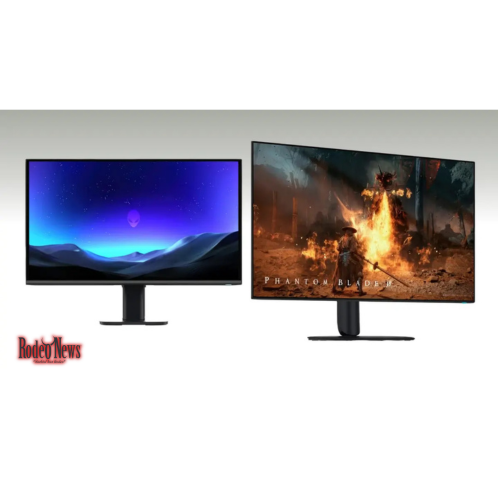
The monitor is part of a two-display announcement from Alienware. Alongside the AW3226Q, the company has introduced the AW2527HX, a smaller 24.5-inch 1080p QD-OLED gaming monitor capable of reaching an extraordinary 560Hz refresh rate.
The two displays target very different audiences. The AW3226Q focuses on high-resolution gaming, image quality and everyday versatility, while the AW2527HX is designed primarily for competitive esports players who value maximum responsiveness.
Together, they show Alienware taking OLED gaming monitors in two directions: more pixels for immersive gaming and more speed for competitive play.
Alienware AW3226Q Brings 4K Tandem OLED to $699
The centerpiece of the announcement is the Alienware AW3226Q, a flat 31.5-inch display with a 3840 × 2160 4K resolution.
Unlike many earlier OLED gaming monitors, the AW3226Q uses an RGB Stripe Tandem WOLED panel. The technology comes from LG Display and stacks multiple OLED layers while using a more traditional RGB-stripe subpixel arrangement.
That design has important implications for both image quality and desktop use.
Alienware says the panel provides 10-bit color and covers 99% of the DCI-P3 color space. The monitor also features a glossy coating, which can help preserve the perceived contrast and vibrancy that make OLED displays attractive to gamers.
The display has a native 165Hz refresh rate, putting it well above the 120Hz or 144Hz speeds common among older 4K gaming monitors.
It also has an advertised 0.03ms gray-to-gray response time, allowing the OLED panel to deliver the extremely fast pixel response that gamers have come to expect from the technology.
Why Tandem WOLED Matters
The most interesting feature of the Alienware AW3226Q may not be its resolution or refresh rate. It is the Tandem OLED technology underneath the display.
Traditional WOLED panels use a white OLED element alongside color filters. Tandem OLED designs instead stack multiple emissive layers, allowing the panel to achieve higher brightness and potentially better efficiency.
The AW3226Q also uses an RGB Stripe subpixel layout.
This is significant because OLED monitors have historically faced criticism surrounding text clarity and color fringing, particularly when their subpixel structures differ from the RGB layouts expected by operating systems.
The RGB Stripe design is intended to provide a cleaner desktop experience while maintaining the advantages of OLED technology.
That makes the AW3226Q interesting beyond gaming.
A 32-inch 4K display can be used for games, video editing, photo work, productivity and general desktop computing. With the improved subpixel arrangement, Alienware is clearly positioning this model as an all-purpose premium display rather than a product designed exclusively for gaming.
4K Resolution Meets 165Hz Gaming
Resolution and refresh rate have traditionally involved trade-offs.
A 4K monitor provides substantially more pixels than a 1440p display, producing sharper images and more detailed game worlds. However, driving games at 3840 × 2160 at high frame rates requires powerful graphics hardware.
The Alienware AW3226Q attempts to strike a practical middle ground with 165Hz.
For single-player games, racing titles and visually demanding adventures, 4K can provide a major improvement in image detail. At the same time, 165Hz gives fast-paced games considerably more fluid motion than a conventional 60Hz panel.
The monitor also supports variable refresh technologies, including G-SYNC Compatible and AMD FreeSync Premium Pro support, according to the published specifications.
That means compatible graphics hardware can synchronize the display’s refresh behavior with the frame rate produced by the GPU.
For gamers, this can help reduce tearing and provide smoother gameplay when frame rates fluctuate.
HDR Performance Is Another Highlight
OLED technology is particularly well suited to HDR because individual pixels can be controlled independently.
The Alienware AW3226Q carries VESA DisplayHDR True Black 400 certification and supports HDR10 and Dolby Vision.
Alienware lists up to 1,000 nits of peak HDR brightness under a 3% average picture level window. SDR brightness is rated at 250 nits.
The distinction between peak brightness and sustained full-screen brightness is important.
A monitor can produce very bright highlights in a small portion of an image without maintaining that brightness across the entire panel. For HDR gaming and movies, however, the ability to produce bright highlights alongside OLED’s deep blacks can create a strong contrast effect.
That combination is one of the biggest reasons enthusiasts continue to favor OLED displays.
Connectivity Looks Ready for Modern Gaming PCs
Alienware has equipped the AW3226Q with a selection of connections designed for both gaming systems and everyday computing.
The monitor includes DisplayPort 1.4 and two HDMI 2.1 ports. It also provides USB-C connectivity with up to 15W of power delivery, along with two USB Type-A ports.
The inclusion of HDMI 2.1 is particularly useful for modern game consoles and gaming PCs.
Meanwhile, USB-C makes the monitor more flexible for laptop users. A single cable can potentially handle display connectivity while providing some charging capability, although the 15W power delivery means it is not intended to replace a high-power laptop charger.
The combination makes the AW3226Q suitable for a desk shared between a gaming PC, laptop and console.
Alienware AW3226Q Price and Release Date
The headline feature may ultimately be the price.
Alienware says the AW3226Q will launch globally in fall 2026 for $699.
Another report identifies the North American manufacturer suggested retail price as $699.99, with a fall 2026 launch window.
That pricing is notable because Tandem OLED technology has generally been associated with premium displays.
Recent high-end RGB Stripe Tandem OLED monitors have occupied considerably more expensive territory. The AW3226Q therefore appears designed to make newer OLED technology accessible to a wider group of gamers.
However, regional pricing can differ significantly from the U.S. price once taxes, distribution costs and local market conditions are considered.
Buyers should therefore treat $699 as the announced U.S. target price rather than a guarantee of the final price in every market.
A Second Alienware OLED Is Built for 560Hz
Alienware’s second announcement is almost the complete opposite of the AW3226Q.
The Alienware AW2527HX is a 24.5-inch 1920 × 1080 gaming monitor designed for competitive esports.
Its defining feature is a 560Hz refresh rate.
While 4K resolution is the headline attraction of the AW3226Q, the AW2527HX is about minimizing latency and maximizing motion clarity.
The monitor uses Samsung Display’s fifth-generation Penta Tandem QD-OLED technology and an RGB Stripe subpixel layout. It is rated for a 0.03ms response time, 99% DCI-P3 coverage and up to 1,500 nits of peak brightness.
Alienware has also given the AW2527HX DisplayHDR True Black 600 certification.
The monitor is being developed in collaboration with Team Liquid, a major esports organization, with Alienware saying professional competitive gaming setups influenced the design.
Who Needs a 560Hz OLED Monitor?
For most gamers, 560Hz will sound excessive.
And for many players, it probably is.
A refresh rate that high is most useful when a game can consistently produce extremely high frame rates. Competitive titles such as Counter-Strike, Valorant and other esports games are much more likely to benefit from ultra-high refresh rates than graphically intensive single-player games.
The advantage is also highly dependent on the player’s hardware and skill level.
At professional or high-level competitive play, even small improvements in motion clarity and input responsiveness can matter. That is why monitor manufacturers continue pushing refresh rates far beyond the 144Hz and 240Hz levels that were once considered premium.
Alienware’s decision to pair 560Hz with OLED is particularly interesting because OLED pixels can transition extremely quickly.
The result is a display that combines the motion advantages of a very high refresh rate with OLED’s pixel response characteristics.