Roman Space Telescope Launch Creates a Stunning Solar Moment
The Roman Space Telescope launch produced more than a successful beginning for NASA’s next major observatory. It also created one of the most striking rocket photographs of 2026, when SpaceX’s Falcon Heavy briefly crossed the face of the rising sun during liftoff from Florida.
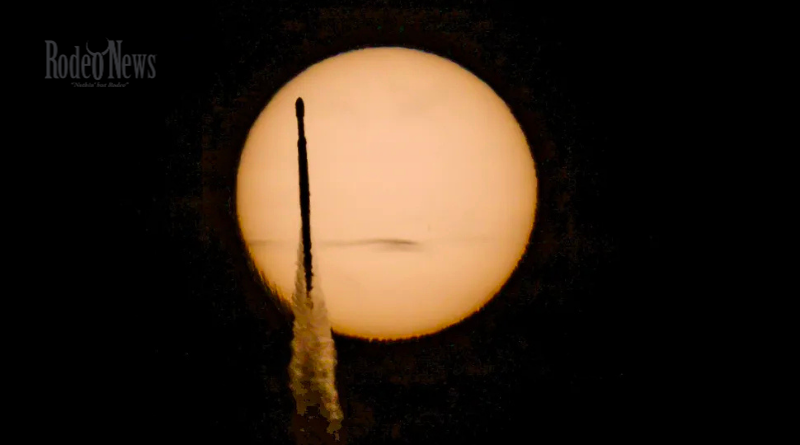
The extraordinary image was captured by Space.com spaceflight writer and photographer Josh Dinner from a parking lot in Titusville, roughly 12 miles from NASA’s Kennedy Space Center. Instead of watching the launch from the Kennedy Space Center press site, Dinner made a last-minute decision to relocate after learning that the rocket’s trajectory could create a rare alignment with the sun.
The gamble paid off.
On Aug. 30, NASA’s Nancy Grace Roman Space Telescope lifted off at 7:26:49 a.m. EDT aboard a SpaceX Falcon Heavy from Launch Complex 39A. The timing was critical not only for the spacecraft’s mission but also for photographers attempting to capture the rocket as a silhouette against the sun.
The result was a split-second image that combined rocket engineering, astronomical timing and photography in a single frame.
Why the Roman Space Telescope Launch Was So Difficult to Photograph
A rocket crossing directly in front of the sun might sound like a matter of simply finding the right place and waiting. In reality, the conditions have to line up with extraordinary precision.
The sun changes position across the horizon every day. Meanwhile, the rocket follows a predetermined flight path. Even a delay of a few minutes can move the launch out of alignment with the sun from a particular viewing location.
For the Roman Space Telescope launch, the timing was especially demanding because the mission used what is known as an instantaneous launch window. NASA needed the rocket to depart at the correct moment to place Roman on its intended trajectory.
That same precision created the opportunity for photographers.
Dinner explained that the launch occurred a little more than 20 minutes after sunrise, when the sun remained relatively low in the sky. From certain locations along Florida’s Space Coast, that created the possibility of the Falcon Heavy flying directly across the solar disk.
The location that offered the right geometry happened to be a Hobby Lobby parking lot in Titusville.
It was hardly the conventional place to photograph a major NASA mission.
But the unusual location offered something the Kennedy Space Center press site could not: a better angle for the solar transit.
A Risky Decision Just Minutes Before Liftoff
Dinner initially planned to cover the launch from Kennedy Space Center, which was only about three miles from Launch Complex 39A.
Leaving the press site meant giving up a much closer view of the Falcon Heavy.
There was another problem. Weather forecasts had suggested only about a 50% chance of favorable conditions for launch viewing. On the morning itself, clouds were still visible along the horizon, creating uncertainty about whether the sun would actually be clear when the rocket reached the correct position.
The decision became a classic example of the risk-reward equation in space photography.
About an hour before launch, space photographer David Diebold encouraged Dinner to attempt the shot. Diebold also offered a solar filter for the camera, making the difficult plan more realistic.
Dinner then made the drive from Kennedy Space Center to Titusville.
The journey took about 25 minutes, leaving little room for error.
When he arrived, other photographers were already preparing for the same potential solar transit. Hundreds of spectators had gathered along the nearby Banana River, hoping to watch the powerful Falcon Heavy rise over Florida’s Space Coast.
The clouds, however, remained a concern.
Then, shortly before launch, the conditions changed.
The sky cleared enough for the photographers to attempt the shot.
The Camera Setup Behind the Viral Launch Photo
Capturing the Roman Space Telescope launch against the sun required specialized equipment and extremely careful exposure settings.
Dinner used a Canon EOS R5 Mark II with an RF100-400mm F5.6-8 lens. He zoomed the lens to 400mm and attached a solar filter supplied by Diebold. The camera was then configured with an exposure of 1/20,000 of a second and an aperture of f/16.
Those settings were crucial because photographing the sun without appropriate protection can seriously damage camera equipment and, more importantly, human eyesight.
The long focal length also helped make the rocket appear larger against the solar disk. But the photographer had almost no opportunity for correction once the rocket entered the correct position.
The Falcon Heavy would cross the sun in a fraction of a second.
There was no second chance.
As the countdown approached, Dinner and the photographers around him watched the sky and their equipment. When the launch began, he did not have time to simply admire the rocket’s ascent.
Instead, he waited for the exact moment.
Then the Falcon Heavy crossed the face of the sun.
Dinner held down the camera shutter and hoped.
The resulting image showed the rocket appearing as a dark silhouette against the bright solar disk, with its exhaust plume extending downward. NASA also published imagery showing the Falcon Heavy and Roman telescope transiting the sun during launch.
The Falcon Heavy Launch Was a Major Mission Milestone
The photograph is spectacular, but the event behind it was far more important than a single image.
The Falcon Heavy carried NASA’s Nancy Grace Roman Space Telescope, a flagship observatory designed to investigate some of the biggest unanswered questions in modern astronomy.
NASA says Roman will combine a wide field of view with rapid survey capabilities, allowing scientists to map billions of galaxies, discover planets outside our solar system and investigate objects such as black holes.
The rocket itself is also notable.
Falcon Heavy uses a central core flanked by two side boosters. NASA said the vehicle’s 27 Merlin engines generated more than 5 million pounds of thrust during the launch.
That enormous power was required to send Roman toward its eventual operating location approximately 1 million miles from Earth.
NASA’s official Roman Space Telescope mission updates
What Makes the Roman Space Telescope So Important?
The Roman Space Telescope launch begins a scientific mission that could reshape our understanding of the universe.
Roman was built to conduct enormous surveys of the cosmos. Rather than focusing on a relatively small region at a time, the observatory will examine huge portions of the sky.
That approach makes it particularly valuable for studying dark energy and dark matter.
Dark matter cannot be directly observed through ordinary light, yet its gravitational influence affects galaxies and the large-scale structure of the universe. Dark energy, meanwhile, is associated with the accelerating expansion of the universe.
Scientists still do not know what either substance fundamentally is.
Roman is designed to gather enormous quantities of data that can help researchers investigate these mysteries.
The telescope will also search for exoplanets, or worlds orbiting stars beyond our solar system.
Its wide-field capabilities mean scientists can survey vast numbers of stars and potentially identify planetary systems that would be difficult to find with narrower-field observatories.
In that sense, Roman is not intended simply to take beautiful pictures.
Its mission is to conduct a statistical survey of the universe at a scale that could reveal patterns that smaller observations might miss.
Roman Will Complement Hubble and Webb
Roman is not intended to replace the Hubble Space Telescope or the James Webb Space Telescope.
Instead, the observatories are expected to complement one another.
Hubble has spent decades producing detailed observations of individual cosmic targets. Webb is optimized for infrared astronomy and can examine extremely distant and ancient objects with remarkable sensitivity.
Roman brings a different advantage: speed and breadth.
NASA describes Roman as an observatory capable of surveying enormous areas of the sky rapidly. Its wide-field observations can identify targets and patterns that can then be examined in greater detail by other telescopes.
That combination could make the next era of astronomy increasingly collaborative.
Roman may identify a distant galaxy, supernova or planetary system, while Hubble or Webb provides more detailed follow-up observations.
Scientists will therefore be able to connect wide surveys with deep investigations.
The Journey Has Only Just Begun
Although the Roman Space Telescope launch was completed successfully, the spacecraft’s scientific work will not begin immediately.
Roman must first travel to its destination and complete a series of deployment, testing and calibration activities.
The telescope is heading toward the Sun-Earth Lagrange Point 2, or L2, a location roughly 1 million miles from Earth. The region provides a useful observing environment for a space telescope because it allows the spacecraft to maintain a favorable relationship with Earth and the Sun.
NASA says Roman’s mission will provide enormous opportunities for astronomy during its planned five-year scientific campaign.
That means the dramatic Falcon Heavy launch was merely the opening scene.
The much bigger story will unfold when Roman begins collecting scientific observations.
Why the Sun-Crossing Photograph Matters
Rocket launches are photographed thousands of times.
However, very few images combine a spacecraft, a rocket and the sun with such precise alignment.
The rarity comes from the number of variables involved.
The launch date must be right. The launch time must be right. The weather must cooperate. The rocket’s trajectory must intersect the sun from the photographer’s location. The photographer must reach that location in time. Finally, the camera must be correctly configured for an event lasting only a fraction of a second.
For the Roman Space Telescope launch, all of those elements came together.
The fact that the successful vantage point was not inside the Kennedy Space Center makes the story even more memorable.
Dinner had to leave a prime media position, drive to another city, find a place among other photographers and trust that the clouds would clear.
They did.
The Falcon Heavy then appeared against the sun exactly as hoped.
Space.com’s original report and photography story
A Perfect Example of Science and Photography Colliding
The extraordinary photograph is also a reminder that space exploration is not experienced only through scientific data.
People remember launches through images.
A powerful photograph can communicate the scale, drama and ambition of a mission in a way that technical specifications cannot.
The Roman mission itself represents years of engineering and scientific planning. The Falcon Heavy represents an enormous achievement in launch technology. Yet the image captured from a roadside parking lot turns that complicated story into something immediately understandable.
A rocket.
A sun.
A spacecraft beginning a journey into deep space.
And one perfectly timed moment.
SpaceX’s official Roman mission page
What Comes Next for NASA’s Roman Telescope?
The next phase will be considerably less dramatic visually, but much more important scientifically.
After reaching its operating destination, Roman will undergo deployment and commissioning activities. Engineers will verify that its systems are working as designed before astronomers begin using the observatory for its planned surveys.
The telescope is expected to generate a huge volume of astronomical information.
Its observations could help researchers better understand the expansion of the universe, investigate the distribution of galaxies, measure cosmic structures and discover large numbers of previously unknown exoplanets.
The mission could also produce unexpected discoveries.
That possibility is one of the most exciting aspects of wide-field astronomy. When scientists survey enormous areas of the sky, they do not necessarily know everything they will find.
Some discoveries may involve objects that are already predicted.
Others could challenge existing theories.
The Lasting Image of a New Space Era
The Roman Space Telescope launch will ultimately be remembered for its scientific achievements. But the breathtaking image of Falcon Heavy crossing the sun may become one of the mission’s defining visual moments.
It captures the extraordinary precision required to send a spacecraft into deep space.
It also captures the human side of exploration.
A photographer had to make a difficult choice, leave a secure viewing location and race toward a parking lot because the geometry of the sun and rocket demanded it.
The decision could easily have failed.
Clouds could have blocked the sun. Traffic could have caused a delay. The rocket could have missed the expected alignment. The photographer could have pressed the shutter at the wrong moment.
Instead, the conditions came together.
At 7:26:49 a.m. EDT on Aug. 30, 2026, Falcon Heavy lifted Roman away from Earth. For a fleeting instant, the rocket crossed the sun.
The telescope continued upward.
The photograph froze the moment forever.
And now the real mission begins: using NASA’s new observatory to look across billions of stars and galaxies in search of answers to some of the universe’s deepest mysteries.