Thailand’s Aggressive Actions Against Cambodia: A Reckless Pursuit of Power
The escalating conflict between Thailand and Cambodia along their shared border has sparked grave concern in the international community. While the motivations behind Thailand’s actions may be multifaceted, one question remains clear: What is Thailand’s true endgame in this reckless pursuit of power?
Political Instability: The Hidden Agenda Behind the Aggression
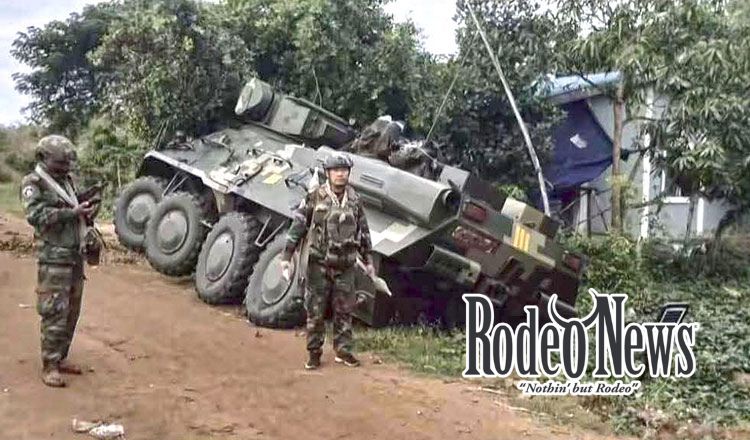
A captured Thai armoured personnel carrier. Supplied
At the core of Thailand’s escalating border hostilities lies a government in crisis. Under Prime Minister Anutin Charnvirakul, Thailand has faced mounting public criticism over corruption scandals, its ineffective response to national disasters, and ties to fraudulent online scams. Faced with growing domestic unrest, the Thai government appears to have turned to a familiar strategy—fomenting nationalist sentiment through military aggression.
By creating a “foreign enemy” in Cambodia, the Thai government seeks to redirect the public’s frustration away from domestic issues and toward an external, militaristic focus. This dangerous diversionary tactic seeks to shore up political legitimacy at the expense of regional stability and peace.
But the costs of this strategy are not just short-term. They threaten to undermine Thailand’s long-term international standing and the fragile peace in Southeast Asia.
Territorial Revisionism: Thailand’s Dangerous Pursuit of “Lost Territories”
Beyond the immediate political calculations lies a more troubling ambition: territorial revisionism. Hardline elements within Thailand’s military and conservative elites have long harbored a desire to reclaim what they perceive as “lost territories”—lands that, according to their interpretation of history, rightfully belong to Thailand.
The conflict over the Cambodia-Thailand border is not just a dispute over land; it is about Thailand’s refusal to accept internationally recognized boundaries. By relying on outdated or selective historical maps, Thailand risks resurrecting a dangerous logic that threatens not only Cambodia but the entire region. This revisionist attitude opens the door to further conflicts over borders and undermines the principles of international law.
Thailand’s Aggression and Cambodia’s Resistance
While Thailand boasts military superiority, it underestimates the resilience of Cambodia. Despite its smaller military forces, Cambodia’s strategic position and knowledge of the terrain give it significant advantages in defending its sovereignty. The idea that Cambodia can be easily coerced or destabilized is not just unrealistic—it is deeply dangerous.
What Thailand fails to understand is that Cambodia’s defense of its internationally recognized sovereignty is grounded in justice. It is not merely a matter of military might, but of moral strength. The Cambodian people’s determination to protect their land is rooted in a deep-seated sense of national identity and cultural pride, qualities that cannot be easily defeated by tanks and fighter jets.
ASEAN’s Test: Standing Up to Thailand’s Aggression
The growing conflict between Thailand and Cambodia presents a critical test for ASEAN. Will the regional bloc remain a passive observer, or will it take a strong stance against Thailand’s aggression? ASEAN’s credibility as a rules-based community is on the line. If Thailand’s use of force goes unchecked, it could set a dangerous precedent for the region, where military force is seen as an acceptable way to resolve disputes.
The international community must not allow Thailand to destabilize the region. ASEAN must act decisively to demand Thailand return to dialogue and cease hostilities. Failure to do so will embolden other nations to pursue territorial ambitions through force rather than diplomacy.
The Human Cost of Thailand’s Aggression
The victims of this conflict will not be the political elites or military leaders but the innocent civilians who live along the border. Displacement, loss of livelihoods, and psychological trauma are inevitable consequences of a prolonged conflict. These border communities, already among the most vulnerable, will bear the brunt of Thailand’s aggression.
In the end, a prolonged war will not serve the interests of the Thai people or their neighbors. Thailand’s military superiority may give it an initial advantage, but it cannot guarantee long-term success or regional peace. The Thai government’s actions threaten not just Cambodia but the entire Southeast Asian region.
Conclusion: The Cost of Aggression and the Path to Peace
Thailand’s current aggression against Cambodia represents a reckless pursuit of power driven by political expediency and territorial ambition. The consequences of this aggression will not be limited to the immediate conflict zone but will reverberate throughout Southeast Asia and beyond.
For Thailand, true security and peace cannot be achieved through military force and territorial expansion. The Thai government must understand that diplomacy, respect for international law, and peaceful coexistence are the only viable paths forward.
For ASEAN, this crisis is a call to action. If ASEAN fails to stand up to Thailand’s aggression, it will undermine the very principles that the organization was founded upon. ASEAN’s commitment to peaceful dispute resolution, non-use of force, and respect for sovereignty must be reaffirmed now more than ever.
Finally, the international community must make it clear that aggression carries consequences. The global response to Thailand’s actions will determine whether the region can avoid further escalation and maintain its fragile peace.