Protests Erupt in Greenland as Trump Renews Push to Take Over Arctic Island
NUUK, Greenland — Thousands of protesters poured into the streets of Greenland’s capital on Saturday, pushing back forcefully against renewed pressure from U.S. President Donald Trump to acquire the Arctic island, chanting that Greenland is “not for sale” and rejecting what they described as foreign intimidation over their future.
The demonstrations, centered in Nuuk, followed Trump’s latest public push to bring Greenland under U.S. control — a move he tied to sweeping tariff threats against Denmark and other European nations. Protesters carried flags, banners and placards, with some wearing red baseball caps modeled after Trump’s signature campaign gear but emblazoned instead with the slogan “Make America Go Away.”
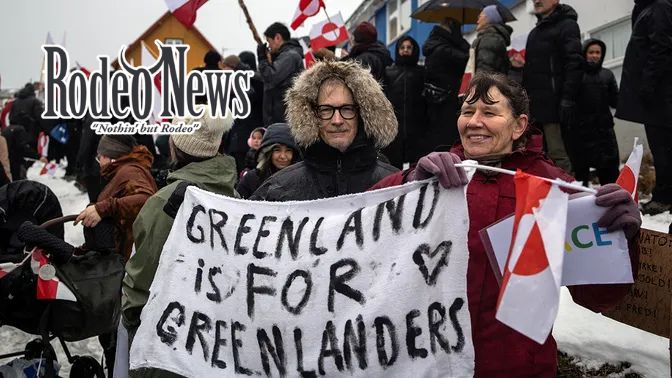
“We are not interested in being Americans,” one demonstrator said in a video shared from the protest, echoing a sentiment repeated throughout the crowd.
March to U.S. Consulate
The protest march, led by Greenland’s Prime Minister Jens-Frederik Nielsen, moved through the capital toward the U.S. consulate, where crowds gathered to voice opposition to any suggestion that the island could be bought or traded as part of geopolitical bargaining.
Chanting “Kalaallit Nunaat” — Greenland’s name in the Greenlandic language — demonstrators emphasized national identity and self-determination. Nielsen addressed the crowd outside the consulate, drawing loud applause as he underscored Greenland’s stance.
“I’ve come here today because I think it’s important to show that Greenland is not for sale. It is not a toy. This is our home,” said Naja Holm, a civil servant who attended the demonstration.
Trump Ties Takeover Push to Tariffs
The protests came hours after Trump escalated his rhetoric in a post on his Truth Social platform, where he announced plans to impose new tariffs on several European countries unless negotiations move forward on what he described as the “complete and total purchase” of Greenland.
According to the post, a 10% tariff would take effect beginning February 1, rising to 25% by June 1, remaining in place until a deal is reached. The announcement immediately drew condemnation across Europe and fueled anger among Greenlanders, who saw the remarks as an attempt to coerce both Denmark and the island’s population.
Greenland is a semi-autonomous territory within the Kingdom of Denmark, controlling most domestic affairs while Copenhagen oversees defense and foreign policy. The island has a population of roughly 57,000.
Strategic Stakes in the Arctic
Trump has repeatedly argued that Greenland is critical to U.S. national security due to its strategic Arctic location and vast mineral resources. He has warned that China and Russia are seeking to expand their influence in the region, framing U.S. control of Greenland as a necessary step to secure Western interests.
His comments revive a controversial idea he floated during his previous term, when he first suggested purchasing Greenland — a proposal that was swiftly rejected by both Danish and Greenlandic officials.
While Greenland’s political leaders acknowledge growing geopolitical competition in the Arctic, they have consistently said that decisions about the island’s future must be made by Greenlanders themselves.
European Leaders Push Back
Trump’s tariff threats prompted swift responses from European leaders, who rejected the idea that economic pressure could be used to influence sovereignty issues.
Sweden’s prime minister said Europe would not be “blackmailed,” while French President Emmanuel Macron issued a sharp warning in a statement posted on X, formerly Twitter.
“No intimidation nor threat will influence us, neither in Ukraine, nor in Greenland, nor anywhere else in the world when we are confronted with such situations,” Macron wrote. “Tariff threats are unacceptable and have no place in this context. Europeans will respond to them in a united and coordinated manner if they were to be confirmed.”
Dutch Prime Minister David van Weel also weighed in, confirming that European governments were consulting closely on a response.
“We have taken note of President Trump’s announcement on tariffs,” van Weel wrote. “Military efforts related to exercises in Greenland are intended to contribute to security in the Arctic region. The Netherlands is in close contact with the EU Commission and partners on our response.”
Independence, But Not American Control
Within Greenland, the issue has reignited debate over the island’s long-term political future. All political parties represented in Greenland’s parliament support eventual independence from Denmark, though they differ on timing and economic readiness.
Despite that shared goal, there is broad consensus that becoming part of the United States is not an acceptable alternative. Greenlandic leaders have repeatedly said they would prefer to remain within the Danish realm rather than come under U.S. sovereignty.
Saturday’s protests reflected that position clearly, with demonstrators framing Trump’s remarks as a challenge not just to Denmark, but to Greenland’s right to self-determination.
As chants echoed through Nuuk and crowds dispersed peacefully by evening, the message from Greenland’s streets was unmistakable: the island’s future, protesters said, will be decided in Greenland — not in Washington.