
Pikachu in Space: 67-Day ISS Adventure Revealed
Pikachu in space is no longer just something fans might imagine in a video game or animated adventure. The famous Pokémon character has now traveled aboard the International Space Station as part of a new collaboration between the European Space Agency and The Pokémon Company International.
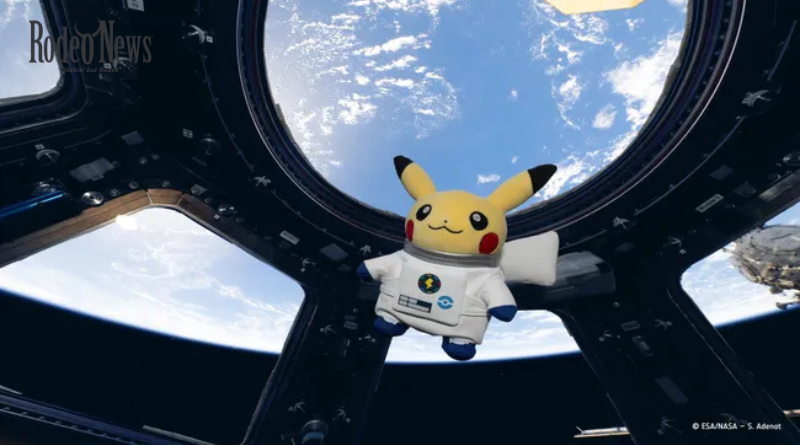
An Astronaut Pikachu plush joined ESA astronaut Sophie Adenot during her mission aboard the orbiting laboratory. According to ESA, the plush spent 67 days in orbit from April 11 to June 17, 2026, completing approximately 1,040 trips around Earth.
The unusual passenger is part of a broader partnership designed to connect space exploration with the curiosity and imagination associated with Pokémon.
The collaboration will also include a new family-friendly exhibition across Europe. The project is scheduled around World Space Week 2026, which runs from October 4 through October 10.
Pikachu in Space Reaches the International Space Station
The journey of Pikachu began with a simple-looking plush toy. However, its destination was anything but ordinary.
The Astronaut Pikachu traveled to the International Space Station and was photographed floating inside the station’s Cupola. The Cupola is the European-built observation module known for its large windows and panoramic views of Earth.
ESA says the Cupola is a favorite location for astronauts to observe the planet below. The station itself orbits approximately 400 kilometers above Earth and circles the planet roughly every 90 minutes. That means astronauts aboard the ISS can experience around 16 sunrises and sunsets each day.
Pikachu therefore received an unusual view of Earth during its orbital adventure.
The image of the yellow Pokémon floating in microgravity provides a striking visual connection between popular culture and human spaceflight.
How Long Did Pikachu Stay in Orbit?
The numbers behind the mission make the story more remarkable.
ESA says Astronaut Pikachu spent 67 days aboard the International Space Station. During that period, it completed approximately 1,040 orbits around Earth.
The ISS travels around Earth at extremely high speed. As a result, even a stay lasting only a few weeks allows objects aboard the station to circle the planet hundreds of times.
For Pikachu, the orbital journey became part of ESA’s wider effort to communicate the excitement of space exploration to audiences beyond the traditional scientific community.
Rather than presenting space only through rockets, laboratories and technical equipment, the partnership uses a character recognized by millions of people around the world.
ESA and Pokémon Join Forces for World Space Week
The Pikachu mission is only one part of the partnership.
ESA and The Pokémon Company International have launched an official collaboration connected with World Space Week 2026. The agencies describe the project as a limited-time effort combining the worlds of science, exploration, imagination and storytelling.
A central part of the project will be a new exhibition created jointly by ESA and Pokémon.
The exhibition is intended to be family-friendly. It will use Pokémon characters and visual storytelling alongside real information about Europe’s activities in space.
Visitors will be able to explore subjects including European missions, rocket launches, astronaut support aboard the ISS, solar research and exploration of the Solar System and wider universe.
That approach gives the collaboration a purpose beyond simply putting a popular character in orbit.
The goal is to make complicated scientific subjects more accessible and engaging, especially for younger audiences.
Why ESA Chose Pokémon
At first glance, Pokémon and a government-backed space agency might seem like an unlikely combination.
However, ESA says the two worlds share a common theme: curiosity.
Pokémon has traditionally centered on exploration, discovery and encounters with unfamiliar worlds. Space exploration involves many of the same ideas, although the destinations are real planets, moons, asteroids and distant regions of the universe.
ESA previously said the collaboration was intended to connect broader audiences with space through creative storytelling. The agency also highlighted its ambition to inspire Europe, particularly young people and future generations, through curiosity and imagination.
The presence of Pikachu aboard the ISS gives that message a highly recognizable symbol.
For longtime Pokémon fans, seeing Pikachu floating in an actual spacecraft offers an entertaining connection to real human spaceflight. For younger viewers who may already know the character, the image could provide an approachable introduction to the International Space Station and the science conducted there.
Astronaut Pikachu Meets Sophie Adenot
The mission also connects the Pokémon collaboration directly to an ESA astronaut.
Sophie Adenot took part in the mission during which the Pikachu plush traveled to the ISS. ESA identifies Adenot as an astronaut who has spent more than 200 days in space and has conducted multiple spacewalks during her mission.
The partnership therefore places Pikachu alongside a real astronaut operating in one of humanity’s most advanced scientific environments.
That contrast is part of what makes the images so memorable.
Pikachu is a fictional character created for entertainment. The ISS, by comparison, is a multinational scientific laboratory where astronauts conduct research under microgravity conditions.
Putting the two together creates a visual bridge between imagination and real-world exploration.
What Happens Inside the ISS?
Although Pikachu is the star of the promotional imagery, the International Space Station remains an important scientific facility.
The ISS has hosted astronauts continuously since 2000. Crews conduct research in microgravity that would be difficult or impossible to perform under normal conditions on Earth.
Experiments aboard the station can involve human health, biology, physics, materials science, technology demonstrations and Earth observation.
The microgravity environment is particularly valuable because it allows researchers to investigate how physical and biological systems behave when the effects of Earth’s gravity are dramatically reduced.
Pikachu, of course, was not sent to conduct a scientific experiment.
Instead, the plush became a symbolic passenger and an ambassador for the ESA-Pokémon partnership.
Its time in orbit demonstrates another aspect of spaceflight: the ability of space exploration to capture public imagination.
The ISS Has Become a Cultural Icon
The International Space Station is often discussed in terms of science, engineering and international cooperation.
But its images have also become part of popular culture.
Astronauts have photographed themselves playing instruments, celebrating holidays, preparing meals and looking through the Cupola windows at Earth. Objects ranging from toys to flags and other personal items have also occasionally appeared in the station’s microgravity environment.
The floating Pikachu fits naturally into that tradition.
The difference is that this particular object is connected to an organized international communications campaign between one of the world’s major space agencies and one of the best-known entertainment franchises.
The image is immediately recognizable even to people who may not regularly follow space news.
A New Way to Talk About Space Exploration
Space agencies have increasingly looked for creative ways to communicate with the public.
Traditional space communication often focuses on mission milestones, scientific discoveries and technical achievements. Those subjects remain essential, but they can sometimes feel distant to people who do not have a background in science.
A character such as Pikachu changes the entry point.
Someone searching for Pokémon news might encounter the ISS for the first time. A child interested in Pikachu might then learn what the International Space Station does. Meanwhile, a space enthusiast may discover more about the Pokémon franchise through the collaboration.
That cross-pollination appears to be central to the project.
ESA describes the partnership as a way to inspire the next generation of explorers by combining science with imagination.
Pikachu in Space Is Part of a Larger ESA Strategy
The partnership comes at an interesting period for European space exploration.
ESA is preparing for a future beyond the International Space Station while continuing to expand Europe’s role in human and robotic exploration.
In September 2026, ESA also announced a Letter of Intent with Starlab concerning potential cooperation in low Earth orbit during the post-ISS era. The agreement is intended to explore future opportunities for European astronaut missions, research and other activities in commercial space infrastructure.
That broader context shows why public engagement remains important.
As the space sector changes, agencies need to explain new missions, commercial partnerships and scientific programs to audiences that extend well beyond traditional space enthusiasts.
A Pokémon collaboration does not replace scientific communication. Instead, it adds another channel for reaching people who might not otherwise follow space programs.
What the Europe-Wide Exhibition Will Show
The upcoming exhibition will combine Pokémon-themed storytelling with real ESA information.
According to ESA, visitors will be able to learn about how Europe launches missions, supports astronauts aboard the International Space Station, studies the Sun and explores the Solar System and universe.
The format is designed to be accessible to families.
That is significant because many scientific concepts can be difficult to communicate through technical language alone. Visual storytelling can help introduce subjects such as orbital mechanics, astronaut training and planetary exploration before visitors encounter the more complicated scientific details.
The Pokémon component provides a familiar starting point.
Once curiosity has been established, the exhibition can move from the fictional world of Pokémon toward the real challenges of space exploration.
From Fictional Adventures to Real Exploration
Pokémon has spent decades encouraging players to explore fictional regions, discover unfamiliar creatures and complete journeys built around curiosity.
Space exploration follows a different path, but the underlying idea of discovery is similar.
Scientists send spacecraft to unfamiliar worlds. Astronauts live aboard laboratories hundreds of kilometers above Earth. Robotic probes travel across the Solar System. Telescopes observe objects that are billions of light-years away.
In each case, exploration begins with a question about what might be found.
That is the concept ESA hopes to emphasize through its partnership with Pokémon.
The collaboration does not turn Pikachu into an astronaut in the literal sense. Instead, it uses the character as a bridge between imaginative exploration and the real scientific work taking place beyond Earth.
Why the Pikachu ISS Image Matters
The photograph of Pikachu floating inside the Cupola is likely to attract attention far beyond the usual space community.
The image is simple. A familiar yellow character appears to float weightlessly against the backdrop of a spacecraft.
Yet it communicates several ideas at once.
It shows what microgravity looks like. It places a well-known cultural character inside a real orbital laboratory. And it demonstrates how space agencies can use creative storytelling to communicate with audiences around the world.
Most importantly, the image gives people another reason to look toward space.
For some viewers, the journey may begin with Pikachu.
It could then lead to questions about the ISS, astronauts, Earth observation, rockets, planetary science or the future of human exploration.
The Next Chapter for Pikachu in Space
The orbital portion of the journey is already complete, but the broader project is just beginning.
The Astronaut Pikachu spent 67 days aboard the ISS before returning from orbit. Now, the character will feature in a collaboration that brings ESA’s space activities closer to audiences across Europe.
The exhibitions connected with World Space Week 2026 will offer another opportunity to bring the partnership to life.
For ESA, the project is about more than a memorable photograph.
It is an attempt to make space exploration feel familiar, exciting and accessible. For Pokémon, it opens a new setting for one of its most recognizable characters.
And for fans, the result is something that would have sounded almost impossible a few years ago: Pikachu has officially been to space.
Final Takeaway
Pikachu in space has become a real chapter in the history of both Pokémon and popular space culture.
An Astronaut Pikachu plush spent 67 days aboard the International Space Station, completing approximately 1,040 orbits, while ESA and The Pokémon Company International prepared a larger collaboration focused on World Space Week 2026.
The partnership combines real science with imaginative storytelling. It also gives ESA a distinctive way to introduce space exploration to families and younger audiences.
Pikachu may be fictional, but its trip to orbit happened in the real world.
And as the ESA-Pokémon exhibition prepares to reach audiences across Europe, the electric Pokémon’s journey may inspire a new generation to look up at the night sky and wonder what is waiting beyond Earth.