U.S. Dollar Falls to Four-Year Low as Tariff Fears and Fed Uncertainty Mount
The U.S. dollar has slipped to its weakest level in four years, underscoring growing investor unease about trade policy, political uncertainty, and the future direction of monetary policy in the world’s largest economy.
Measured by the ICE U.S. Dollar Index — which tracks the greenback against a basket of six major currencies — the dollar has fallen more than 3% since mid-January and is now hovering near levels last seen in 2021. The decline stands in stark contrast to the buoyant U.S. stock market, which has continued to climb despite mounting macroeconomic risks.
For consumers, the dollar’s weakness may be felt most directly when traveling abroad. For businesses, however, the impact is broader and more costly. A softer dollar raises the price of imported goods such as furniture, clothing, and industrial components, adding pressure to corporate margins already strained by the Trump administration’s sweeping tariff agenda.
Tariffs, Politics, and a Shaky Policy Outlook
Economists point to a convergence of destabilizing forces driving the currency lower. At the top of the list are renewed tariff threats from President Donald Trump, concerns about federal finances, and rising anxiety over political brinkmanship in Washington.
“The dollar’s latest drop reflects the return of tariff risks and growing pressure on the Federal Reserve,” said Alex Kuptsikevich, chief market analyst at FxPro. “President Trump has made it clear he is comfortable with the dollar at its current level, and that message has not gone unnoticed by investors.”
In recent weeks, the White House has floated the possibility of expanding tariffs on a range of imported goods, a move that has revived fears of a broader trade confrontation. At the same time, Congress is once again approaching a funding deadline, raising the prospect of another government shutdown.
Democratic lawmakers are pushing for changes to immigration enforcement tied to the administration’s agenda, with a shutdown deadline looming this weekend. A lapse in funding would follow last year’s 43-day shutdown — the longest in U.S. history — which disrupted air travel, delayed government services, and left hundreds of thousands of federal workers without pay.
That kind of uncertainty is weighing heavily on currency markets.
“The dollar’s strength depends on institutional stability, fiscal credibility, and policy predictability,” Nigel Green, CEO of financial advisory firm deVere Group, said in an email. “Shutdown risks weaken all three pillars.”
A Shift Away From the Dollar
Beyond short-term political drama, longer-term structural trends are also pressuring the greenback. According to a 2025 report from JPMorgan Chase, global investors have been gradually rotating out of the dollar and into hard assets, particularly gold, as concerns about U.S. debt levels and geopolitical risk grow.
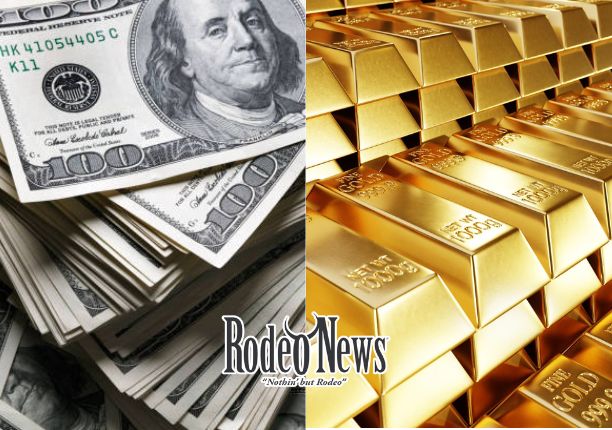
Gold prices recently surged above $5,500 an ounce, setting a fresh record and signaling heightened demand for perceived safe-haven assets. This rotation is often described on Wall Street as the “Sell America” trade — a pullback from U.S. assets, including the dollar and Treasury securities, in favor of alternatives overseas.
The trend has coincided with a gradual decline in the dollar’s share of global foreign exchange reserves. Data from the International Monetary Fund shows that about 56% of global reserves were held in dollars in the third quarter of 2025, down roughly 1.5 percentage points from the start of the year.
While the dollar remains the world’s dominant reserve currency by a wide margin, the shift highlights a slow erosion of confidence at the margins.
Trump’s View: A Weaker Dollar Is “Great”
President Trump has shown little concern about the dollar’s slide. During an appearance in Iowa on January 27, he dismissed suggestions that the currency had fallen too far.
“No, I think it’s great,” Trump said, according to The Wall Street Journal. “The value of the dollar — look at the business we’re doing.”
Following those remarks, the dollar dropped nearly 1%, as traders interpreted the comments as tacit approval of a weaker currency. A softer dollar can benefit U.S. exporters by making American-made goods cheaper abroad, potentially boosting overseas demand.
Treasury Secretary Scott Bessent sought to calm markets the following day, telling CNBC that the administration is not intervening in currency markets and continues to support a “strong dollar” policy. Even so, investors remain skeptical about whether that stance will hold amid mounting political pressure.
The Federal Reserve Factor
Adding to market anxiety is growing uncertainty surrounding the Federal Reserve. President Trump has repeatedly criticized Fed Chair Jerome Powell for holding interest rates steady, arguing that the central bank should cut rates aggressively to support growth.
“The Fed should substantially lower interest rates, NOW!” Trump wrote on social media Thursday.
Lower interest rates tend to weaken a currency by reducing returns on dollar-denominated assets. Investors, in turn, may seek higher yields elsewhere, putting further downward pressure on the dollar.
Trump is expected to announce a nominee to replace Powell as early as next week. Analysts warn that a Fed chair perceived as more aligned with the White House could undermine confidence in the central bank’s independence — a key pillar supporting the dollar’s global role.
“Without strong backing from both the Treasury and the Fed, the dollar could fall another 7% to 8% in the coming months,” Kuptsikevich said. “That would bring it back to levels last seen in 2018 and 2021.”
📊 Historical Context: Dollar Index Comparison
Below is an example illustrating how the current dollar level compares with previous periods of weakness:
| Year | Approx. ICE U.S. Dollar Index Level | Key Market Drivers |
|---|---|---|
| 2018 | ~88 | Trade war concerns, Fed tightening cycle |
| 2021 | ~89 | Pandemic recovery, ultra-loose monetary policy |
| 2026 (Current) | ~87–88 | Tariff threats, Fed pressure, political uncertainty |
Source: ICE U.S. Dollar Index, market estimates
What Comes Next
For now, investors appear cautious rather than panicked. But with trade policy in flux, a potential government shutdown looming, and questions swirling around the Federal Reserve’s future leadership, the dollar’s path remains uncertain.
If those risks intensify, analysts say the greenback could face further declines — reshaping global markets and adding another layer of complexity to an already fragile economic outlook.