
Stock Market Today: Wall Street Faces a Crucial Test
The stock market today is sending a mixed signal to investors as Wall Street begins a week packed with major earnings, inflation data, Federal Reserve commentary and geopolitical risks. The Dow Jones Industrial Average managed to finish higher on Monday, while the S&P 500 and Nasdaq Composite slipped as technology and semiconductor shares came under pressure.
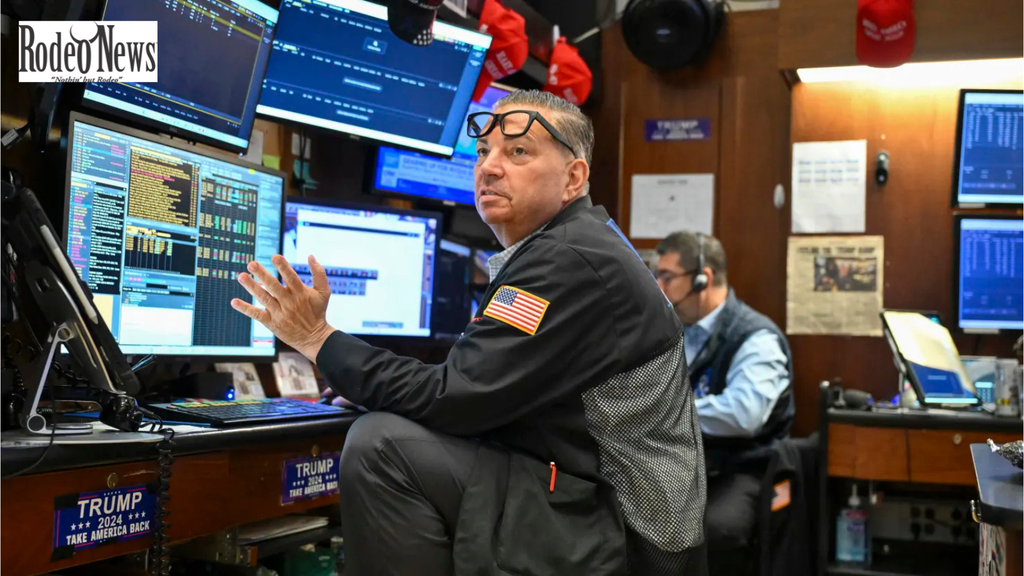
The divergence between the major indexes highlights a market that is becoming increasingly selective. Investors are still willing to buy companies with strong earnings and defensive characteristics, but enthusiasm for expensive artificial-intelligence and semiconductor stocks has weakened ahead of Nvidia’s closely watched earnings report.
At the same time, fresh U.S. economic pressure on Iran and renewed trade tensions with Canada added another layer of uncertainty. Investors are also preparing for the latest inflation data and Federal Reserve commentary later in the week.
The result is a market caught between optimism over corporate growth and concerns about valuations, inflation, interest rates and geopolitical developments.
1. Stock Market Today Shows a Sharp Divide Between Tech and the Dow
The clearest signal from Monday’s session was the different performance of the three major U.S. indexes.
The Dow Jones Industrial Average gained about 140 points, or 0.26%, to close at 53,417.16. By comparison, the S&P 500 declined 0.28% to 7,652.86, while the Nasdaq Composite fell 0.76% to 25,980.19.
That split was largely driven by technology stocks.
The Nasdaq has much greater exposure to large technology and semiconductor companies than the Dow. Consequently, selling pressure in chipmakers had a substantially larger impact on the technology-heavy index.
Nvidia was among the most closely watched names. Its shares dropped about 2.9% ahead of the company’s quarterly earnings report, while other semiconductor companies also suffered notable declines. Micron Technology, Advanced Micro Devices and Broadcom were among the stocks weighing on the technology sector.
The weakness suggests that investors are becoming more cautious about the extraordinary gains associated with the AI trade.
That does not necessarily mean investors have abandoned artificial intelligence. Instead, the market appears to be demanding stronger evidence that enormous spending on chips, data centers and AI infrastructure will translate into sustainable revenue and profits.
2. Nvidia Earnings Could Become the Week’s Biggest Market Catalyst
For the stock market today, few events matter more than Nvidia’s upcoming earnings report.
The semiconductor giant has become one of the most important companies in the global AI investment cycle. Its financial results can influence not only its own share price but also the broader semiconductor industry and many technology stocks that depend on continued AI spending.
Nvidia is scheduled to report earnings Wednesday after the market closes. Investors will be watching revenue, profit, data-center demand and, perhaps most importantly, management’s outlook for future AI infrastructure spending.
The stakes are high because expectations surrounding AI remain elevated.
A strong report with an optimistic forecast could revive momentum across chipmakers and large technology companies. On the other hand, even solid results may not be enough if investors believe expectations have become too aggressive.
This distinction is important.
Markets do not simply react to whether a company beats earnings expectations. They also react to how much good news is already reflected in the share price.
That explains why semiconductor stocks were weak before Nvidia’s report. Investors appear to be positioning for the possibility of a major move once the company provides its latest assessment of AI demand.
The reaction could extend well beyond Nvidia.
Companies involved in memory, networking, data storage, optical components and data-center infrastructure could all respond sharply to Nvidia’s outlook. That makes the earnings report one of the most important events for the technology sector this week.
3. Iran Tensions Add a New Geopolitical Risk
Another major factor shaping the stock market today is the escalating economic confrontation between the United States and Iran.
The Trump administration announced expanded economic pressure against Iran, including sanctions targeting entities and countries maintaining commercial relationships with Tehran. Treasury Secretary Scott Bessent described the campaign as a major effort to isolate Iran economically.
Investors have been closely monitoring the situation because the conflict has implications for energy markets, global trade and inflation.
Oil prices, however, moved lower on Monday despite the geopolitical developments. U.S. crude settled around $85 a barrel, while reports indicated that crude prices had fallen by more than 2% during the session.
Falling oil prices provided some relief to investors.
Higher energy prices can increase inflationary pressure and raise costs for consumers and businesses. Lower prices, by contrast, can give central banks more room to consider interest-rate reductions if other inflation measures also improve.
The situation remains unpredictable, however.
Any disruption to major shipping routes or energy supplies could quickly reverse the decline in crude prices. That means geopolitical developments remain an important risk for stocks even when investors appear relatively calm.
Treasury Yields Remain a Major Market Signal
Bond markets are another important piece of the puzzle.
The 10-year Treasury yield eased to around 4.70% on Monday. That followed renewed attention on Treasury plans to increase debt buybacks and reports that the government could potentially use its General Account to support those purchases.
Lower long-term yields can theoretically support growth stocks because future corporate earnings become more attractive when discounted at lower rates.
Yet technology stocks still declined.
That suggests Monday’s technology sell-off was not simply a reaction to bond yields. Concerns about AI valuations and semiconductor demand appeared to outweigh the potential benefit from lower borrowing costs.
The bond market will remain important throughout the week because investors are also waiting for new inflation data and Federal Reserve guidance.
Inflation Data Could Change the Interest-Rate Outlook
Another critical event arrives Wednesday with the latest Personal Consumption Expenditures inflation report.
The PCE price index is closely watched by the Federal Reserve and could influence expectations for monetary policy. Investors are particularly interested in whether inflation is continuing to moderate or showing signs of remaining stubbornly high.
The market’s reaction could be significant.
A softer inflation reading could strengthen expectations that monetary policy may become less restrictive. That would potentially support stocks, especially growth-oriented companies whose valuations are sensitive to interest rates.
A hotter-than-expected report could have the opposite effect.
Higher inflation could keep interest rates elevated for longer, increasing pressure on highly valued technology companies and other assets that depend heavily on future earnings growth.
Investors therefore have two major catalysts arriving almost simultaneously: Nvidia earnings and inflation data.
That combination could produce significant volatility.
U.S.-Canada Trade Tensions Return to the Spotlight
Trade policy also returned to the market narrative Monday after President Donald Trump threatened higher tariffs on Canadian automobiles and automotive parts beginning in 2027.
The development followed unsuccessful trade negotiations between the United States and Canada.
For investors, the issue extends beyond the automotive industry.
Tariffs can affect manufacturing costs, supply chains and corporate profit margins. If companies pass higher costs on to consumers, tariffs can also contribute to inflation.
That creates a difficult environment for the Federal Reserve.
Central bankers must balance economic growth against inflation. A combination of tariffs, geopolitical disruptions and strong consumer demand could make inflation more persistent than policymakers would prefer.
Markets will therefore continue to monitor trade announcements alongside economic data.
What Investors Should Watch Next
The stock market today may be less about one headline and more about how several catalysts interact.
First, investors will watch Nvidia’s earnings. The company has become a key indicator of whether the AI investment cycle remains strong.
Second, the PCE inflation report could influence expectations for interest rates.
Third, Federal Reserve Chair Kevin Warsh is scheduled to speak at the Jackson Hole symposium later in the week. His comments could provide additional clues about the central bank’s thinking on inflation, interest rates and the broader economy.
Fourth, markets will continue tracking developments involving Iran and U.S. sanctions.
Finally, trade negotiations and tariff announcements could create additional volatility for industrial and consumer companies.
Taken together, these events make the week unusually important for both stocks and bonds.
Why the Market’s Mixed Performance Matters
Monday’s market action should not automatically be interpreted as a broad collapse in investor confidence.
The Dow’s gain shows that investors were still willing to put money into selected large companies. At the same time, the declines in the S&P 500 and Nasdaq demonstrate that the market remains vulnerable when technology stocks weaken.
This creates an important distinction between market weakness and sector rotation.
Investors may simply be reducing exposure to high-growth technology names while shifting toward companies viewed as more defensive or attractively valued.
Financial companies, for example, helped support the Dow during Monday’s session, while several semiconductor and technology names fell sharply.
That pattern could continue if investors become more concerned about AI valuations or interest rates.
Conversely, a strong Nvidia report combined with favorable inflation data could quickly restore confidence in technology stocks.
Bottom Line: A High-Stakes Week for Wall Street
The latest stock market today signals point to a market entering one of the most important weeks of the summer.
The Dow finished higher, but technology stocks pushed the S&P 500 and Nasdaq lower. Nvidia’s earnings now loom over the semiconductor sector, while inflation data and Federal Reserve commentary could determine the direction of interest-rate expectations.
Meanwhile, the geopolitical situation involving Iran and renewed U.S.-Canada trade tensions add uncertainty to an already complicated market environment.
For investors, the key issue is whether the market can absorb these risks without losing its broader upward momentum.
A strong Nvidia outlook, cooler inflation and stable Treasury yields could provide the combination needed for technology stocks to recover.
But disappointing earnings, persistent inflation or a fresh geopolitical escalation could produce another round of selling.
For now, Wall Street remains highly focused on the data. The next several trading sessions could reveal whether Monday’s technology sell-off was simply a temporary pullback or the beginning of a more meaningful change in investor sentiment.
Suggested External Links
- Reuters market coverage — Independent market reporting and closing data.
- Reuters Wall Street coverage — Market opening and macroeconomic developments.
- Investopedia market preview — Additional context on Nvidia, inflation and Federal Reserve events.
Suggested Internal Links
Because no target website/domain was supplied, internal URLs cannot be created accurately without inventing links. Recommended internal-link anchors for your WordPress site are: