
Lakers vs Thunder Game 1 2026: 3 Shocking Takeaways from OKC’s Dominant Win
The Lakers vs Thunder Game 1 2026 Western Conference semifinals matchup delivered a surprising result that few expected to unfold so decisively. The Oklahoma City Thunder controlled the second half and defeated the Los Angeles Lakers 108–90, taking a 1–0 series lead in dominant fashion.
Despite an early burst from Los Angeles, the game quickly shifted in Oklahoma City’s favor. What began as a competitive contest turned into a showcase of depth, defense, and execution from the league’s rising powerhouse.
Here are the three most important takeaways from Game 1.
1. Lakers’ Offensive Collapse Changed Everything
The Lakers started Game 1 with energy and confidence. Early in the first quarter, they even jumped out to a quick 7–0 lead, showing promise that they might control the pace. However, that momentum did not last long.
As the game progressed, the Lakers’ offense became increasingly stagnant. Ball movement slowed, spacing collapsed, and shot selection deteriorated. The Thunder’s defensive pressure forced Los Angeles into difficult mid-range attempts and contested drives.
LeBron James still delivered a strong individual performance with 27 points, but the supporting cast failed to maintain consistency. The Lakers’ inability to generate reliable secondary scoring became the turning point of the game.
By the second half, Oklahoma City fully controlled defensive tempo, forcing turnovers and limiting transition opportunities. The Lakers’ scoring drought allowed the Thunder to extend their lead steadily until the game was out of reach.
For a team built around veteran leadership, the lack of offensive flexibility was a major concern moving forward in the series.
2. Austin Reaves’ Struggles Hurt Lakers’ Spacing
One of the biggest storylines from the Lakers vs Thunder Game 1 2026 matchup was Austin Reaves’ performance. Expected to be a key secondary scorer and playmaker, Reaves struggled heavily throughout the night.
He finished with an inefficient shooting line of roughly 3-for-16, scoring just 8 points overall. His inability to convert open looks allowed the Thunder defense to collapse more aggressively on LeBron James and other primary ball handlers.
When Reaves is effective, the Lakers’ offense becomes significantly more dynamic. He can space the floor, attack closeouts, and create rhythm plays. In Game 1, however, none of those elements were present.
Oklahoma City exploited this weakness by shrinking defensive coverage inside the arc. As a result, driving lanes closed quickly, and the Lakers were forced into contested jump shots late in possessions.
This performance raised questions about offensive reliability outside of LeBron. If Reaves cannot bounce back, the Lakers may struggle to adjust their scoring balance for the remainder of the series.
3. Thunder Depth and Holmgren’s Impact Took Over
While the Lakers struggled offensively, Oklahoma City demonstrated exactly why they are considered one of the deepest teams in the NBA.
Even though Shai Gilgeous-Alexander was not dominant in terms of scoring efficiency, the Thunder did not rely on him alone. Instead, their supporting cast stepped up in a major way.
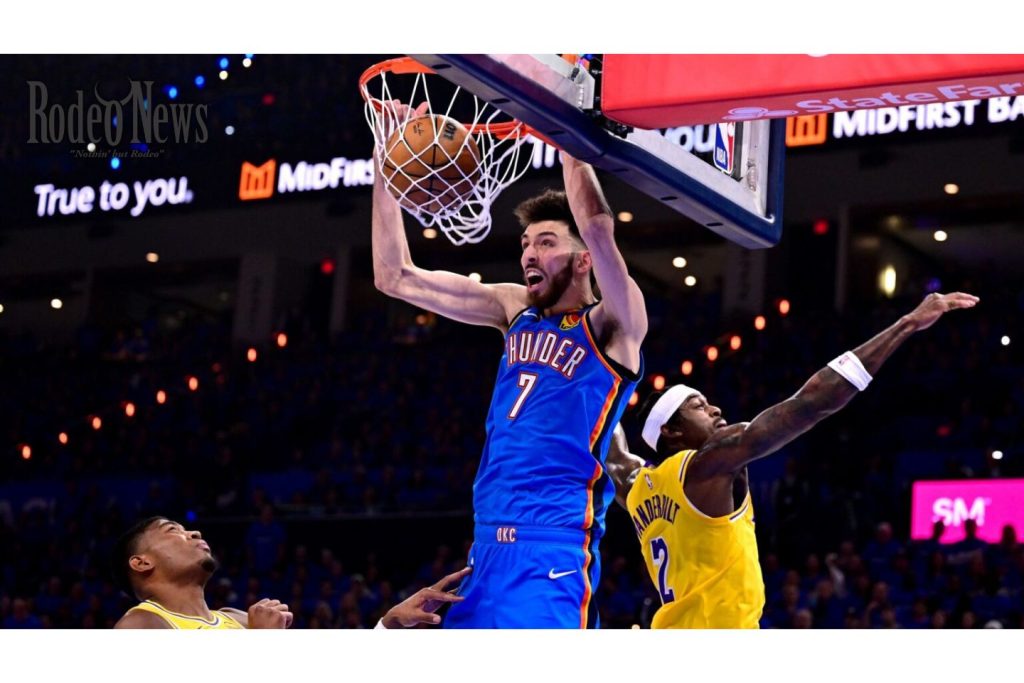
Chet Holmgren delivered one of the standout performances of the night, finishing with 24 points and 12 rebounds. His presence in the paint disrupted the Lakers’ interior scoring and controlled defensive rebounding, limiting second-chance opportunities.
Beyond Holmgren, Oklahoma City’s bench unit also outperformed Los Angeles significantly. The energy, shot-making, and defensive intensity from their second unit created a consistent separation every time the Lakers attempted to close the gap.
This depth advantage became one of the defining factors of the game. While the Lakers leaned heavily on their starters, the Thunder rotated fresh, high-impact players who maintained intensity on both ends of the floor.
The result was a steady build-up of momentum that eventually turned into a comfortable double-digit victory.
Tactical Breakdown: Why OKC Controlled the Game
From a tactical standpoint, Oklahoma City executed a clear and effective game plan:
- Pressure perimeter ball handlers to disrupt rhythm
- Force Lakers into isolation-heavy possessions
- Protect the paint with Holmgren as a defensive anchor
- Push pace whenever turnovers were created
The Lakers, meanwhile, struggled to adapt. Their half-court offense lacked movement, and their reliance on isolation plays made them predictable.
Additionally, the absence of consistent perimeter shooting allowed the Thunder defense to collapse inward, further shrinking scoring options.
What This Means for the Series
The Lakers vs Thunder Game 1 2026 result sets an important tone for the rest of the series. Oklahoma City now holds home-court momentum and confidence, while Los Angeles must quickly make adjustments.
For the Lakers, the key concerns are clear:
- Secondary scoring must improve
- Turnovers must be reduced
- Reaves or another guard must step up offensively
- Defensive transitions must tighten
For the Thunder, the formula remains simple:
- Continue relying on depth
- Maintain defensive pressure
- Let Holmgren and perimeter defense dictate tempo
If Game 1 is any indication, Oklahoma City has multiple ways to win, while the Lakers are still searching for stability beyond their superstar leadership.
Looking Ahead to Game 2
Game 2 will be a critical test for both teams. The Lakers must respond with urgency to avoid falling into a 0–2 series deficit, while the Thunder will look to assert full control at home.
Adjustments to watch include:
- Increased ball movement from the Lakers
- Possible rotation changes for LA’s bench
- Continued defensive switching from OKC
- Whether LeBron is forced into an even higher usage role
If Los Angeles cannot fix its offensive inefficiencies quickly, the series could shift heavily in Oklahoma City’s favor.