Greta Gerwig Narnia Takes a Bold Rock Opera Turn
The Greta Gerwig Narnia adaptation is finally beginning to reveal its visual and creative identity, and the new film appears to be taking a very different path from previous versions of C.S. Lewis’s fantasy world.
Gerwig’s upcoming Narnia: The Magician’s Nephew is being shaped around a striking creative idea: a fantasy film inspired by the scale, emotion and mythology of rock music.
Speaking to Empire, Gerwig described her initial ambition for the project as wanting a “rock opera.” She emphasized that the film is not literally a musical, but said the music and mythology of major British rock artists became an important influence on the way she imagined Lewis’s story.
That approach helps explain some of the surprising details emerging from the first look at the movie.
Among the biggest revelations is the official confirmation that Meryl Streep will provide the voice of Aslan. The film also features an Aslan design with visual elements influenced by David Bowie, while the story itself moves its young protagonists into postwar 1950s Britain.
Netflix is scheduled to release Narnia: The Magician’s Nephew in theaters on February 12, 2027, before the movie arrives on Netflix on April 2.
Greta Gerwig Narnia Embraces a Rock Opera Vision
Gerwig’s description of the movie as a “rock opera” offers one of the clearest clues yet about how she intends to approach The Magician’s Nephew.
The phrase might initially suggest that the movie will feature characters suddenly breaking into songs. Gerwig, however, has clarified that this is not what she means.
Instead, rock music serves as a creative and emotional reference point.
She cited major artists including David Bowie, Paul McCartney, David Gilmour, Pete Townshend, Jimmy Page and Robert Plant as important influences on her artistic life.
For Gerwig, that musical influence connects directly to the mythology at the heart of The Magician’s Nephew.
The story explores the creation of Narnia itself. Aslan sings the world into existence, turning music into a fundamental part of the fictional universe.
Gerwig sees a natural connection between that idea and rock music.
Her interpretation suggests that sound, movement, spectacle and emotion could become important parts of how the new film presents Narnia.
Rather than treating music simply as background accompaniment, the production appears to be using the idea of music as part of the film’s mythology.
David Bowie Becomes a Surprising Narnia Influence
One of the most unexpected elements of the first look is the apparent influence of David Bowie on Aslan.
The Great Lion has traditionally been presented as a majestic, powerful and spiritually significant figure.
Gerwig’s version introduces a different visual language.
According to current reports about the Empire first look, Aslan features mismatched eyes and a prominent red marking that deliberately evokes Bowie.
The connection is particularly interesting because Bowie represented a very specific kind of theatrical transformation.
His career repeatedly blurred the boundaries between music, fashion, performance and identity.
For Gerwig, that seems to provide a useful visual reference for a character who is simultaneously an animal, a creator and one of the most powerful beings in the Narnia universe.
The Bowie influence does not mean Aslan is being turned into a rock musician.
Instead, it appears to be part of a broader aesthetic strategy.
The design suggests that Gerwig wants her version of Narnia to feel strange, theatrical and otherworldly rather than simply reproducing the familiar visual style of previous adaptations.
Meryl Streep Is Officially Aslan
Another major revelation surrounding the Greta Gerwig Narnia project is the confirmation of Meryl Streep as the voice of Aslan.
Rumors about Streep’s involvement had circulated for more than a year, but the Empire report now confirms the casting.
Gerwig also explained why she wanted Streep for the role.
She was looking for an actor capable of combining authority and emotional depth with warmth, humor and a sense of wonder.
That combination was particularly important because Aslan is not simply a commanding fantasy character.
The character must also communicate joy, compassion, mystery and an almost mythological sense of age.
Gerwig said she wanted someone older than 70 who could convey the wisdom of experience while still possessing the freshness of a child.
She ultimately identified Streep as fitting that unusually specific combination.
The casting gives the new Aslan a distinctive voice before audiences have even seen the full film.
The Story Moves Into 1950s Britain
The visual changes do not stop with Aslan.
Gerwig has also changed the historical setting surrounding Digory and Polly.
Instead of keeping the story in the early 20th century period associated with the original novel, the film moves the children into postwar 1950s Britain.
That decision gives the movie a different cultural backdrop.
Britain in the 1950s was still dealing with the consequences of World War II.
Cities were rebuilding.
Bomb sites remained visible.
A generation of children was growing up in a society shaped by loss, austerity and major social change.
Gerwig has connected that environment to the later explosion of British popular culture.
Her interpretation is built around the idea that a generation surrounded by destruction could eventually create something radically imaginative.
That theme fits naturally with the creation of Narnia.
The fictional world begins in the middle of an ordinary reality before expanding into something enormous and magical.
The contrast between postwar Britain and the birth of an entirely new fantasy universe could therefore become one of the film’s central visual ideas.
Digory and Polly Lead the Adventure
At the center of the story are Digory Kirke and Polly Plummer.
The two young characters are played by newcomers David McKenna and Beatrice Campbell.
Their adventure is fundamentally different from the premise of The Lion, the Witch and the Wardrobe.
Instead of discovering an already-established Narnia through a wardrobe, The Magician’s Nephew explores the origins of the world itself.
That gives Gerwig an opportunity to create a version of Narnia audiences have never seen on screen.
The film can show the process of creation rather than simply sending characters into an existing fantasy kingdom.
It also introduces characters and locations that help explain the mythology behind Lewis’s wider series.
Among the most important is Jadis, who later becomes associated with the White Witch.
Emma Mackey plays the character in Gerwig’s adaptation.
Emma Mackey Plays Jadis
Mackey’s casting as Jadis adds another major connection to the broader Narnia mythology.
Jadis is introduced in The Magician’s Nephew as the last queen of Charn, a figure whose actions have consequences for the future of Narnia.
The character is therefore more than a conventional fantasy villain.
Her history connects directly to the mythology surrounding the creation of Narnia and the dangers that emerge after the world comes into existence.
By adapting The Magician’s Nephew, Gerwig is effectively starting at one of the chronological beginnings of Lewis’s universe.
That gives her the opportunity to establish mythology that could potentially inform future films.
Netflix has positioned the movie as a sweeping adventure centered on the creation of Narnia.
The Movie Has a Major Ensemble Cast
The film’s cast extends well beyond its young leads.
Alongside McKenna, Campbell and Mackey, the production features Carey Mulligan, Ciarán Hinds, Daniel Craig, Kobna Holdbrook-Smith, Denise Gough, Susan Wokoma and Meryl Streep.
Daniel Craig’s involvement is particularly notable given his international profile and previous work in large-scale franchises.
Carey Mulligan also reunites with Gerwig after the director’s earlier work in contemporary and period drama.
The ensemble gives the production significant acting experience around its two young leads.
That is important for a story that moves between ordinary human life and a massive fantasy mythology.
The adults need to establish a believable real-world environment before the movie transitions into its more fantastical elements.
Mark Ronson and Andrew Wyatt Return
The musical identity of the Greta Gerwig Narnia project is also supported by collaborators familiar to fans of her work.
Mark Ronson and Andrew Wyatt, who worked with Gerwig on Barbie, are providing the original score for The Magician’s Nephew.
Their involvement is particularly interesting given Gerwig’s emphasis on music as a creative influence.
The film is not being presented as a conventional musical, but the score could play an important role in creating its atmosphere.
Gerwig’s Barbie demonstrated how music could become an important storytelling device in a large studio production.
For Narnia, the challenge is different.
The music needs to support the creation of a fantasy world while reflecting Gerwig’s rock-inspired vision.
That could result in a soundscape quite different from earlier cinematic versions of Narnia.
Netflix Is Giving Narnia a Major Theatrical Release
The film’s release strategy is another major part of the story.
Netflix originally planned a different rollout for Gerwig’s Narnia film, but the company has since shifted toward a much broader theatrical strategy.
The movie is scheduled to open in theaters on February 12, 2027, with IMAX previews beginning February 10. It will then arrive on Netflix on April 2.
The theatrical window is significant because Netflix has traditionally emphasized streaming for many of its original films.
Narnia: The Magician’s Nephew represents a much larger theatrical commitment.
The scale of Lewis’s fantasy world makes the decision understandable.
A story about the creation of an entire magical universe is naturally suited to a large cinema screen.
IMAX also gives Netflix a way to emphasize the film’s visual scale before it becomes available to subscribers at home.
A New Beginning for the Narnia Franchise
Gerwig’s film is not simply another sequel to the previous Narnia movies.
It is a new adaptation of Lewis’s source material, giving Netflix an opportunity to establish its own cinematic version of the world.
The earlier film series began with The Lion, the Witch and the Wardrobe in 2005, followed by Prince Caspian and The Voyage of the Dawn Treader.
Gerwig is approaching the books from a different point.
The Magician’s Nephew is the sixth Narnia novel by publication order but is the first chronologically in the fictional timeline.
That makes it a logical starting point for a new screen interpretation.
More importantly, the story provides an origin narrative.
The audience gets to see how Narnia begins.
That gives the filmmakers considerable freedom to establish a visual language for the world from the beginning.
Why Gerwig’s Approach Is Different
The most notable feature of the new adaptation may be the combination of traditional fantasy and rock-inspired aesthetics.
Gerwig is not simply updating the costumes or changing the setting.
She appears to be thinking about the entire emotional identity of the story.
The idea of Narnia as a world created through music provides a thematic bridge between Lewis’s mythology and Gerwig’s own artistic influences.
The 1950s setting gives that concept a historical foundation.
The Bowie-inspired Aslan design adds a contemporary cultural reference.
And the involvement of Ronson and Wyatt gives the production a musical team familiar with Gerwig’s creative process.
Together, those elements point toward a film that wants to feel recognizable as Narnia while still establishing its own identity.
The First Look Raises Expectations
The first official look matters because Gerwig and Netflix have kept many details of the production private.
The new material gives audiences their clearest indication yet of the film’s visual direction.
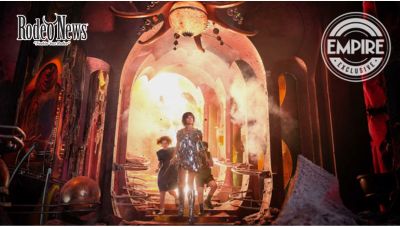
Digory and Polly appear alongside Jadis in a fantastical environment, while Aslan’s unusual design immediately stands out.
The images do not reveal the entire story.
They do, however, reinforce the idea that this will not be a straightforward remake of earlier Narnia adaptations.
Instead, Gerwig is building a new interpretation around themes of music, creation, childhood, loss and imagination.
Those themes are closely connected to the source novel.
What Comes Next for Narnia
The biggest question now is how audiences will respond to Gerwig’s interpretation.
The director is coming off the enormous cultural impact of Barbie, while Narnia represents a completely different kind of filmmaking challenge.
The story requires large-scale fantasy environments, creatures, mythology and visual effects.
At the same time, Gerwig has to preserve the emotional intimacy that makes Digory and Polly’s journey meaningful.
The decision to emphasize rock music and Bowie as creative influences adds another layer of curiosity.
It suggests that the film will have a strong stylistic identity rather than simply attempting to recreate the fantasy aesthetics audiences already associate with Narnia.
Netflix is also betting on the strength of the theatrical experience.
The February 2027 release will give audiences the chance to see Gerwig’s version of Narnia on the big screen before the film becomes available to Netflix subscribers.
Greta Gerwig Narnia Heads Toward a Bold 2027 Debut
The Greta Gerwig Narnia adaptation is now emerging as one of Netflix’s most ambitious fantasy projects.
The Magician’s Nephew combines a famous literary property with a director known for distinctive visual and emotional storytelling.
Gerwig’s description of the film as a “rock opera” offers an intriguing window into her approach, even though the movie is not literally a musical.
Her inspirations include David Bowie and several of the defining figures of British rock, while Aslan’s new appearance reportedly incorporates a deliberate Bowie influence.
Meryl Streep’s confirmed casting as Aslan adds another major element to the production.
Meanwhile, Emma Mackey, David McKenna and Beatrice Campbell lead the new generation of Narnia characters, supported by an experienced ensemble that includes Daniel Craig and Carey Mulligan.
The story’s move into 1950s Britain also gives Gerwig a distinctive foundation for exploring the relationship between trauma, imagination and creation.
Most importantly, the film will introduce audiences to Narnia at the moment of its birth.
That gives Gerwig a rare opportunity.
Rather than simply returning to a familiar fantasy world, she can define what this new cinematic version of Narnia looks, sounds and feels like from the beginning.
With a February 12, 2027 theatrical release and an April 2 Netflix debut, the next chapter of Lewis’s world is now moving closer to audiences.
And if Gerwig’s rock-inspired vision delivers on its promise, Narnia may look very different the next time audiences step through its magical door.