Tesla’s flying Roadster has delivered one of the most extraordinary product demonstrations in the electric vehicle industry’s recent history. But beyond its dramatic aerial maneuvers and rocket-inspired engineering, the vehicle raises a much bigger question: Is Elon Musk preparing Tesla to move beyond its traditional identity as a car manufacturer?
The next-generation Tesla Roadster was unveiled at an event in Texas on October 15, 2026. Developed with technology associated with Musk’s aerospace company, SpaceX, the vehicle demonstrated an ability to launch briefly into the air, perform midair maneuvers and land using specialized propulsion hardware. The presentation was a striking departure from an ordinary electric vehicle launch.
However, the demonstration also highlighted the gap between an ambitious engineering concept and a practical consumer product. Tesla has not established that its rocket-assisted configuration is suitable for ordinary public-road use, and production is not expected to begin until 2028, according to reports published after the unveiling.
For Tesla, the Roadster could therefore serve two purposes. It is a showcase for advanced vehicle engineering, but it is also a symbol of a company increasingly associated with artificial intelligence, robotics and autonomous transportation.
The suggestion that Tesla is saying goodbye to the car business is best understood as an interpretation of its changing priorities, not an announcement that the company plans to stop making vehicles.
Tesla Flying Roadster: A Spectacular Engineering Statement
The Roadster demonstration was designed to capture attention, and its unconventional features made it difficult to compare with a conventional sports car.
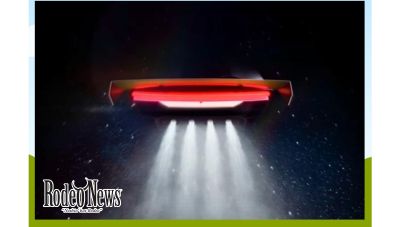
Tesla showed a vehicle capable of using an underbody suction system to maintain contact with a curved track, including an inverted section. The demonstration then featured the car launching into the air and completing a maneuver before returning to the ground with assistance from compressed-air thrusters.
These systems represent a combination of automotive engineering and aerospace-inspired technology. Instead of relying solely on tires, conventional aerodynamics and electric motors to deliver performance, the showcased configuration used additional hardware intended to create brief bursts of lift and unusual vehicle movement.
The result was an attention-grabbing presentation that pushed the boundaries of what audiences typically expect from an electric sports car.
Tesla also highlighted extraordinary acceleration claims, including a reported zero-to-60-mph time of less than one second. That figure remains a manufacturer claim rather than a performance result that should automatically be treated as independently verified for a production vehicle.
Axios
+1
For enthusiasts, the appeal is obvious. The Roadster promises a combination of speed, futuristic engineering and visual spectacle that few conventional production vehicles can match.
Yet spectacular performance does not necessarily translate into commercial success. The more complicated the technology becomes, the greater the challenge of making it reliable, affordable, maintainable and safe for everyday customers.
That distinction is central to understanding why the new Roadster may be more important as a statement about Tesla’s future than as a potential source of mass-market revenue.
Why the Roadster Could Mark a Turning Point for Tesla
Tesla helped transform public perceptions of electric vehicles by demonstrating that battery-powered cars could be desirable, fast and technologically advanced.
The original Roadster played an important role in that story. It established the company as a serious participant in the automotive industry before Tesla expanded into higher-volume models and a broader charging ecosystem.
The new version carries a different message.
Rather than concentrating exclusively on making electric cars more practical for everyday drivers, Tesla is presenting a vehicle built around an extreme vision of performance. Its technology also reflects the engineering overlap between Tesla’s automotive operations and SpaceX’s aerospace expertise.
That approach fits a broader change in how Musk describes Tesla’s ambitions. The company has increasingly emphasized autonomous driving, robotaxis, artificial intelligence and humanoid robots as potential pillars of its long-term business.
Axios
+1
The implication is not that vehicles have become irrelevant. Tesla’s automotive business remains central to its operations. Instead, the company appears to be pursuing a future in which selling cars is only one part of a much larger technology strategy.
The Roadster makes that transition visible in an unusually dramatic way. It celebrates the excitement of driving at a time when Tesla is also developing systems intended to reduce or eliminate the need for human drivers.
That contradiction may be precisely what makes the vehicle so interesting.
Elon Musk’s Vision Extends Beyond Traditional Cars
Musk’s long-term ambitions have increasingly centered on technologies that could change how people move, work and interact with machines.
At Tesla, autonomous driving and robotaxi services are intended to reshape transportation by shifting more responsibility from human drivers to software. Robotics represents another potential growth area, with humanoid machines envisioned for certain industrial and repetitive tasks.
These initiatives are fundamentally different from the conventional business of designing, manufacturing and selling cars. They depend on software development, artificial intelligence, computing infrastructure, sensor systems and the ability to deploy technology at scale.
The Tesla flying Roadster sits at the intersection of those ambitions and the company’s automotive heritage. It is still a sports car, but its unusual propulsion technology draws on expertise developed in the aerospace sector.
The relationship with SpaceX is especially significant. Tesla specializes in electric vehicles, batteries and vehicle control systems, while SpaceX develops rockets and spacecraft. Sharing engineering knowledge between the companies can create opportunities for experimentation that would be less common at a traditional automaker.
Nevertheless, technical collaboration does not automatically prove that the companies will merge or operate as a single business. Speculation about a potential Tesla-SpaceX combination has intensified around the Roadster reveal, but the companies have not confirmed a merger agreement.
MarketWatch
+1
For now, the most defensible conclusion is that Musk is increasingly presenting his companies as interconnected technology ventures rather than isolated businesses.
Tesla Flying Roadster Faces Major Safety and Regulatory Questions
The excitement surrounding the Tesla flying Roadster should not obscure the practical obstacles facing a vehicle that can briefly lift itself off the ground.
Road vehicles are subject to safety standards governing crash protection, braking, steering, occupant restraints and other essential systems. A car equipped with compressed-air thrusters and a mechanism for generating lift introduces additional questions that ordinary vehicles do not face.
Authorities would need to determine how such technology could be operated safely, what restrictions should apply and whether the vehicle could be approved for public-road use in different jurisdictions.
Tesla’s demonstration also raised questions about the distinction between a prototype capable of performing a maneuver and a finished vehicle that customers can use reliably.
A brief aerial stunt does not establish that the car can fly over meaningful distances, avoid obstacles in complex environments or operate safely near pedestrians and other vehicles. Nor does it demonstrate that the technology could function consistently under different weather conditions.
The distinction matters because consumers may interpret a dramatic product reveal as evidence that a finished product is almost ready for delivery.
In this case, the reported production target of 2028 indicates that substantial development work remains. Tesla has also acknowledged that the rocket-equipped configuration is not approved for public-road use.
Axios
+1
Safety is another concern. Musk described the vehicle as not necessarily optimized for safety, emphasizing its extreme performance characteristics during the presentation. That statement reinforces the need to distinguish a specialized demonstration vehicle from a road-ready production model.
Axios
+1
The Roadster’s long-term prospects will depend on whether Tesla can convert its engineering achievements into a product that meets regulatory requirements without losing the features that make it distinctive.
Why the Flying Roadster May Not Transform Tesla’s Revenue
A vehicle capable of dramatic aerial maneuvers could attract enormous attention, but its commercial potential is likely to differ significantly from that of Tesla’s mainstream electric cars.
High-performance sports cars typically serve a smaller market than mass-produced vehicles. Their prices, specialized components and limited practicality restrict the number of potential customers.
The rocket-equipped Roadster adds further complications. Its propulsion hardware, compressed-air systems and specialized engineering could increase production costs and make maintenance more complex.
The company has also not fully resolved key commercial questions, including the final price, detailed production specifications and delivery timetable for the showcased configuration. Reports following the event indicated that the rocket-equipped version would be offered under restricted conditions rather than as an ordinary road-going model.
Axios
+1
Even if Tesla succeeds in bringing the vehicle to market, it is unlikely to generate the volume of sales associated with its mainstream electric vehicles.
That does not mean the Roadster lacks commercial value. A high-profile flagship can strengthen a brand’s image, demonstrate engineering capabilities and attract customers who might otherwise overlook the company’s broader product range.
Luxury automakers frequently use exclusive performance vehicles to showcase their technical expertise, even when those models represent a small portion of total sales.
For Tesla, the Roadster could provide a similar halo effect. Its futuristic features may help maintain public interest while the company develops technologies that could have broader applications.
However, the financial significance of that strategy should not be overstated. A successful demonstration is not equivalent to sustained revenue, and consumer excitement does not guarantee profitable production.
Investors will ultimately need evidence that Tesla can turn its technological ambitions into products and services that customers are willing to pay for at scale.
What the Roadster Means for Tesla’s Artificial Intelligence Strategy
Tesla’s interest in artificial intelligence extends beyond the software used in its vehicles.
Autonomous driving requires systems capable of interpreting surroundings, predicting the movements of other road users and making decisions in complex environments. Developing those capabilities involves large amounts of data, powerful computing resources and extensive testing.
Robotaxis could eventually allow Tesla to generate revenue from transportation services rather than relying entirely on vehicle sales. Instead of purchasing a car for personal use, customers might pay for individual journeys provided by an autonomous fleet.
That model could change the economics of transportation, although its success depends on technical reliability, regulatory approval, customer acceptance and operating costs.
Humanoid robotics presents a different opportunity. Machines capable of performing repetitive physical tasks could eventually be used in manufacturing, logistics and other settings where automation offers economic advantages.
Neither business is guaranteed to deliver the results Musk envisions. Autonomous driving remains technically challenging, while general-purpose robots must overcome obstacles involving dexterity, reliability, cost and safe operation around people.
The Roadster does not directly solve those problems. Its significance lies more in what it communicates about Tesla’s engineering culture and the broader ambitions of its leadership.
A company that can attract attention with a highly unusual vehicle may also strengthen its reputation as a place where ambitious technical experiments are pursued.
Still, branding and engineering demonstrations cannot substitute for measurable progress in AI performance, robotaxi deployment or robotics commercialization.
Tesla’s transformation will ultimately be judged by the products it delivers and the business results they produce.
Could Tesla and SpaceX Become More Closely Connected?
The Roadster unveiling has also renewed discussion about a possible combination of Tesla and SpaceX.
The two companies have distinct core businesses, but their engineering capabilities overlap in areas such as advanced materials, control systems, computing and high-performance hardware. The Roadster’s compressed-air thrusters provide a visible example of how aerospace technology can be adapted for an automotive demonstration.
Some market observers have interpreted the collaboration as a sign that Musk may want to bring his business interests closer together. However, speculation is not confirmation, and neither company has announced a merger agreement.
MarketWatch
+1
A potential combination would raise significant questions about corporate governance, valuation, shareholder interests and the management of businesses with very different financial and operational requirements.
Tesla is a publicly traded electric-vehicle and technology company. SpaceX operates in the aerospace sector, with its own contracts, capital requirements and strategic priorities. Combining them would require careful consideration of how assets, liabilities and future investments should be valued.
The Roadster’s engineering collaboration therefore offers evidence of technical overlap, but it should not be treated as proof of an impending corporate transaction.
For Tesla shareholders, the more immediate question is whether the company’s expanding ambitions can create sustainable value without distracting management from its existing business.
How Tesla’s Strategy Could Affect the Electric Vehicle Industry
Tesla’s evolving priorities could have implications for competitors across the automotive industry.
Traditional manufacturers have spent years investing in electric powertrains, battery technology, software and driver-assistance systems. Many are now competing on price, efficiency, charging convenience and the quality of their digital features.
If Tesla devotes more resources to AI, robotics and autonomous transportation, rivals could find opportunities to strengthen their positions in conventional electric vehicles.
However, Tesla’s technological ambitions could also produce innovations that eventually benefit its automotive products. Improvements in computing, control systems, battery management and manufacturing could support both experimental vehicles and mainstream models.
The outcome will depend on how effectively the company allocates capital and engineering talent.
The flying Roadster is unlikely to determine the future of the electric vehicle market on its own. Its more important role may be to illustrate the increasingly blurred boundaries between automotive engineering, aerospace technology and artificial intelligence.
That convergence could encourage manufacturers to reconsider what a vehicle can do. Yet the industry’s immediate priorities remain much more practical: delivering dependable products, controlling costs, expanding charging infrastructure and meeting customer expectations.
A futuristic prototype can inspire the public, but sustained industrial success requires products that work reliably outside a carefully controlled demonstration environment.
The Roadster’s Biggest Challenge Is Turning Spectacle Into Reality
Tesla has built much of its reputation on challenging assumptions about what electric vehicles can achieve. The Roadster’s dramatic unveiling continues that tradition, combining high-performance engineering with a presentation designed to generate global attention.
But the company faces a familiar challenge: translating ambitious promises into commercially viable products.
The next two years will be important as Tesla works toward the reported 2028 production target. Potential customers will want clear information about pricing, specifications, delivery schedules, reliability and the capabilities available in each version.
Regulators will also need to determine what forms of operation are permissible, particularly for the rocket-equipped configuration.
Until those questions are resolved, the flying Roadster remains as much a statement of intent as a conventional product launch.
Tesla’s wider strategy will face an even more demanding test. Autonomous driving, robotaxis and humanoid robotics offer potentially significant opportunities, but each requires substantial investment and measurable progress before its commercial impact can be established.
The company must balance these long-term ambitions with the financial realities of manufacturing and selling vehicles today.
That balance could determine whether Tesla successfully evolves into a broader technology company or risks spreading its resources across too many difficult projects.
Conclusion: Is Tesla Really Saying Goodbye to Cars?
The Tesla flying Roadster represents a striking moment in Elon Musk’s effort to redefine the company’s future. Its rocket-inspired technology demonstrates an appetite for engineering experiments that go far beyond the expectations of a conventional automaker.
Yet the idea that Tesla is abandoning the car business requires an important qualification. The company has not announced that it will stop manufacturing vehicles. Instead, its strategy increasingly emphasizes AI, autonomous transportation and robotics alongside its established automotive operations.
The Roadster captures that tension. It celebrates the excitement of driving while Musk promotes a future in which autonomous systems could handle much of transportation.
Whether the vehicle becomes a commercially successful product remains uncertain. Its production timeline, safety requirements, regulatory status and final specifications will all influence its prospects.
For now, the strongest conclusion is that Tesla is attempting to expand the definition of what it is. The flying Roadster may not replace the company’s mainstream vehicles, but it offers a memorable illustration of the ambitions shaping its next chapter.
The real test will not be whether the Roadster can perform an astonishing stunt. It will be whether Tesla can turn its broader technological vision into safe, useful and profitable products.