Michael Dell Donation Surpasses $1 Billion, Transforming UT Austin
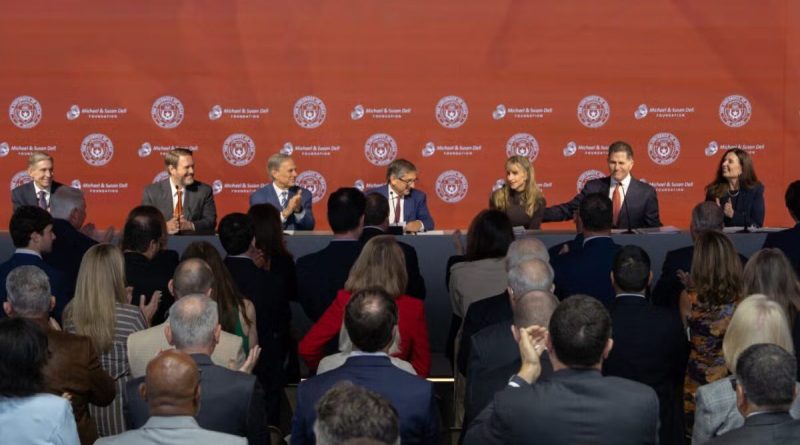
The Michael Dell donation milestone has officially crossed an unprecedented threshold, with billionaire entrepreneur Michael Dell and his wife Susan Dell surpassing $1 billion in total contributions to the University of Texas at Austin (UT Austin). This historic achievement positions the couple as the university’s first-ever billion-dollar donors and marks a defining moment in the future of higher education, healthcare, and research in the United States.
Announced on April 21, 2026, the latest contribution—valued at $750 million—will fund a groundbreaking expansion of UT Austin’s medical and research infrastructure. The investment is expected to reshape the university’s capabilities in artificial intelligence, healthcare innovation, and advanced computing.

A Historic Philanthropic Milestone
The Michael Dell donation is not just another philanthropic gesture—it represents a transformational commitment spanning decades. With this latest funding, the Dells have officially become the largest donors in UT Austin’s history, reinforcing their long-standing relationship with the institution where Michael Dell famously launched his computer business from a dorm room.
University officials confirmed that this milestone reflects years of sustained giving, including earlier contributions that helped establish the Dell Medical School in 2013.
This cumulative investment underscores a broader vision: building a world-class ecosystem where education, research, and real-world innovation intersect.
$750 Million Investment: What It Will Fund
The newest Michael Dell donation of $750 million will support several major initiatives, each designed to push UT Austin into the top tier of global research universities.
1. UT Dell Medical Center
A significant portion of the funding will go toward constructing the UT Dell Medical Center, a next-generation hospital expected to open by 2030. This facility is being described as an “AI-native” hospital, meaning artificial intelligence will be integrated into every layer of patient care—from diagnostics to treatment planning.
The hospital aims to revolutionize healthcare delivery by enabling faster diagnoses, personalized treatments, and improved patient outcomes.
2. Advanced Research Campus
The donation will also fund the creation of the UT Dell Campus for Advanced Research, a sprawling development designed to bring together experts in life sciences, engineering, and computing.
This campus will serve as a hub for:
- Medical research and innovation
- Artificial intelligence development
- Data-driven healthcare solutions
By combining these disciplines, UT Austin aims to accelerate breakthroughs that can directly impact global health.
3. Supercomputing Expansion
Another critical component of the Michael Dell donation is investment in the Texas Advanced Computing Center (TACC). The funding will help expand one of the most powerful academic supercomputing systems in the United States.
This enhancement will support large-scale data analysis, AI modeling, and scientific research across multiple disciplines.
4. Scholarships and Student Support
Beyond infrastructure, the Dells’ contribution will significantly expand:
- Undergraduate scholarships
- Student housing initiatives
- Financial aid programs
These efforts aim to ensure that students from diverse backgrounds can access and benefit from UT Austin’s growing resources.
Transforming Healthcare Through Artificial Intelligence
One of the most compelling aspects of the Michael Dell donation is its focus on integrating artificial intelligence into healthcare systems.
The planned medical center will leverage AI to:
- Predict diseases earlier
- Optimize hospital workflows
- Personalize treatment plans
- Enhance clinical decision-making
Experts believe this approach could redefine how hospitals operate, setting a new global standard for patient care.
Additionally, the project will involve collaboration with leading institutions such as MD Anderson Cancer Center, further strengthening its impact on cancer research and treatment.
Boosting Austin as a Global Innovation Hub
The impact of the Michael Dell donation extends far beyond the university campus. It is expected to significantly boost Austin’s position as a global center for technology and healthcare innovation.
City leaders and university officials anticipate that the investment will:
- Create thousands of jobs
- Attract top-tier researchers and faculty
- Encourage private-sector partnerships
- Drive economic growth
Michael Dell himself emphasized the synergy between a strong research university and a dynamic city, noting that such collaborations can lead to “breakthroughs that change lives.”
Supporting UT Austin’s $10 Billion Vision
The donation also plays a crucial role in UT Austin’s ambitious plan to raise $10 billion over the next decade. This broader fundraising campaign aims to elevate the university’s medical and research capabilities into the top 10 nationally.
With the Dells’ contribution accounting for a significant portion of that goal, momentum is expected to accelerate as other donors and institutions join the effort.
A Legacy of Giving
The Michael Dell donation milestone is part of a broader pattern of philanthropy that has defined the couple’s legacy. Through the Michael & Susan Dell Foundation, they have supported initiatives in:
- Education
- Healthcare
- Child welfare
- Economic opportunity
In recent years, their giving has reached billions of dollars, including large-scale programs aimed at improving financial access and long-term outcomes for children and families.
Their approach to philanthropy is often described as strategic and impact-driven, focusing on scalable solutions rather than one-time contributions.
Challenges and Context
While the Michael Dell donation is widely celebrated, it also highlights broader trends in higher education funding.
As public funding declines, universities are increasingly relying on large private donors to finance major projects. This shift raises important questions about:
- Institutional independence
- Funding priorities
- Equity in higher education
Some faculty members have also expressed concerns about political and policy challenges that could impact the university’s long-term trajectory.
Why This Donation Matters Globally
The significance of the Michael Dell donation extends beyond Texas or even the United States.
It represents:
- A new model for integrating AI into healthcare
- A blueprint for university-led innovation ecosystems
- A major step forward in data-driven medicine
If successful, the UT Dell Medical Center could become a global reference point for how technology and healthcare can be seamlessly combined.
Internal Link
Read more insights on tech innovation at:
👉 https://yourwebsite.com/ai-healthcare-future
External Sources
- University of Texas official announcement
- AP News coverage on AI medical center
- Axios report on donation impact
Conclusion
The Michael Dell donation surpassing $1 billion is more than a financial milestone—it is a transformative investment in the future of education, healthcare, and innovation.
By funding an AI-driven medical center, expanding research capabilities, and supporting students, Michael and Susan Dell are helping redefine what a modern university can achieve.
As UT Austin moves forward with its ambitious vision, this historic contribution will likely stand as a cornerstone of its evolution into a global leader in science, medicine, and technology.