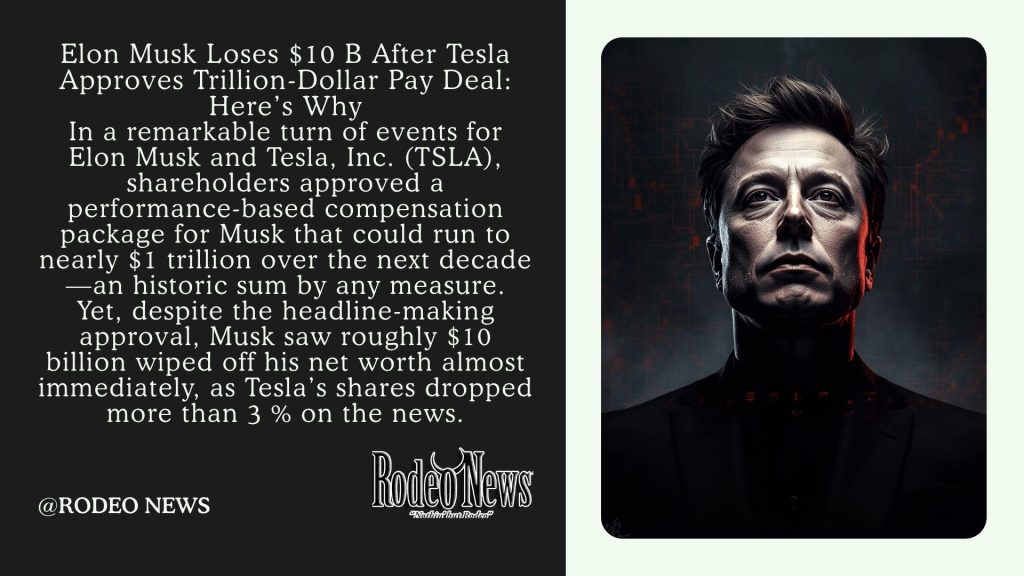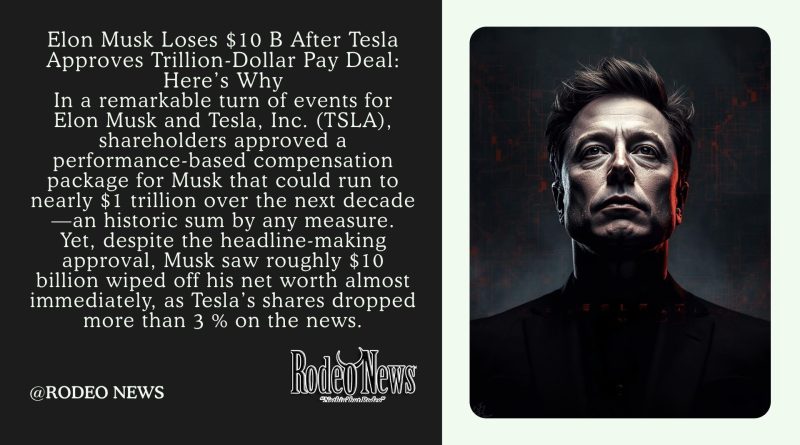
Elon Musk Loses $10 B After Tesla Approves Trillion-Dollar Pay Deal: Here’s Why
In a remarkable turn of events for Elon Musk and Tesla, Inc. (TSLA), shareholders approved a performance-based compensation package for Musk that could run to nearly $1 trillion over the next decade—an historic sum by any measure. Yet, despite the headline-making approval, Musk saw roughly $10 billion wiped off his net worth almost immediately, as Tesla’s shares dropped more than 3 % on the news.
What the deal entails
The pay package delegates to Musk a massive stake in Tesla if certain long-term milestones are met:
- A market capitalisation target of approximately $8.5 trillion.
- Delivery of 20 million vehicles annually.
- Deployment of 1 million humanoid robots (via Tesla’s “Optimus” project)
- Establishment of 1 million commercial robot-taxis
- Rising adjusted earnings (EBITDA or equivalent) of at least $400 billion on a sustained basis
In short, the board and Musk are positioning Tesla not merely as an automaker, but as a future leader in robotics and artificial intelligence
Why Musk lost $10 billion despite the win
The paradox here is two-fold:
- Stock drop upon news – Tesla’s share price declined in the wake of the vote, reflecting investor unease at the magnitude of the payout and the associated dilution risk. This triggered an immediate net-worth hit for Musk.
- Stringent performance conditions – The full value of the package is far from guaranteed. Musk only unlocks the award if the ambitious targets are met. In effect, much of the “trillion-dollar” number is conditional. Until that happens, the premium is speculative.
Governance and shareholder concerns
The size of the package drew vocal opposition from major investors and proxy advisory firms. For example:
- Norges Bank Investment Management (Norway’s sovereign wealth fund), a significant Tesla shareholder, announced plans to vote against the deal, citing concerns over dilution and “key person” risk. The Guardian
- Firms such as Institutional Shareholder Services (ISS) and Glass Lewis urged shareholders to reject the proposal, arguing it lacked sufficient guardrails. Reuters
- Critics argued Tesla’s board was too closely aligned with Musk — raising questions about independence and oversight. Reuters
On the other side, Tesla’s board emphasised the risk of losing Musk’s leadership if he were not properly incentivised — a key argument in favour of the deal. The Straits Times
The broader implications
This deal sets a precedent in several ways:
- It may shift expectations around executive compensation in tech and automotive sectors, especially for CEOs who also play an operational and product-vision role. www.ndtv.com
- It demonstrates how intertwined Musk’s personal wealth, investor confidence, and Tesla’s future ambitions have become.
- The conditional nature of the payout means Tesla’s ability to deliver on robotics, AI, and autonomous mobility will be under even greater scrutiny.
What comes next
For shareholders, the key will be to monitor progress against the performance milestones — not just vehicle deliveries, but robotics, autonomous systems, and margin expansion. For Musk, the deal reinforces his role as the central figure in Tesla’s long-term transformation. But for now, the immediate hit to his net worth emphasises that even giant pay deals are not immune to market scepticism.
If you’d like, I can craft a shorter “by-the-numbers” summary or a deeper dive on how this might affect governance at Tesla.