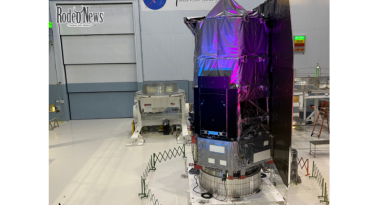
Roman Space Telescope: 5 Stunning Launch Moments
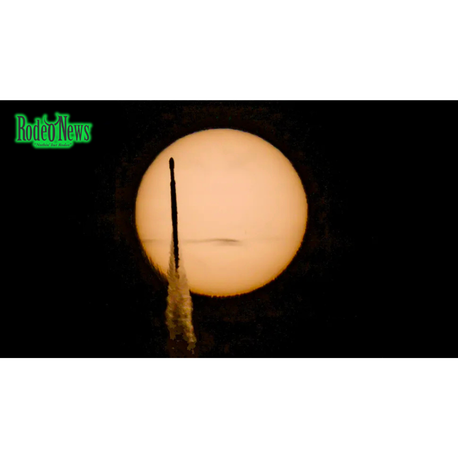
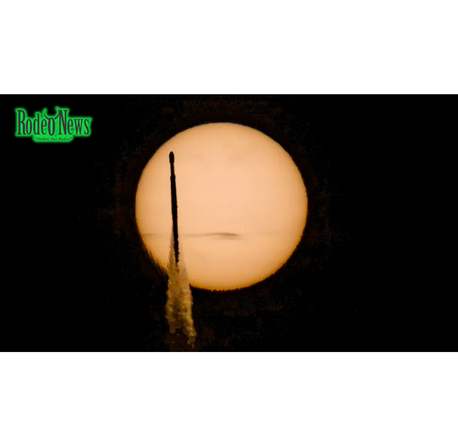
The Roman Space Telescope has begun its journey into space, but one extraordinary photograph has given the historic NASA mission an unforgettable visual signature. During the Aug. 30 launch from Florida, the observatory appeared to cross directly in front of the Sun as it climbed into the sky aboard a SpaceX Falcon Heavy rocket.
Space.com photographer Josh Dinner captured the remarkable moment from a parking lot in Titusville, Florida. The image shows the Falcon Heavy and NASA’s Nancy Grace Roman Space Telescope silhouetted against the bright solar disk, creating what appears to be a perfectly timed transit.
The photograph was not simply the result of luck. Dinner described a carefully considered effort involving the launch trajectory, the position of the Sun and an improvised shooting location that ultimately placed him in a Hobby Lobby parking lot.
The spectacular image came during a major milestone for NASA. The Roman Space Telescope launched at 7:26 a.m. EDT Sunday from Launch Complex 39A at NASA’s Kennedy Space Center in Florida. The observatory is now beginning a roughly three-month journey toward its final operating location, about 1 million miles from Earth.
1. The Roman Space Telescope Created a Picture-Perfect Moment
Photographing a rocket launch is difficult under normal circumstances. Capturing a spacecraft precisely as it crosses the Sun is another challenge entirely.
The position of the rocket changes rapidly during ascent, while the Sun remains an extremely bright and unforgiving photographic target. The timing must be precise, and the photographer must also be in the correct location to align the launch vehicle with the solar disk.
Dinner’s photograph succeeded in capturing exactly that alignment.
According to Space.com, he ended up racing to a Titusville Hobby Lobby parking lot after determining that the location offered the right perspective for the launch. The resulting image showed the Falcon Heavy crossing the face of the Sun with the Roman observatory visible against the solar background.
The photograph highlights a fascinating intersection between spaceflight and terrestrial photography. The telescope itself was traveling thousands of miles per hour, while the photographer had only a narrow window in which the alignment could occur.
That made preparation essential.
2. SpaceX Falcon Heavy Delivered NASA’s New Observatory
The photograph would not have been possible without one of the world’s most powerful operational rockets.
The Roman Space Telescope launched aboard SpaceX’s Falcon Heavy, a heavy-lift rocket consisting of a central core and two side boosters. NASA reported that the rocket’s 27 Merlin engines generated more than 5 million pounds of thrust during the ascent.
The launch marked another important milestone for Falcon Heavy and NASA’s next-generation astronomy program.
At liftoff, the three first-stage cores worked together to propel the spacecraft away from Florida. About two minutes into the flight, the two side boosters separated from the center core and began their return toward landing zones near the launch site.
NASA later reported that the boosters completed their planned returns, with landings at Landing Zone 2 and Landing Zone 40.
The Falcon Heavy’s center core continued powering the second stage and the Roman observatory toward space.
This sequence demonstrated the complexity behind what appeared from the ground as a single brilliant streak across the morning sky.
3. The Launch Was Only the Beginning for Roman
Although the launch generated spectacular photographs, the most important part of the mission is still ahead.
The Roman Space Telescope is designed to investigate some of the biggest questions in modern astronomy. NASA says the observatory will study dark matter, dark energy and exoplanets while surveying enormous portions of the sky.
Unlike telescopes that concentrate on relatively small regions, Roman is designed to combine a wide field of view with sharp infrared observations.
That capability could transform how astronomers study the universe.
Roman is expected to map billions of galaxies and gather enormous quantities of astronomical data. Its wide surveys will allow scientists to investigate how the universe has evolved and how its structure has changed over cosmic time.
The mission is planned to operate for approximately five years, with NASA identifying a potential 10-year goal. The telescope’s destination is the Sun-Earth L2 point, a location roughly 1 million miles from Earth that is well suited to space observatories.
4. Roman Could Transform the Search for Dark Energy
One of the central scientific goals of the Roman Space Telescope is understanding dark energy.
Dark energy is the name scientists give to the mysterious phenomenon associated with the accelerating expansion of the universe. Although its effects can be measured, its fundamental nature remains one of the major unanswered questions in physics and astronomy.
Roman will give researchers a powerful new tool for studying that problem.
By conducting enormous surveys of galaxies and cosmic structures, the telescope will help scientists investigate how the universe expanded over time.
Its observations could complement data from other major observatories and ground-based surveys.
The result could be a much clearer picture of the forces shaping the cosmos.
5. The Telescope Will Also Search for Distant Worlds
The Roman Space Telescope is not only focused on cosmology.
NASA expects the observatory to make important contributions to the study of planets beyond our solar system, known as exoplanets. Its wide-field capabilities will allow astronomers to investigate distant planetary systems and search for worlds that would be difficult to identify through more conventional observing strategies.
Roman will also carry a coronagraph instrument designed to demonstrate technologies for directly studying planets orbiting other stars.
NASA’s Jet Propulsion Laboratory said the mission will test the Coronagraph Instrument as part of its effort to advance techniques for studying exoplanets.
That technology demonstration could have significance well beyond the Roman mission itself.
If successful, it could help pave the way for future space telescopes capable of studying the atmospheres and environments of distant worlds in greater detail.
Why the Roman Launch Photograph Matters
The spectacular Sun-crossing photograph does more than provide a beautiful image.
It captures the precise transition between a spacecraft still connected to Earth and one beginning its journey into deep space.
For the public, such images can make an extraordinarily complex scientific mission easier to understand.
A spacecraft built over many years, a massive rocket, a carefully calculated trajectory and a photographer positioned in exactly the right location all came together for a fraction of a second.
The result was a photograph that instantly communicates the scale and ambition of the mission.
It also demonstrates why launch photography remains such a specialized field.
A photographer cannot simply arrive at a random viewing location and expect a rocket to cross the Sun perfectly. The camera position, focal length, timing, weather and launch trajectory all matter.
In this case, Dinner’s decision to relocate quickly to the Titusville parking lot proved critical.
The Science Behind the Spectacular Launch
The Falcon Heavy launch involved a carefully choreographed series of events.
NASA reported that the rocket passed Max Q, the point during ascent when aerodynamic pressure on the vehicle is greatest. Shortly afterward, the two side boosters shut down and separated from the center core.
The center core then continued toward main engine cutoff and stage separation.
The second-stage Merlin Vacuum engine subsequently took over, pushing Roman toward its intended trajectory. NASA also reported that the rocket’s fairing separated after the vehicle reached an altitude where the spacecraft no longer needed its protection from the atmosphere.
Each of these events occurred within minutes.
From the ground, however, the launch could look deceptively simple: a bright rocket rising through the morning sky.
Behind that image was an intricate sequence involving propulsion, guidance, separation, communications and spacecraft protection.
Roman’s Journey to the Sun-Earth L2 Point
The Roman Space Telescope is now on a three-month journey toward its final orbit.
NASA says the observatory will operate around the Sun-Earth L2 point, a region of space that allows a spacecraft to maintain a useful relationship with both Earth and the Sun.
Getting there is an important part of the mission.
After launch, the spacecraft must perform its planned maneuvers and complete a series of deployment and commissioning activities before scientific observations can begin.
Once operational, Roman will survey huge portions of the universe.
Its observations are expected to produce a massive volume of data for astronomers around the world.
That makes the launch only the first major step in a much longer scientific campaign.
A New Era for NASA Astronomy
The successful launch represents a major moment for NASA’s astronomy program.
Roman has been developed to answer questions that cannot easily be addressed by observing only a small number of individual objects.
Its ability to survey large areas quickly will give astronomers a different way of looking at the cosmos.
Instead of focusing solely on individual stars or galaxies, researchers can examine enormous populations and identify patterns across the universe.
That approach could produce discoveries that scientists do not currently anticipate.
In this sense, Roman is not simply another space telescope.
It is a survey observatory designed to generate a broad map of the universe while also enabling targeted studies of individual astronomical objects.
What Comes Next for the Roman Space Telescope?
The immediate priority is spacecraft commissioning.
NASA and mission teams must ensure that the observatory’s systems are functioning correctly after launch. The telescope will then continue its journey toward the Sun-Earth L2 region.
Once Roman reaches its operating location, engineers will begin preparing its instruments and systems for scientific observations.
The mission’s planned five-year lifetime gives astronomers years to investigate dark energy, dark matter, exoplanets and the evolution of galaxies. NASA’s technical overview lists a 10-year goal, potentially extending the observatory’s scientific productivity even further.
The first images and scientific results will therefore be only the beginning.
The Bottom Line
The Roman Space Telescope has officially left Earth, beginning one of NASA’s most ambitious astronomy missions of the decade.
Its Falcon Heavy launch was successful, its side boosters returned to Florida and the observatory is now traveling toward its final destination near the Sun-Earth L2 point.
But for many people, the launch will also be remembered for one extraordinary image.
Josh Dinner’s photograph of the spacecraft crossing the Sun transformed a complex scientific event into a single, unforgettable moment. The image captured the Roman Space Telescope at the exact intersection of technology, timing and human persistence.
Now the telescope has a much bigger task ahead.
Over the coming years, Roman will survey billions of galaxies, investigate the mysterious forces driving cosmic expansion, search for distant worlds and collect vast amounts of data about the universe.
The Sun-crossing photograph lasted only an instant.
The scientific mission it represents could reshape our understanding of the cosmos for decades.