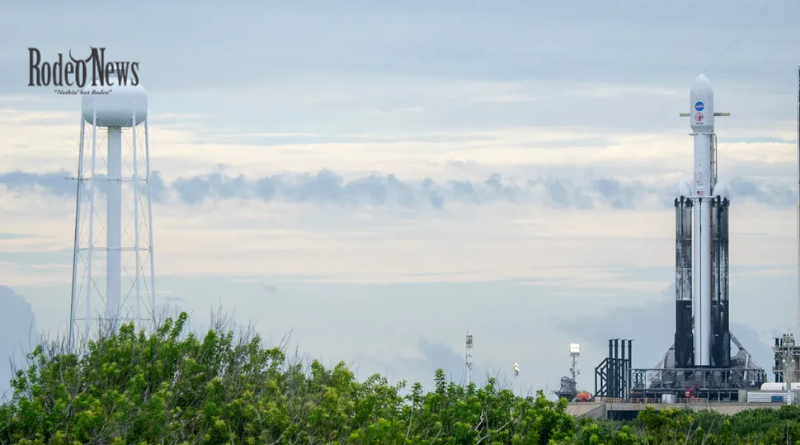
The Nancy Grace Roman Space Telescope is entering the final hours before one of NASA’s most important astronomy missions of the decade. The observatory is now positioned for launch at NASA’s Kennedy Space Center in Florida, where it is scheduled to ride a SpaceX Falcon Heavy into space on Sunday, Aug. 30.
NASA and SpaceX are targeting liftoff for 7:26 a.m. EDT (1126 GMT) from Launch Complex 39A. NASA’s official launch coverage is scheduled to begin at 6:20 a.m. EDT.
The mission is designed to transform how scientists study the universe. Roman will investigate dark energy and dark matter, examine the evolution of galaxies, search for exoplanets and perform wide-field surveys that could reveal enormous numbers of distant cosmic objects.
With the spacecraft now at the launch pad, attention is shifting from preparation to launch-day operations.
Nancy Grace Roman Space Telescope Reaches the Launch Pad
The latest milestone came on Aug. 29, when the Falcon Heavy carrying Roman was raised into position at Launch Complex 39A.
Space.com reported that the rocket and telescope were standing on the historic launch pad less than 24 hours before the planned liftoff. NASA also scheduled science and prelaunch briefings for the final day of preparations.
The launch campaign has progressed through several major steps during August. The observatory was encapsulated inside the Falcon Heavy payload fairing before being transported to SpaceX’s facilities at Kennedy Space Center.
NASA’s mission team then completed the Launch Readiness Review on Aug. 28. The review cleared Roman for its planned launch, marking a major milestone before the spacecraft’s final trip to the pad.
That approval means teams have completed the formal assessments needed to proceed with the mission under the current launch plan.
However, as with every major rocket launch, weather and technical conditions can still affect the countdown.
1. Roman Is Scheduled to Launch on Falcon Heavy
The Nancy Grace Roman Space Telescope will launch aboard SpaceX’s Falcon Heavy, one of the most powerful operational rockets available for missions requiring substantial lift capacity.
The rocket will depart from Launch Complex 39A at Kennedy Space Center, a historic Florida launch site that has hosted some of the most significant missions in American spaceflight.
NASA currently lists the launch for 7:26 a.m. EDT on Aug. 30. The agency’s live coverage begins earlier, allowing viewers to follow the final preparations and countdown.
The timing is especially important because early-morning weather conditions can influence whether the rocket receives permission to fly.
Space.com reported that weather conditions were expected to be generally favorable for the Sunday morning attempt, although clouds, showers and thunderstorms remained potential concerns. If the launch cannot occur on Sunday, another opportunity was identified for Monday, Aug. 31, at 7:22 a.m. EDT.
That backup opportunity gives NASA and SpaceX additional flexibility if weather or another issue prevents Sunday’s launch.
2. Roman Will Study Dark Energy and Dark Matter
The biggest scientific goal of the Nancy Grace Roman Space Telescope is not simply to photograph distant stars.
Roman is being designed to help scientists understand some of the most fundamental mysteries in modern cosmology, particularly dark energy and dark matter.
Dark matter cannot be seen directly with conventional telescopes. Scientists infer its presence from the gravitational effects it has on visible matter and light.
Dark energy is even more mysterious. It is associated with the accelerating expansion of the universe, but scientists still do not know exactly what it is.
Roman will conduct enormous surveys of the sky to gather data that can help researchers investigate how the universe has evolved over cosmic time.
NASA says Roman will use several techniques to study dark energy and explore how the expansion of the universe has changed. Its wide-field observations will provide a huge statistical sample for scientists studying the structure and history of the cosmos.
This broad survey capability is one of the mission’s defining characteristics.
3. Roman Will See a Much Wider Area Than Hubble
One of the most striking features of the Roman telescope is its extremely wide field of view.
NASA says Roman’s field of view will be at least 100 times larger than Hubble’s, allowing it to capture enormous portions of the sky in individual observations.
That does not mean Roman will simply replace Hubble.
Instead, the two observatories have different strengths.
Hubble has become famous for producing detailed images of individual astronomical objects. The James Webb Space Telescope, meanwhile, is optimized for highly sensitive observations of the infrared universe and distant targets.
Roman is designed to complement both.
Its strength will be speed and scale. Scientists will be able to survey huge areas of the sky and collect large datasets that can reveal patterns that would be difficult to identify through narrower observations.
NASA expects Roman could measure light from roughly a billion galaxies over its lifetime.
That enormous dataset could become one of the mission’s most valuable scientific contributions.
4. Roman Will Search for Exoplanets
Another major goal of the Nancy Grace Roman Space Telescope is the study of planets beyond our solar system.
Roman will use multiple techniques to investigate planetary systems and is expected to significantly expand scientists’ understanding of how planets form and evolve.
The observatory also carries a Coronagraph Instrument, a technology demonstration designed to help scientists directly image exoplanets and planetary systems.
The challenge is enormous.
A planet can be incredibly faint compared with the star it orbits. Looking directly at such a planet is similar to trying to see a tiny object next to an extremely bright light.
Roman’s coronagraph is designed to suppress the overwhelming light from a star, making it easier to detect much fainter objects nearby.
NASA describes the coronagraph as a technology demonstration rather than the primary instrument for the entire mission. Even so, its performance could have important implications for future observatories designed to study potentially habitable worlds.
5. Roman Will Travel Nearly 1 Million Miles From Earth
After launch, Roman will not remain in low Earth orbit.
The telescope is expected to travel to the Sun-Earth L2 Lagrange point, a region roughly 930,000 miles from Earth.
This location is important because it provides a stable observing environment for a space telescope designed to study the distant universe.
NASA’s technical specifications list the mission’s orbit as Sun-Earth L2. The observatory is designed for a primary mission of about five years, with a goal of operating for up to 10 years if its resources allow.
Getting Roman to its final operating environment will take time.
NASA says the observatory will undergo a carefully controlled sequence of deployments, calibrations and tests after launch. The commissioning period is expected to last about three months before normal scientific operations begin.
That means the launch will be only the beginning of Roman’s mission.
Why the Roman Telescope Matters
The significance of the Nancy Grace Roman Space Telescope goes beyond any single discovery.
Modern astronomy increasingly depends on large datasets. Instead of studying only a handful of galaxies or planetary systems, scientists can learn more by examining enormous populations and identifying statistical patterns.
Roman was built for exactly that kind of research.
Its wide field of view will allow researchers to survey large portions of the sky efficiently. Those observations can be used to investigate galaxy formation, gravitational lensing, dark matter, dark energy, exoplanets and many other areas of astrophysics.
The telescope could also make discoveries that scientists are not specifically expecting.
This has happened repeatedly in astronomy. New observatories often reveal unexpected objects or phenomena because they observe the universe in ways previous instruments could not.
Roman’s combination of wide-field imaging, infrared capabilities and advanced technology could therefore create opportunities across several branches of science.
Roman Is Designed to Complement Webb and Hubble
The arrival of another major space telescope does not mean the end of Hubble or Webb.
Instead, NASA’s observatories are increasingly being used as complementary tools.
Hubble remains particularly valuable for high-resolution observations across multiple wavelengths. Webb is optimized for extremely sensitive infrared studies, including observations of very distant galaxies and star-forming regions.
Roman will bring a different advantage: enormous surveys of the sky.
Researchers can use Roman to identify interesting targets across large regions and then use Hubble or Webb for more detailed follow-up observations.
That combination could make the three observatories more powerful together than any one telescope operating alone.
What Happens After Launch?
The launch itself will be only the first major milestone.
Once Roman separates from Falcon Heavy, mission controllers will begin a long sequence of operations designed to prepare the observatory for scientific work.
The spacecraft must travel toward its destination near L2. At the same time, teams will activate and test its instruments and spacecraft systems.
NASA expects Roman’s first science images to be released after the commissioning process, with the agency currently pointing to early 2027 for those initial images.
Scientists will then begin using the telescope for its planned survey programs.
The first images will likely attract enormous public attention. However, the most important scientific results may take much longer to emerge.
Roman will collect vast amounts of data over years. Researchers will use those observations to build maps, measure cosmic distances, identify exoplanets and test theories about the evolution of the universe.
How to Watch the Roman Telescope Launch
NASA plans to provide live coverage of the Nancy Grace Roman Space Telescope launch.
The agency’s official schedule calls for coverage to begin at 6:20 a.m. EDT on Aug. 30, ahead of the targeted 7:26 a.m. EDT liftoff. NASA says coverage will be available through multiple platforms, including NASA+, YouTube and other streaming services.
Viewers should remember that 7:26 a.m. EDT is a target time rather than a guarantee. Rocket launches depend on weather, vehicle health, range conditions and numerous other factors.
For the latest official information, readers can follow NASA’s Roman Space Telescope mission updates and NASA Live coverage.
A New Chapter in Space Astronomy
The final hours before launch represent the culmination of years of engineering, testing and scientific planning.
The Nancy Grace Roman Space Telescope is designed to answer questions that reach to the foundations of modern physics. Why is the universe expanding faster? What is dark matter? How do planetary systems form? How common are planets around other stars?
Roman will not answer all of those questions immediately.
But its enormous surveys could provide the evidence scientists need to make major progress.
With the telescope and Falcon Heavy now at Launch Complex 39A, the mission has entered its most visible stage. NASA has cleared Roman for launch, and the target remains 7:26 a.m. EDT on Aug. 30.
If the countdown proceeds as planned, the launch will mark the beginning of a new era of wide-field space astronomy.
And once Roman reaches its destination and begins sending its first scientific observations back to Earth, astronomers may finally get a much broader view of the universe — one capable of revealing not only what is already expected, but also discoveries nobody has imagined yet.