King Haakon VIII Takes Throne After Harald Dies
Norway has entered a new royal era after King Haakon VIII succeeded his father, King Harald V, following the monarch’s death at the age of 89. Harald died peacefully at Oslo University Hospital on Friday, August 28, at 6:35 a.m., according to the Norwegian Royal Court.
The death ended Harald’s more than three decades on the Norwegian throne and triggered a period of national mourning. His son, formerly Crown Prince Haakon, immediately became the country’s new king, marking a significant transition for the Norwegian monarchy.
Harald had reigned since 1991 and was widely regarded as a modernizing and unifying monarch. His death has prompted tributes from across Norway and abroad, while attention has quickly turned toward the responsibilities facing King Haakon VIII.
King Harald V Dies at 89
King Harald V died after a long period in which his health had increasingly become a concern. He was hospitalized before his death, and reports said his condition had been complicated by a bacterial infection.
The Norwegian Royal Court confirmed that the king died peacefully at Rikshospitalet in Oslo.
Harald was 89 and had been Europe’s oldest reigning monarch. His death brings an end to a 35-year reign that saw Norway’s monarchy continue to adapt to a changing society.
Reuters described Harald as a reform-minded head of state who helped modernize the institution while emphasizing tolerance, unity and national identity.
For many Norwegians, Harald was more than a constitutional figure. He became closely associated with the country’s national identity and was often praised for his approachable personality and willingness to speak openly on issues affecting modern Norwegian society.
King Haakon VIII Begins a New Era
The succession to King Haakon VIII occurred immediately after Harald’s death.
Haakon, 53, had spent decades preparing for the role. As Crown Prince, he frequently represented his father at official events and increasingly carried out important duties when Harald’s health prevented him from doing so.
His accession therefore represents continuity as much as change.
The new king is expected to preserve many of the traditions associated with his father’s reign while establishing his own identity as monarch. Reuters reported that Haakon has already begun carrying out his responsibilities and is expected to formally swear an oath to uphold Norway’s constitution before Parliament.
Unlike some European monarchies, Norway does not hold a traditional coronation. Instead, the transition is expected to follow the country’s relatively understated royal traditions.
The new reign is likely to focus on public service, constitutional duties and maintaining confidence in the monarchy.
Harald’s 35-Year Reign Leaves a Lasting Legacy
Harald became king in January 1991 after the death of his father, King Olav V.
Over the following 35 years, he developed a reputation as a monarch who combined tradition with a more modern understanding of the role.
One of the defining features of Harald’s reign was his emphasis on inclusion. He became particularly well known for speeches promoting tolerance and acceptance, including a widely remembered address in which he emphasized that Norway belonged to people of different backgrounds and identities.
Reuters noted that Harald was an important national figure during moments of crisis, including the aftermath of the 2011 attacks in Norway. His public response helped reinforce his reputation as a symbol of national unity.
His approach also helped the monarchy maintain a relatively personal image.
Harald did not present himself as a distant or untouchable sovereign. Instead, his public appearances often showed a more informal side of royal life, helping him connect with the Norwegian population.
A Monarch Who Modernized Norway’s Royal Family
Harald’s personal history also contributed to the modernization of the monarchy.
His marriage to Sonja Haraldsen was significant because she was a commoner. Their relationship challenged older expectations surrounding royal marriage and eventually became an important part of the modern Norwegian royal story.
The couple married in 1968, more than two decades before Harald became king.
Harald was also known for his passion for sailing. He represented Norway in Olympic sailing competitions, giving him a public identity beyond his constitutional position.
That combination of royal duty, sport and personal openness helped make Harald unusually relatable for a European monarch.
His legacy will therefore not be measured only by the length of his reign. It will also be judged by how he helped maintain public support for an institution that has had to adapt to a rapidly changing society.
Norway Mourns Its Former King
Following Harald’s death, Norway entered a period of mourning.
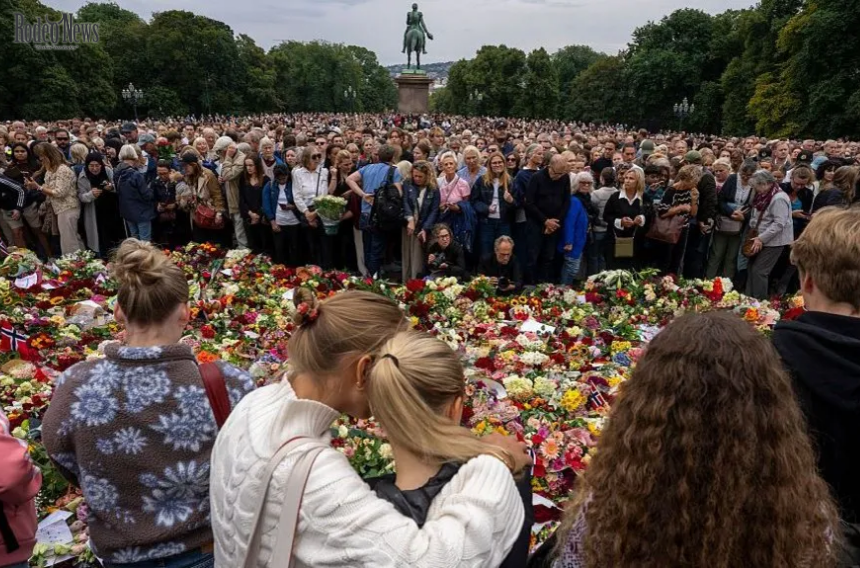
Citizens gathered near the Royal Palace in Oslo to leave flowers and pay their respects. Flags have been flown at half-mast, while public tributes have highlighted Harald’s contribution to the country.
Reuters reported that crowds gathered outside the palace as people remembered the former king and his decades of service.
The response has reflected the personal connection many Norwegians felt with Harald.
For a large portion of the population, he was the only king they had known for most of their adult lives. His death therefore represents not only the end of a reign but also the closing of an era.
International leaders and members of other European royal families have also expressed their condolences.
Sweden’s King Carl XVI Gustaf described Harald as a good friend to him, his family and Sweden, while wishing the new king success in his future role.
What Happens Next for King Haakon VIII?
The first priority for King Haakon VIII will be managing the transition while the country mourns.
The new monarch is expected to take an oath before Norway’s Parliament, known as the Storting. This is an important constitutional step that formally reinforces the king’s commitment to the country’s laws and democratic institutions.
A funeral for Harald will follow, although arrangements are being handled according to royal and national protocol.
Reuters reported that Harald’s funeral is expected to take place in Oslo, with his burial planned at the royal mausoleum at Akershus Fortress.
The transition is likely to be deliberately restrained.
Norway’s monarchy has traditionally avoided the elaborate ceremonies associated with some other European royal houses. That understated approach is expected to continue under Haakon.
The new king’s early public appearances will therefore be closely watched for clues about the tone of his reign.
Crown Princess Ingrid Alexandra Becomes the Future of the Monarchy
Another important figure in the transition is Haakon’s daughter, Princess Ingrid Alexandra.
At 22, she is now the heir apparent to the Norwegian throne and is expected to become the next generation of the monarchy.
Her position represents another important development in Norway’s royal succession.
Ingrid Alexandra has already taken part in official duties and public events, giving her experience that will become increasingly important as the royal family moves into a new generation.
Her eventual role could also further modernize the Norwegian monarchy. She is part of a younger generation that has grown up in an era of social media, greater transparency and changing expectations of public institutions.
For now, however, the focus remains on her father as he begins his reign.
Challenges Await the New King
Although King Haakon VIII enters the throne with extensive preparation and public experience, his reign will not be without challenges.
The Norwegian royal family has faced a series of controversies in recent years, creating questions about the future of public support for the institution.
Haakon’s wife, Queen Mette-Marit, has faced significant health challenges and underwent a lung transplant earlier in 2026. Her previous association with Jeffrey Epstein has also drawn public scrutiny.
Meanwhile, Marius Borg Høiby, Mette-Marit’s son from a previous relationship, was convicted in a case involving serious criminal offenses and sentenced to prison. His case has become another difficult issue for the royal household.
These controversies do not directly concern Haakon’s constitutional position, but they affect the wider public perception of the monarchy.
That makes the new king’s ability to maintain trust especially important.
Public Support Will Be Closely Watched
Norway remains a constitutional monarchy in which the king has largely ceremonial and representative responsibilities.
However, public support remains crucial to the institution’s long-term future.
Recent controversies have contributed to questions about whether the monarchy can maintain the same level of popularity it enjoyed during much of Harald’s reign.
Harald himself remained highly respected even during difficult periods. Reuters reported that a February 2026 poll gave him a very high personal approval score, highlighting the strength of his individual reputation.
Haakon will not necessarily inherit that popularity automatically.
He must build his own relationship with the Norwegian public.
His advantage is that he has spent years in the public eye and has already represented Norway domestically and internationally. His challenge will be transforming that experience into a distinct identity as king.
The Meaning of the New Reign
The accession of King Haakon VIII is more than a change of name at the top of Norway’s monarchy.
It represents a generational transition.
Harald belonged to a generation shaped by the Second World War and the reconstruction of postwar Norway. Haakon represents a newer generation that has grown up in a highly connected and rapidly changing world.
The new king will inherit an institution that his father spent decades modernizing.
His task will be to preserve what works while responding to new expectations.
That could mean continuing the monarchy’s emphasis on inclusion, environmental issues, international cooperation and national unity.
It could also mean greater attention to transparency and public accountability as the royal family navigates controversies surrounding some members.
Norway Begins a New Chapter
The death of King Harald V closes one of the most important chapters in modern Norwegian royal history.
For 35 years, Harald served as a familiar national figure through political changes, social transformation and periods of national tragedy. His style helped shape the modern image of the Norwegian monarchy.
Now, King Haakon VIII takes on the responsibility of carrying that institution into the future.
His reign begins during a moment of mourning but also transition. The new monarch has years of preparation behind him, yet the public will now judge him on his own performance.
The immediate days will be devoted to honoring Harald and supporting the royal family.
After that, attention will turn toward Haakon’s priorities, his public leadership and his ability to maintain confidence in Norway’s constitutional monarchy.
The succession is peaceful and constitutionally straightforward. Yet its significance is profound.
A king who ruled Norway for more than three decades is gone. A new monarch has taken his place.
For Norway, the era of Harald V has ended.
The era of King Haakon VIII has begun.