US-South Korea Drills Cut as Iran War Shifts Forces
The US-South Korea military drills are facing further reductions as Washington grapples with military demands linked to the war with Iran, creating new uncertainty over the future of the long-standing security partnership between Washington and Seoul.
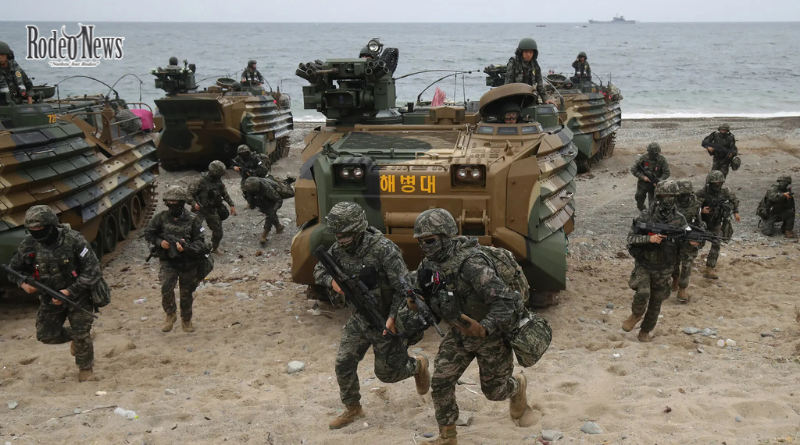
South Korea’s Marine Corps said Monday that the United States had cancelled a joint amphibious landing exercise scheduled for September. The decision follows the earlier scaling back of the allies’ annual Ulchi Freedom Shield exercise and comes amid growing tensions over South Korea’s refusal to participate directly in US military operations against Iran.
The latest cancellation adds another layer to a rapidly changing security picture in East Asia. While Washington has emphasized its continuing alliance with Seoul, reductions in combined exercises have raised questions about military readiness and the US commitment to maintaining a strong presence on the Korean Peninsula.
Why US-South Korea Military Drills Are Being Reduced
The immediate explanation for the cancelled September exercise is a shortage of available US forces.
According to South Korea’s Marine Corps, the US military informed its South Korean counterpart in June that American force availability would be constrained for the division-level amphibious exercise, known as Ssangyong. The two countries are reportedly discussing ways to resume the exercise in the future.
The development comes after President Donald Trump ordered the Pentagon to substantially reduce the scale of joint military exercises with South Korea.
Trump has cited several reasons for the policy. They include the cost of the exercises, his desire to avoid what he considers unnecessarily provocative military activity toward North Korea and frustration with Seoul’s decision not to participate in US operations connected to Iran.
That combination makes the latest cancellation particularly significant.
It is not simply a scheduling issue. The decision reflects competing US military priorities at a time when American forces are being asked to support operations in the Middle East while continuing commitments in Europe and the Indo-Pacific.
Iran War Creates New Pressure on the Alliance
The war with Iran has become an unexpected source of tension between Washington and Seoul.
The Trump administration has questioned why South Korea should receive extensive US military protection while declining to assist the United States in the conflict with Iran. Trump has publicly pointed to the cost of maintaining American troops in South Korea and has questioned the broader balance of the alliance.
South Korea, however, has not treated the situations as equivalent.
Seoul’s primary security concern remains the threat posed by North Korea. The country hosts a substantial US military presence precisely because of the possibility of conflict on the Korean Peninsula.
That creates a difficult strategic calculation for South Korean leaders. Supporting US operations in another region could potentially weaken the resources available for the country’s own defense, while refusing to participate risks creating friction with its most important security partner.
The dispute therefore goes beyond the question of one military exercise.
It raises broader questions about what Washington expects from its Asian allies when US forces are engaged in conflicts outside the region.
Ulchi Freedom Shield Was Already Cut Short
The September amphibious exercise is not the first major training activity to be affected.
The annual Ulchi Freedom Shield exercise was shortened earlier this month after Washington requested changes to its duration and scale. South Korea’s Joint Chiefs of Staff confirmed that the allies agreed to end the exercise on August 21, six days earlier than originally planned. Some field-training activities were also reduced.
Ulchi Freedom Shield is one of the most important recurring exercises between the US and South Korean militaries.
The exercise is designed to improve the allies’ ability to coordinate their forces during a potential crisis. It combines command-post training and field exercises, allowing military personnel to practice decision-making, communications and operational coordination.
Associated field training is particularly important because personnel and commanders regularly change.
The Associated Press reported that the exercise is intended to strengthen readiness against possible North Korean aggression and that reducing such training could create concerns about the alliance’s operational preparedness.
The latest changes therefore have significance beyond the number of training days removed from the schedule.
Trump Has Also Pointed to North Korea
Iran is only one part of the explanation for the reduction in US-South Korea military drills.
Trump has also emphasized his relationship with North Korean leader Kim Jong Un.
The president has argued that the exercises can send a hostile signal to Pyongyang. His administration has also shown interest in reopening diplomatic engagement with North Korea.
That creates a delicate balance.
Large-scale US-South Korean exercises are intended to deter North Korean aggression. At the same time, North Korea has historically viewed the exercises as preparation for an attack and has repeatedly demanded that Washington and Seoul stop them.
Reducing the exercises could therefore be viewed as a possible diplomatic opening.
However, it also carries military risks.
If exercises become smaller or less frequent, commanders and troops have fewer opportunities to practice operating together under realistic conditions.
The challenge for Washington and Seoul is finding a balance between diplomacy and deterrence.
North Korea Remains a Major Security Threat
The reduction in drills has not eliminated the threat from Pyongyang.
North Korea has continued developing its missile and military capabilities and has responded critically to US-South Korean exercises.
After the allies concluded the shortened Ulchi Freedom Shield exercise, North Korea launched a barrage of short-range ballistic missiles, according to the Associated Press. North Korean officials also dismissed the reduction in the exercises as insufficient.
That response highlights one of the central problems facing the alliance.
Washington may hope that smaller exercises could help create conditions for renewed diplomacy. But Pyongyang has shown that reducing military activity does not necessarily produce an immediate reduction in military pressure.
North Korea’s growing cooperation with Russia also complicates the strategic environment.
The country has developed closer military ties with Moscow, potentially giving Pyongyang additional access to military experience, technology and economic support.
For Seoul, those developments make military readiness particularly important.
South Korea Wants Greater Defense Independence
The uncertainty surrounding the US-South Korea military drills has also strengthened arguments in Seoul for greater military independence.
South Korean President Lee Jae Myung has reiterated the country’s long-standing goal of eventually regaining full wartime operational control of its forces.
The issue has existed for years, but fluctuations in US military policy have given it renewed urgency.
Lee has argued that a strong US alliance and stronger South Korean defense capabilities are not mutually exclusive. Instead, Seoul wants to develop greater capacity to defend itself while maintaining close cooperation with Washington.
That could include greater investment in advanced military technology, expanded domestic defense capabilities and efforts to strengthen South Korea’s ability to conduct major operations independently.
For South Korea, the latest changes to joint exercises could therefore become an argument for accelerating those efforts.
What the Changes Mean for the US-South Korea Alliance
The alliance itself has not ended or been formally weakened.
US forces remain stationed in South Korea, and Washington continues to regard Seoul as an important security partner in Asia.
However, military exercises are a visible and practical component of that alliance.
They demonstrate that the two militaries can coordinate their forces, test command structures and respond to changing threats.
Reducing them does not automatically mean that the alliance is collapsing. But repeated reductions could affect readiness over time.
Reuters reported that Trump’s approach to the alliance has involved questions about costs, burden-sharing and the broader role of US forces in Asia. The relationship has also been affected by disagreements over trade, defense responsibilities and Seoul’s approach to regional security issues.
The latest developments show how those disputes are increasingly interconnected.
A disagreement over Iran can influence military planning in Korea. A desire to improve relations with North Korea can affect exercises with South Korea. And changes in US force availability can reshape Seoul’s defense calculations.
A Wider Test for US Strategy in Asia
The issue extends beyond the Korean Peninsula.
US allies across Asia are watching how Washington manages its military commitments while dealing with conflicts elsewhere.
If US forces are redirected toward the Middle East, Asian allies may question whether enough American military capacity remains available to address threats in the Indo-Pacific.
That does not necessarily mean the United States is abandoning Asia.
But it does create a credibility challenge.
Military alliances depend not only on formal agreements but also on regular training, planning and confidence that forces can be deployed when needed.
The cancellation of the September amphibious exercise is therefore important because it comes after another significant reduction in joint training.
What Happens Next?
For now, the United States and South Korea are expected to continue working together despite the disagreements.
The two countries have reportedly discussed options for resuming the cancelled amphibious exercise. Meanwhile, South Korea is likely to continue strengthening its own defense capabilities while maintaining the US alliance.
The larger question is whether the current reductions are temporary responses to the Iran conflict or part of a broader transformation of the US military relationship with South Korea.
That answer may depend on several factors.
The first is the trajectory of the Iran war and how long US forces remain heavily committed to the conflict.
The second is whether Trump succeeds in reopening direct diplomacy with Kim Jong Un.
The third is how North Korea responds to the reduction in military exercises.
And finally, Seoul will have to determine how much greater responsibility it is prepared to assume for its own defense.
For now, the cancellation of the September exercise is another warning that strategic priorities in Asia are changing quickly.
The US-South Korea military drills have long served as a symbol of the alliance’s military strength. Their reduction does not erase that partnership, but it does expose new tensions over Iran, North Korea, military spending and the future role of American forces in the region.
As Washington balances competing global commitments, Seoul is being pushed to think more seriously about defense independence. At the same time, North Korea continues to build its military capabilities.
The result is an increasingly complicated security environment in which even routine military exercises can carry major geopolitical consequences.