Curiosity Rover Stuck Rock Drama Revealed on Mars
NASA’s legendary Curiosity rover faced an unusual challenge on the surface of Mars after a massive rock became lodged onto its robotic drill arm for nearly a week.
The unexpected incident happened while the rover attempted to collect a rock sample in the dusty terrain of Gale Crater. Instead of smoothly extracting powdered material for scientific analysis, the rover accidentally lifted an entire slab of Martian rock off the ground. Engineers back on Earth then spent several days trying to free the stubborn object from the rover’s drill system.
The event quickly captured attention online because it showed both the challenges and resilience of robotic space exploration. Although the situation looked dramatic, NASA eventually succeeded in freeing the rover without causing permanent damage.
How the Curiosity Rover Got the Rock Stuck
The problem began on April 25, 2026, during a drilling operation on a rock target nicknamed “Atacama.” NASA designed the rover’s drill system to bore into rocks and collect powdered samples that can later be analyzed by onboard scientific instruments.
However, this time something unexpected happened.
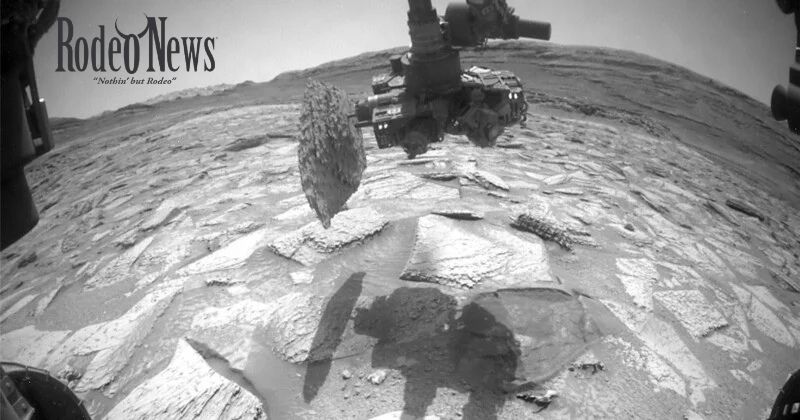
When Curiosity retracted its robotic arm after drilling, the entire rock lifted with it rather than remaining fixed to the Martian surface. NASA estimated the rock weighed approximately 28.6 pounds, or 13 kilograms, making it one of the heaviest accidental objects ever carried by the rover’s arm.
The rock measured roughly 1.5 feet across and remained tightly attached to the drill sleeve. Engineers said this had never happened before during the rover’s mission.
NASA explained that drilling operations had occasionally fractured rocks in the past, but a rock staying attached to the drill mechanism itself was unprecedented.
A Week-Long Problem on Another Planet
A stuck rock may sound like a minor issue on Earth, but conditions on Mars make even simple repairs extremely difficult.
Curiosity operates millions of miles away from Earth, meaning communication delays can stretch to around 30 minutes round-trip depending on planetary positions. Every movement therefore requires careful planning and testing before commands are sent.
NASA engineers initially tried vibrating the drill to shake the rock loose. Unfortunately, the strategy did not work.
Over several days, mission specialists tested different arm orientations and drill motions. Small fragments broke away from the rock, but the main slab remained attached.
Finally, on May 1, engineers successfully freed the rock by tilting, rotating, and spinning the drill assembly in a carefully coordinated maneuver. The rock eventually detached and shattered after falling back onto the Martian surface.
While the rover lost some of the intended sample material, the mission itself continued safely.
Why This Incident Matters
The Curiosity rover stuck rock incident demonstrates the unpredictable nature of planetary exploration.
Mars remains an incredibly hostile environment filled with sharp rocks, extreme temperatures, and dusty terrain that constantly challenges robotic equipment. Even after more than a decade on the Red Planet, Curiosity still encounters surprises that engineers never anticipated during testing on Earth.
The rover originally launched in 2011 and landed on Mars in 2012 as part of NASA’s Mars Science Laboratory mission. Although the mission was initially planned for only two years, Curiosity continues operating successfully nearly 14 years later.
Its longevity has already exceeded expectations by a massive margin.
The rover has traveled across Gale Crater, climbed sections of Mount Sharp, and collected scientific evidence suggesting Mars may once have supported microbial life.
Because of that history, even relatively small operational problems receive significant attention from scientists and space enthusiasts alike.
Curiosity’s History of Mechanical Challenges
This is not the first time Curiosity has experienced technical difficulties.
Over the years, the rover’s drill system has suffered intermittent issues, including electrical faults and feed mechanism problems. NASA engineers have repeatedly developed creative software and operational workarounds to keep the aging rover functional.
The harsh Martian environment also causes constant wear and tear.
Recent images released by NASA showed significant damage to Curiosity’s aluminum wheels after years of crossing sharp terrain. Engineers nevertheless confirmed the rover remains mobile and scientifically productive.
In another unusual case, NASA’s newer rover, Perseverance, previously carried a “pet rock” lodged in one of its wheels for hundreds of Martian days without major consequences.
These incidents highlight how robotic explorers must adapt continuously to unpredictable conditions on alien worlds.
The Science Mission Continues
Despite the temporary setback, Curiosity’s scientific mission remains active.
NASA says the rover continues investigating ancient environments that may once have supported life billions of years ago. Scientists are especially interested in sedimentary rock layers within Gale Crater because they preserve clues about Mars’ wetter and potentially habitable past.
Recently, Curiosity contributed to discoveries involving complex organic molecules and unusual mineral formations. Researchers believe these findings could improve understanding of whether ancient Mars possessed the chemical ingredients necessary for life.
The rover carries a sophisticated suite of scientific instruments, including cameras, spectrometers, environmental sensors, and internal laboratories capable of analyzing rock powder directly on Mars.
Its robotic arm plays a crucial role in those operations, making the stuck rock incident especially concerning for mission engineers.
Fortunately, the successful recovery demonstrated the durability of Curiosity’s systems and the expertise of NASA’s operations team.
Social Media Reacts to the Mars Mishap
The Curiosity rover stuck rock story quickly gained traction online because many people found the situation strangely relatable.
NASA and science media outlets compared the incident to having gum stuck to a shoe or accidentally lifting something heavier than expected. Videos and images captured by the rover showed the rock dangling beneath the robotic arm while Martian landscapes stretched into the distance.
Some users joked that even advanced robots exploring another planet still experience ordinary mechanical frustrations.
Others praised the engineering achievement behind remotely solving such a complicated problem from Earth.
The incident also reminded the public how dependent modern space exploration is on autonomous systems and careful robotic engineering.
Unlike astronauts who could physically remove the obstruction by hand, Curiosity had to rely entirely on remote commands and mechanical maneuvers.
Why Curiosity Still Matters in 2026
Even with newer missions active on Mars, Curiosity remains one of NASA’s most important planetary science platforms.
The rover paved the way for future exploration systems and demonstrated that long-term robotic science operations on Mars are possible. Its design also influenced the development of Perseverance, which landed on Mars in 2021.
Curiosity’s continuing discoveries help scientists better understand the geological history of the Red Planet and prepare for future human missions.
The rover has already transformed scientific understanding of Mars by confirming the planet once hosted lakes, rivers, and environmental conditions capable of supporting microbial life.
As a result, every new mission update — including strange mishaps like the stuck rock incident — continues attracting global interest.
NASA’s Next Steps
Following the successful release of the Atacama rock, NASA engineers are expected to resume drilling activities at alternative rock targets in Gale Crater.
Mission teams will likely study the incident carefully to better understand why the rock remained attached to the drill sleeve and whether future operations require adjustments.
The event may also provide useful lessons for future robotic exploration systems designed for Mars and other planetary bodies.
For now, Curiosity continues rolling across the Martian surface, proving once again why it remains one of the most successful robotic explorers ever built.