White House Dinner Shooting Aftermath Revealed: A Nation Confronts Chaos
The White House dinner shooting aftermath has left the United States grappling with more than just security concerns. What unfolded at the 2026 White House Correspondents’ Dinner was not only a violent disruption of a prestigious event but also a moment that exposed deeper truths about power, vulnerability, and public perception in times of crisis.
The incident, which took place on April 25, 2026, at the Washington Hilton, quickly escalated from a security breach into a national conversation about safety, inequality, and the psychological toll of recurring violence. While authorities moved swiftly to neutralize the threat, the emotional and symbolic aftermath continues to unfold.
What Happened at the White House Correspondents’ Dinner
The annual White House Correspondents’ Dinner is typically a blend of politics, media, and celebrity culture. However, this year’s event took a dramatic turn when a gunman attempted to breach a secured checkpoint.
According to reports, the suspect—identified as 31-year-old Cole Tomas Allen—approached the venue armed with multiple weapons, including a shotgun and a handgun.
Witnesses described a sudden eruption of chaos. Loud noises rang out near the security perimeter, prompting an immediate response from Secret Service agents. Within moments, high-profile attendees, including President Donald Trump and Vice President JD Vance, were evacuated from the premises.
Despite the severity of the situation, no fatalities were reported. A Secret Service officer was struck but survived due to a ballistic vest.
A Surreal Scene: Chaos Meets Normalcy
One of the most widely discussed aspects of the White House dinner shooting aftermath is how strangely ordinary some reactions appeared amid the chaos.
Guests inside the ballroom were initially unsure how to respond. Some froze, others followed instructions, while a few appeared almost detached from the unfolding danger. Reports even highlighted individuals continuing mundane activities as the situation escalated.
This contrast between expected panic and actual behavior underscores a growing phenomenon: the normalization of crisis. In a society repeatedly exposed to acts of violence, reactions can become muted, fragmented, or even surreal.
Cheryl Hines and the Optics of Power
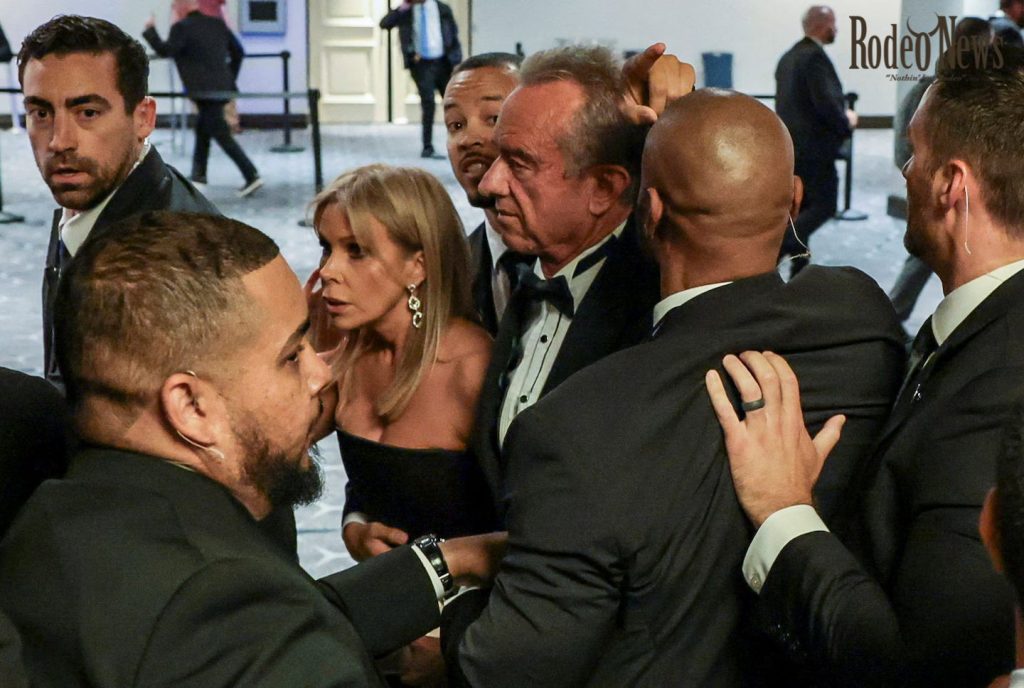
A particularly striking moment from the aftermath involved actress Cheryl Hines and her husband, Health Secretary Robert F. Kennedy Jr.
Footage showed Kennedy being urgently escorted out by security personnel while Hines followed behind, largely on her own.
This brief but powerful image sparked widespread discussion online. It highlighted how, in moments of danger, protection is often distributed unevenly—prioritizing political power over personal relationships.
The scene became symbolic of a broader reality: even in elite settings, access to safety is not equal.
Security Failures and Hard Questions
In the days following the incident, scrutiny quickly turned toward security protocols.
How did an armed individual manage to get so close to a heavily guarded event attended by top government officials?
Investigators revealed that the suspect had checked into the hotel prior to the event and navigated internal areas before approaching the checkpoint.
This has raised serious concerns about:
- Internal hotel security coordination
- Screening procedures for guests and staff
- Intelligence and threat detection systems
While officials have emphasized that the situation was contained quickly, critics argue that the breach itself represents a significant failure.
The Suspect: Profile and Motive
Cole Tomas Allen, the man accused of carrying out the attack, is described as a highly educated individual from California.
Authorities say he traveled across the country and planned the attack in advance. Investigators also discovered writings suggesting strong political motivations and deep personal grievances.
He now faces multiple federal charges, including attempted assassination and firearms offenses. If convicted, he could face life in prison.
The case has reignited debates about radicalization, mental health, and the accessibility of weapons in the United States.
America’s Growing Desensitization to Violence
Beyond the immediate facts, the White House dinner shooting aftermath has triggered a deeper cultural reflection.
Why do such घटन no longer shock the public in the same way?
Experts suggest that repeated exposure to violence—through news cycles, social media, and lived experience—has created a sense of emotional fatigue. Incidents that once would have dominated public consciousness now compete with a constant stream of crises.
This desensitization can lead to:
- Slower emotional responses
- Reduced public outrage
- Increased acceptance of risk
The dinner shooting, while dramatic, fits into a broader pattern that many Americans have come to see as disturbingly familiar.
Political Fallout and Policy Debate
As expected, the incident has also sparked political reactions.
Some leaders have used the घटना to call for stronger security infrastructure, including proposals for more controlled and fortified event spaces. Others argue that the focus should instead be on addressing root causes, such as gun laws and extremist ideologies.
The divide reflects a long-standing tension in American politics:
- Security vs. civil liberties
- Prevention vs. response
- Infrastructure vs. policy reform
With national attention focused on the incident, the coming weeks are likely to see renewed legislative discussions.
Media, Spectacle, and Reality
Another layer of the aftermath involves how the event was perceived and discussed in the media.
The White House Correspondents’ Dinner is inherently tied to media culture. When violence entered that space, it blurred the line between coverage and participation.
Journalists who were present became part of the story. Their accounts, reactions, and even personal experiences contributed to the narrative.
This dual role raises important questions:
- Can media remain objective during personal risk?
- How does proximity to danger shape reporting?
- Does coverage amplify or normalize such events?
The Psychological Impact on Attendees
While physical injuries were limited, the psychological effects may be long-lasting.
Attendees included politicians, journalists, celebrities, and staff—many of whom experienced sudden fear and uncertainty. For some, the event may leave lasting impressions of vulnerability.
Common psychological responses to چنین incidents include:
- Anxiety and hypervigilance
- Difficulty processing the event
- Increased perception of threat in public spaces
Mental health professionals emphasize the importance of addressing these impacts, even when physical harm is minimal.
A Defining Moment in Modern Political Culture
The White House dinner shooting aftermath may ultimately be remembered as more than a security incident.
It represents a convergence of several defining elements of modern American life:
- Political polarization
- Media saturation
- Public exposure to violence
- Unequal access to safety
The event disrupted not only a high-profile gathering but also the illusion of control that such environments are meant to project.
Conclusion: What the Aftermath Reveals
The White House dinner shooting aftermath is not just about what happened—it is about what it reveals.
It shows how fragile even the most secure spaces can be. It exposes the visible hierarchy of protection in moments of crisis. And perhaps most importantly, it reflects a society increasingly accustomed to instability.
As investigations continue and debates unfold, one thing is clear: this incident will shape conversations about security, politics, and public life for years to come