The Joe Turner revival review is already generating strong reactions across the theater world, as the 2026 Broadway production of Joe Turner’s Come and Gone delivers a compelling yet complex theatrical experience. Starring Taraji P. Henson and Cedric the Entertainer, this revival marks a major cultural moment—bringing August Wilson’s timeless storytelling back to center stage.
Directed by Debbie Allen, the production opened in April 2026 and revisits a deeply emotional narrative set in a 1911 Pittsburgh boarding house. While the play’s core themes remain as powerful as ever, critics note a mix of brilliance and inconsistency in execution.
A Story Rooted in History and Identity
At its heart, Joe Turner’s Come and Gone is a story about identity, displacement, and healing. Set during the Great Migration, the play follows a group of African Americans navigating life after slavery, searching for lost family, purpose, and belonging.
The boarding house, run by Seth and Bertha Holly, becomes a symbolic refuge. Characters arrive carrying emotional burdens—none more profound than Herald Loomis, whose journey reflects the trauma and resilience embedded in Black American history.
This revival preserves Wilson’s poetic dialogue and layered storytelling, which continues to resonate decades after its original debut in 1984.
Taraji P. Henson’s Broadway Breakthrough
One of the most talked-about elements in this Joe Turner revival review is the Broadway debut of Taraji P. Henson.
Henson plays Bertha Holly, the emotional anchor of the boarding house. Her performance has been widely described as warm, grounded, and deeply human. Audiences reportedly respond with strong applause upon her entrance, signaling her immediate impact on stage.
Bertha is not just a caretaker—she represents stability in a world of uncertainty. Henson brings nuance to the role, portraying both strength and compassion without overstatement.
However, some critics suggest that her performance occasionally feels stylistically different from the rest of the cast, creating moments of tonal imbalance.
Still, her presence undeniably elevates the production, marking a successful transition from screen to stage.
Cedric the Entertainer Brings Charisma
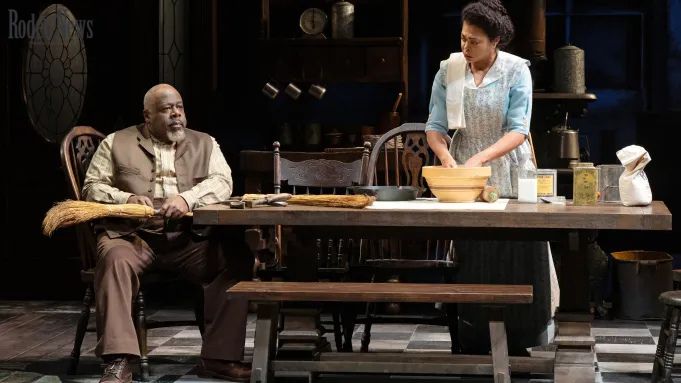
Opposite Henson, Cedric the Entertainer plays Seth Holly, the pragmatic boarding house owner.
His performance is widely praised for its natural charisma and grounded humor. Seth acts as the stabilizing force within the play, offering structure and realism amid the emotional turbulence of other characters.
Critics highlight how Cedric’s comedic background enhances the play’s lighter moments, particularly in scenes centered around everyday life in the boarding house.
Yet, this tonal warmth also contributes to one of the production’s main criticisms: an imbalance between realism and the play’s mystical elements.
The Spiritual Core Feels Uneven
A key theme in many Joe Turner revival review discussions is the production’s struggle to fully capture the play’s spiritual depth.
Wilson’s work blends realism with mysticism—particularly in Herald Loomis’ journey toward self-discovery and liberation. However, critics note that the staging sometimes softens these supernatural elements.
Moments that should feel intense or transformative—such as Loomis’ spiritual breakdown—are described as visually restrained and emotionally muted.
This creates a disconnect between the play’s philosophical ambition and its onstage execution.
Supporting Cast Delivers Standout Performances
While the leads draw major attention, the supporting cast plays a crucial role in the production’s success.
Ruben Santiago-Hudson, in particular, stands out as Bynum Walker—a spiritual guide whose presence anchors the play’s deeper themes. Critics consistently highlight his performance as one of the most powerful in the production.
Meanwhile, Joshua Boone’s portrayal of Herald Loomis adds emotional intensity, even when the staging limits the character’s full impact.
Together, the ensemble captures the communal atmosphere that defines Wilson’s work—where each character represents a piece of a larger cultural narrative.
Direction and Visual Choices
Directed by Debbie Allen, the revival aims to balance tradition with accessibility.
Allen’s approach emphasizes warmth and humanity, particularly in the boarding house scenes. However, critics argue that this focus sometimes comes at the expense of the play’s darker, more complex layers.
The set design, featuring movable doors and window frames, reflects the transient nature of the characters’ lives. Yet, some reviews describe it as visually underwhelming, lacking the depth needed to support the story’s emotional weight.
Audience Reception vs Critical Perspective
Interestingly, audience reactions appear more enthusiastic than some critical reviews.
Many theatergoers praise the emotional storytelling and strong performances, describing the play as both “powerful” and “thought-provoking.”
On platforms like Reddit, viewers highlight the cast’s chemistry and the emotional impact of key scenes, even expressing a desire to see the production again.
This contrast suggests that while critics may focus on structural and tonal issues, audiences are more responsive to the play’s emotional resonance.
Why This Revival Still Matters
Despite its imperfections, this production remains culturally significant.
Joe Turner’s Come and Gone is part of Wilson’s “Pittsburgh Cycle,” a series chronicling African American life across the 20th century.
Bringing this story back to Broadway in 2026—especially with high-profile actors—reintroduces its themes to a new generation.
The play’s exploration of identity, trauma, and healing feels particularly relevant today, as conversations about history and representation continue to evolve.
Final Verdict: A Flawed but Impactful Revival
This Joe Turner revival review ultimately reveals a production that is both powerful and uneven.
Strengths:
- Strong performances from Taraji P. Henson and Cedric the Entertainer
- Outstanding supporting cast, especially Ruben Santiago-Hudson
- Timeless themes that remain deeply relevant
Weaknesses:
- Inconsistent tone between realism and mysticism
- Underwhelming staging in key moments
- Visual design lacking emotional depth
Even with its flaws, the revival succeeds in honoring August Wilson’s legacy. It reminds audiences of the enduring power of storytelling—and the importance of revisiting history through art.
Conclusion
The 2026 Broadway revival of Joe Turner’s Come and Gone is not perfect, but it is undeniably important.
For fans of theater, history, and powerful performances, it offers a meaningful experience that lingers long after the curtain falls.
And perhaps that’s the true measure of success—not perfection, but impact.