Blue Origin Rocket Reuse Breakthrough Shocks Space Race
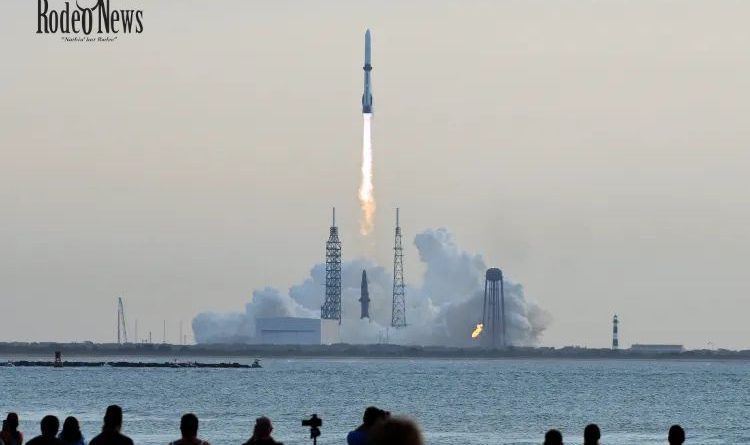
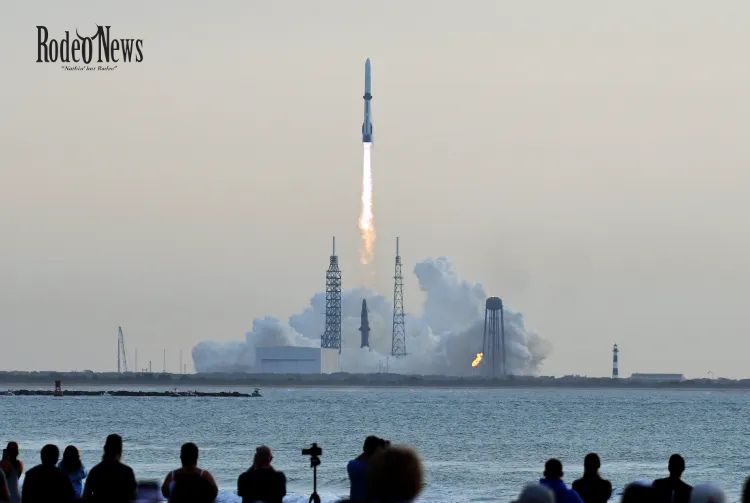
The Blue Origin rocket reuse milestone has officially arrived, marking a major turning point in the modern space race. On April 19, 2026, Blue Origin successfully launched and reused its massive New Glenn rocket, demonstrating a critical capability that could reshape the economics of space travel.
While the mission was not flawless, the successful reuse of the rocket’s booster signals that Blue Origin is closing the gap with industry leader SpaceX — and may soon become a serious competitor in the global launch market.
A Historic First for New Glenn Rocket Reuse
The launch marked the first time Blue Origin reused a New Glenn booster, a goal the company has pursued for years. The rocket lifted off from Cape Canaveral, carrying a commercial communications satellite into orbit.
Crucially, the first-stage booster — previously flown on an earlier mission — successfully returned and landed on a sea-based platform after separation.
This achievement places Blue Origin among a very small group of companies capable of recovering and reusing large orbital-class rocket boosters — a breakthrough that dramatically reduces launch costs and increases flight frequency.
According to mission details, the booster had undergone upgrades, including improvements to its thermal protection system, allowing it to withstand the intense heat of reentry.
Why Rocket Reuse Is a Game-Changer
The significance of Blue Origin rocket reuse cannot be overstated. Traditionally, rockets were discarded after a single launch, making space missions extremely expensive.
Reusable rockets change that equation entirely.
By recovering and refurbishing boosters, companies can:
- Reduce launch costs dramatically
- Increase launch frequency
- Improve sustainability in space operations
This is the same model that helped SpaceX dominate the commercial launch industry with its Falcon 9 rocket. Now, Blue Origin is proving it can follow — and potentially challenge — that model.
The New Glenn rocket itself is designed with reuse in mind, with its first stage capable of flying up to 25 missions.
Mission Success… With a Major Setback
Despite the breakthrough in reuse, the mission was only a partial success.
The rocket successfully deployed its payload — the BlueBird 7 satellite built by AST SpaceMobile — and the satellite powered on after separation. However, a critical issue emerged shortly after.
The satellite was placed into a lower-than-planned orbit, making it unable to perform its intended operations.
Because of limitations in its onboard propulsion system, the satellite will eventually be deorbited rather than used for its original purpose.
Experts believe the issue likely stems from the rocket’s upper stage, which may have failed to execute a key burn required to reach the correct altitude.
The Role of BlueBird 7 and Space-Based Internet
The payload, BlueBird 7, was part of an ambitious effort to create a space-based cellular network capable of delivering direct-to-phone connectivity.
Developed by AST SpaceMobile, the satellite was designed to function as a massive orbiting cell tower, enabling standard smartphones to connect to broadband networks from space.
This concept directly competes with satellite internet systems like SpaceX’s Starlink and Amazon’s own Project Kuiper.
Although the satellite itself will not be operational due to the orbit issue, the mission still provides valuable data for future launches.
A Critical Step in the SpaceX vs Blue Origin Rivalry
The success of Blue Origin rocket reuse is especially important in the context of the ongoing rivalry between Jeff Bezos and Elon Musk.
For years, SpaceX has dominated the reusable rocket market, launching hundreds of missions with its Falcon 9 boosters.
Blue Origin, meanwhile, has lagged behind — focusing primarily on suborbital flights with its New Shepard vehicle.
Now, with New Glenn entering the reusable orbital launch arena, the competitive landscape is shifting.
Industry analysts say this milestone could:
- Increase competition in launch pricing
- Accelerate innovation in reusable technology
- Expand access to space for commercial customers
Inside the New Glenn Rocket
The New Glenn rocket is a heavy-lift launch vehicle designed for large payloads and complex missions.
Key features include:
- A two-stage design with a reusable first stage
- Seven BE-4 engines powering the booster
- A massive payload fairing — among the largest in the industry
- Capability to carry satellites, cargo, and potentially humans
The rocket’s reusable booster lands vertically on a droneship in the ocean, similar to SpaceX’s landing approach.
Its long-term goal is to support missions ranging from satellite deployment to lunar exploration.
What Went Wrong With the Upper Stage?
While the booster performed as expected, the upper stage appears to have underperformed, leading to the incorrect orbital insertion.
Reports suggest that a second burn — necessary to circularize the orbit — may not have occurred as planned.
This type of issue is not uncommon in early-stage rocket programs. Even SpaceX experienced multiple failures before achieving consistent success with reusable systems.
However, such setbacks highlight the complexity of orbital launches, where even minor deviations can have major consequences.
Industry Impact and Future Outlook
Despite the payload issue, the Blue Origin rocket reuse milestone is widely seen as a success for the company.
The ability to reuse boosters reliably is one of the most important factors in reducing the cost of access to space — a key goal for both commercial and government missions.
Looking ahead, Blue Origin is expected to:
- Conduct additional New Glenn launches in 2026
- Refine upper-stage performance
- Expand partnerships with satellite companies
- Compete more aggressively with SpaceX
The company is also working on future projects, including lunar landers and large-scale satellite deployments.
Global Space Race Enters a New Phase
The success of Blue Origin rocket reuse signals that the space industry is entering a new era — one defined by competition, innovation, and rapid progress.
With multiple companies now capable of reusable launches, the cost barrier to space is expected to drop significantly.
This could unlock new opportunities in:
- Satellite communications
- Space tourism
- Scientific research
- Deep space exploration
At the same time, competition between major players like Blue Origin and SpaceX is likely to intensify, driving further advancements.
Conclusion: A Breakthrough With Lessons Learned
The Blue Origin rocket reuse mission represents both a breakthrough and a learning opportunity.
On one hand, the successful recovery and reuse of the New Glenn booster marks a historic achievement that brings Blue Origin closer to the forefront of the space industry.
On the other hand, the failure to place the satellite into the correct orbit highlights the challenges that still remain.
Ultimately, the mission underscores a simple truth: progress in space exploration is rarely perfect — but each step forward brings the industry closer to a more accessible and sustainable future beyond Earth.