Artemis 2 Record Distance Shocking 1st Human Gap
The Artemis 2 record distance has officially rewritten the limits of human spaceflight—not just in how far astronauts can travel, but how far apart humans can exist in the universe at the same time.
During a brief yet historic moment on April 6, 2026, astronauts aboard NASA’s Artemis 2 mission and crew members on China’s Tiangong space station reached the greatest separation ever recorded between humans in history. This milestone marks a powerful symbol of how far humanity has advanced in space exploration—and how global that journey has become.
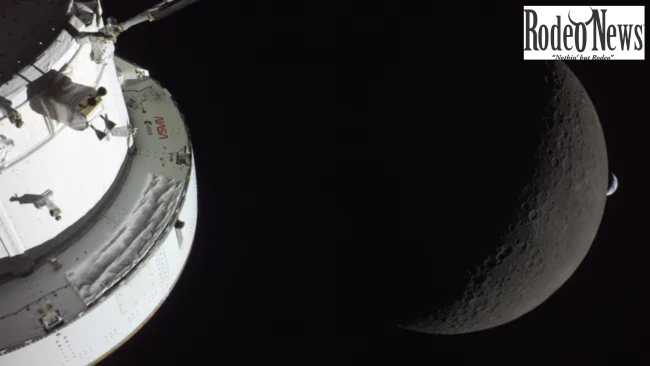
A Historic Moment Beyond the Moon
At the heart of this milestone was NASA’s Orion spacecraft, carrying four astronauts on the Artemis 2 mission. As the spacecraft looped around the far side of the Moon, it reached a distance of more than 252,700 miles (over 406,000 kilometers) from Earth.
Meanwhile, three astronauts aboard China’s Tiangong space station remained in low Earth orbit, roughly a few hundred kilometers above the planet.
The result? For a short period, the distance between these two groups of humans became the largest ever recorded.
Astrophysicist Jonathan McDowell calculated and highlighted this extraordinary gap, noting that never before had humans been so far apart in space.
Why the Artemis 2 Record Distance Matters
The Artemis 2 record distance is not just a number—it represents a turning point in human spaceflight.
For decades, records focused on how far a single crew could travel from Earth. Artemis 2 already broke that milestone, surpassing the Apollo 13 mission from 1970.
But this new achievement adds a different dimension: human separation across space.
This matters because:
- It demonstrates simultaneous human presence in vastly different regions of space
- It reflects increasing international activity beyond Earth
- It highlights the growing complexity of space operations
In short, humanity is no longer confined to a single region of space at any given time.
The Artemis 2 Mission: A New Era Begins
Artemis 2 is NASA’s first crewed lunar mission in more than 50 years, following the Apollo era. The mission carried four astronauts:
- Reid Wiseman
- Victor Glover
- Christina Koch
- Jeremy Hansen
Their journey lasted about 10 days and served as a critical test for future missions aimed at landing humans on the Moon again.
Unlike Apollo missions, Artemis 2 is part of a broader long-term vision: establishing a sustained human presence on and around the Moon.
Tiangong: China’s Presence in Orbit
While Artemis 2 pushed deep into space, China’s Tiangong space station represented another frontier—continuous human habitation in orbit.
Tiangong is a fully operational space station that supports long-duration missions and scientific research. It reflects China’s growing role in space exploration and its independent capabilities in maintaining a human presence beyond Earth.
The record-setting moment between Artemis 2 and Tiangong underscores a key reality: space is no longer dominated by a single nation.
A Record That Redefines Human Boundaries
The Artemis 2 record distance builds on a legacy of space milestones but pushes into new territory.
Previously, the focus was on:
- The farthest distance humans traveled
- The longest duration in space
- The fastest speeds achieved
Now, we are entering an era where human distribution in space becomes a measurable achievement.
This shift reflects how space exploration is evolving from isolated missions to a broader, interconnected presence.
The Science Behind the Distance
To understand the scale of this record, consider the geometry involved.
- Artemis 2: traveling beyond the Moon’s far side
- Tiangong: orbiting Earth at low altitude
At peak separation, the two groups were separated by hundreds of thousands of kilometers, spanning nearly the entire Earth-Moon system.
This is not just a symbolic gap—it represents real challenges in:
- Communication delays
- Navigation precision
- Mission coordination
Such factors will become even more critical as humans venture toward Mars and beyond.
Global Implications for Space Exploration
The Artemis 2 record distance highlights a growing trend: multi-location human presence in space.
This has several implications:
1. Increased International Competition
Countries are accelerating their space programs, aiming to achieve new milestones and assert leadership.
2. Opportunities for Collaboration
Despite geopolitical tensions, space remains a domain where cooperation is possible—and often necessary.
3. Expansion Beyond Earth Orbit
With missions like Artemis, humanity is steadily moving beyond low Earth orbit toward deep space exploration.
Emotional Impact on Astronauts
While the numbers are impressive, the human experience is equally profound.
Astronauts aboard Artemis 2 described feelings of awe and reflection as they traveled farther from Earth than any humans before them.
Seeing Earth as a distant, fragile sphere reinforces a powerful message: humanity shares a single home.
At the same time, knowing that other humans were orbiting Earth—yet unimaginably far away—adds a new psychological dimension to space travel.
What Comes Next After Artemis 2?
The success of Artemis 2 sets the stage for future missions, particularly Artemis 3, which aims to land astronauts on the Moon.
Looking ahead:
- Artemis 3 will attempt a human lunar landing
- Future missions may establish a lunar base
- Long-term plans include sending humans to Mars
Each step will likely produce new records—not just in distance, but in how humanity spreads across space.
A Symbol of Humanity’s Expanding Reach
The Artemis 2 record distance is more than a scientific achievement—it is a symbol of human progress.
For the first time in history, humans existed at opposite ends of the Earth-Moon system simultaneously. This moment represents:
- Technological advancement
- International presence in space
- The beginning of a multi-location human civilization