Hassan Khomeini Emerges as Key Figure in Iran’s Supreme Leader Succession
The death of Ali Khamenei has thrust Iran into one of the most consequential political transitions since the 1979 revolution, intensifying deliberations among the clerical elite over who will inherit the country’s most powerful office.
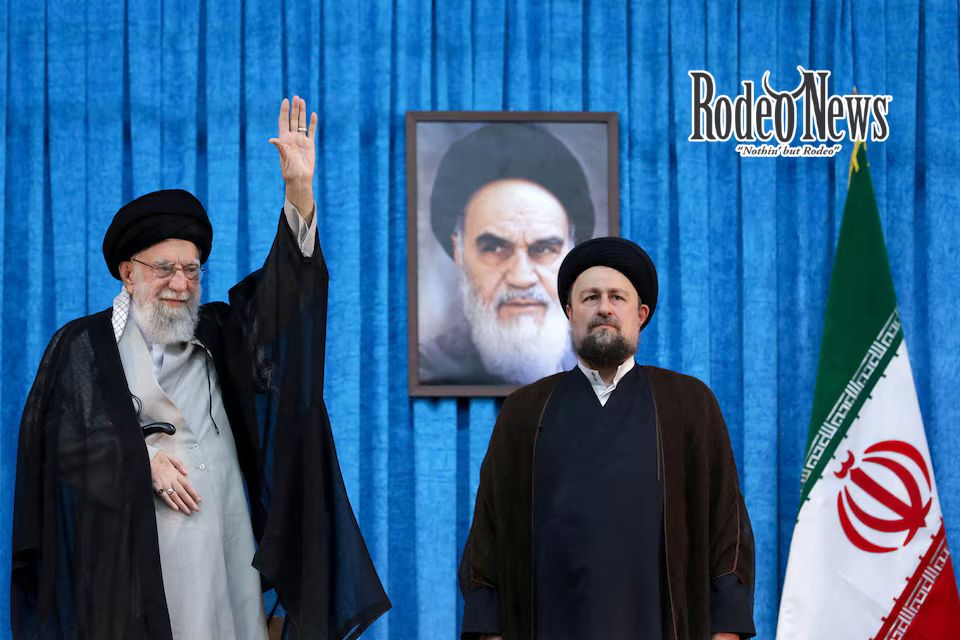
Among the names drawing renewed attention is Hassan Khomeini, grandson of the Islamic Republic’s founder, Ruhollah Khomeini. Though he has never held formal government office, Hassan Khomeini’s lineage, clerical standing, and reformist sympathies have placed him at the center of mounting speculation about Iran’s political future.
A Symbolic Heir in a Moment of Uncertainty
At 53, Hassan Khomeini occupies a largely ceremonial yet symbolically potent role as custodian of his grandfather’s mausoleum in southern Tehran. The position carries moral authority within the Islamic Republic’s political architecture, even if it does not confer executive power.
The urgency surrounding succession intensified after Khamenei, 86, was killed in a U.S.-Israeli attack — a development that has left Iran’s leadership scrambling to project unity amid external pressure and internal strain.
Under Iran’s constitution, the Assembly of Experts — a body of senior clerics — is tasked with selecting the Supreme Leader. While deliberations traditionally occur behind closed doors, political factions have begun maneuvering publicly, revealing divisions between hardline conservatives and figures advocating recalibration.
Between Reform and Loyalty
Hassan Khomeini is widely regarded as a relative moderate within Iran’s clerical establishment. He maintains close ties with reformist figures such as former presidents Mohammad Khatami and Hassan Rouhani, both of whom sought greater engagement with the West during their administrations.
Yet his record reflects a delicate balancing act: reformist in tone, but steadfastly loyal to the Islamic Republic’s framework.
In 2021, he publicly criticized the powerful Guardian Council after it disqualified reformist candidates from running in the presidential election — a decision that paved the way for hardliner Ebrahim Raisi to assume office before his death in a 2024 helicopter crash.
“You can’t pick someone for me and tell me to vote for them,” Khomeini said at the time, in unusually blunt remarks for a senior cleric.
He also demanded transparency following the 2022 death of Mahsa Amini, whose arrest by Iran’s morality police sparked nationwide protests. Khomeini called on authorities to “transparently and precisely account” for what had happened to the 22-year-old woman.
However, during the subsequent unrest — the deadliest since the revolution — he also criticized demonstrators who chanted against Khamenei and later participated in pro-government rallies. In public statements, he accused rioters of serving foreign interests and likened some acts of violence to extremist movements.
A Counterweight to Hardliners?
Some Iranian politicians view Hassan Khomeini as a potential counterweight to hardline candidates who consolidated power during Khamenei’s tenure. Among them is Mojtaba Khamenei, the late leader’s influential son, whose name has circulated in succession discussions despite sensitivities around dynastic optics.
Installing a figure perceived as moderate could serve as a stabilizing gesture at a time of economic strain, diplomatic isolation, and generational dissent. Waves of protests in recent years have underscored deep frustrations over social restrictions, economic hardship, and political exclusion.
For some within Iran’s political establishment, elevating a cleric with reformist credentials — yet firm revolutionary roots — could help shore up legitimacy without fundamentally altering the system.
A Progressive Theologian?
Close associates have described Hassan Khomeini as intellectually curious and socially progressive by clerical standards. A longtime friend once characterized him as open to Western philosophy, attentive to social media trends, and relatively flexible on issues such as music, women’s rights, and cultural expression.
Still, he remains a mid-ranking cleric without executive experience. His influence has been moral rather than administrative, and critics question whether symbolic capital alone can translate into effective leadership at a moment of geopolitical tension.
In a condolence message following Khamenei’s death, Khomeini described the late Supreme Leader as “the hero of the people of Iran and Muslims,” pledging that Iranians would continue along the path laid out by his grandfather.
The statement reinforced what may be his central political identity: a bridge between the revolution’s founding ideals and a society increasingly pressing for change.
The Road Ahead
The selection of Iran’s next Supreme Leader will shape not only domestic governance but also the country’s posture toward regional rivals and Western powers. The process, opaque by design, is expected to unfold amid heightened security and political sensitivity.
Whether Hassan Khomeini ultimately emerges as a consensus candidate or remains a symbolic presence will depend on calculations within the clerical establishment — and on whether Iran’s leadership prioritizes continuity, consolidation, or cautious reform.
For now, as Iran navigates one of the most pivotal chapters in its modern history, the grandson of its revolutionary founder stands once again in the national spotlight.